https://robertreich.substack.com/p/how-can-it-be-that-trump-is-running?
Monday, September 30, 2024

Saturday, September 28, 2024
antiracismdsa: Latino Civil Rights vs.Project 2025

Friday, September 27, 2024
Why Do Some People Still Support Trump ?
Why do people still back Trump, after everything? 5 things to understand about MAGA supporters’ thinking
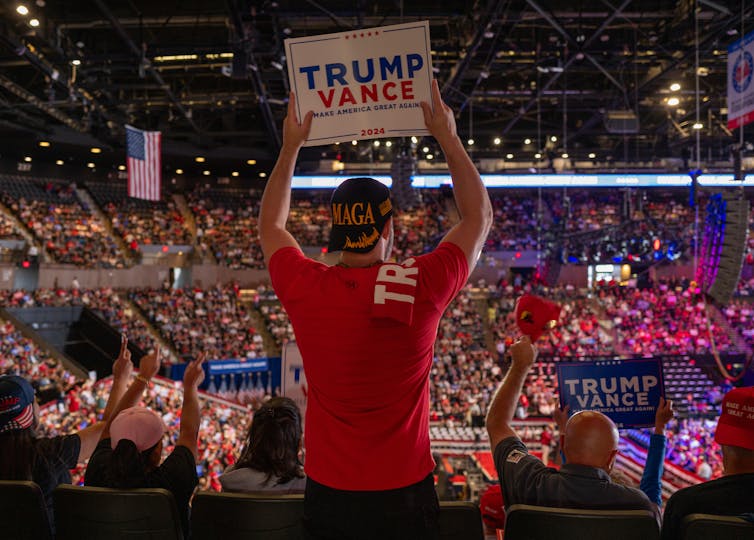
For many people, especially those leaning left, Donald Trump’s disqualifications to be president seem obvious, prompting some to question: How could anyone still vote for Trump?
Some of the evidence Trump’s critics cite include his two impeachments, multiple criminal indictments at the state and federal levels and a felony conviction. Opponents also say that Trump is a threat to democracy, a misogynist, racist, a serial liar and a rapist.
About 78% of Democrats and Democrat-leaning independent voters say that Trump broke the law when he allegedly tried to overturn the 2020 election results. But less than half of Republicans think he did anything wrong.
I am an anthropologist of peace and conflict, and I have been studying what I call the Trumpiverse since 2015, when Trump descended a golden escalator and announced his candidacy for president. I later wrote a related book in 2021, called “It Can Happen Here.”
More recently, I have been examining toxic polarization – and ways to stop it. Many efforts to reduce people’s polarized views begin with an injunction: Listen and understand.
To this end, I have attended Trump rallies, populist and nonpartisan events and meetings where Democrats and Republicans connect and talk. Along the way, I have spoken with Trump supporters ranging from the Make America Great Again, or MAGA, faithful to moderate “hold the nose and vote for him” conservatives.
And indeed, many on the left fail to understand who Trump voters are and how they vary. Trump’s base cannot simply be dismissed as racist “deplorables,” as Hillary Clinton famously said in 2016, or as country bumpkins in red MAGA hats. Trump voters trend older, white, rural, religious and less educated. But they include others outside those demographic groups.
Many people have thoughtful reasons for voting for Trump, even if their reasoning – as is also true for those on the left – is often inflamed by populist polarizers and media platforms.
Here are five key lines of reasoning that, in varying combinations, inform Trump voters’ choice.
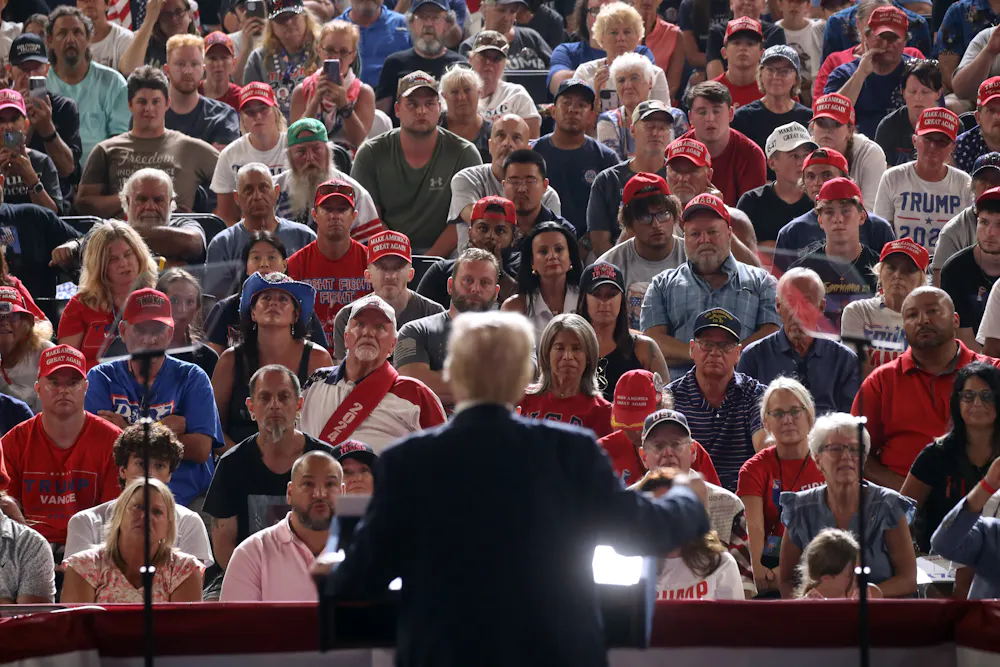
1. Media distortion
Where those on the left see Trump’s many failings, those on the right may see what some political observers call Trump Derangement Syndrome, sometimes simply called TDS.
According to this line of argument, the left-leaning media dissects Trump’s every word, and the media then distorts what he says. I have found that some Trump supporters think that people who feed too much on this allegedly biased media diet can get TDS and develop a passionate, perhaps illogical dislike of Trump.
I have also heard hardcore Trump supporters argue, with no evidence, that such “fake news” media outlets, like CNN, are part of a larger deep state plot of the federal government to upend the will of the people. This plot, according to those who propagate it, includes not just leftists, government bureaucrats and people who claim to be Republicans, but really aren’t, but also people in law enforcement.
Some Trump supporters also see merit in his contention that he is being wrongly persecuted, just like some see the Jan. 6 defendants being persecuted.
2. Bread on the table, money in the bank
“Are you better off than you were four years ago?”
For many Trump voters, the answer to Ronald Reagan’s famous question is clear: “No.” They accurately remember Trump’s term as one of tax cuts, economic growth and stock market highs.
It is true that overall employment numbers and average pay went up under President Joe Biden. But for some Trump supporters, that economic boost pales in comparison to the massive surge in inflation during Biden’s term, with prices rising almost 20%. While the inflation rate has recently abated, prices remain high – as voters are reminded of every day at the grocery store.
Polls also show that Trump has a strong lead over Democratic presidential nominee Kamala Harris on how they would handle the economy, which is a top concern for voters, especially Republicans.
3. A border invasion
Another reason some Americans want to vote for Trump: immigration.
Like inflation, the number of people illegally crossing the border soared under Biden.
This massive influx of “illegal aliens,” as Trump calls them, dropped to its lowest level in four years in July 2024. This happened after the Biden administration made it harder for immigrants to apply for asylum at the U.S.-Mexico border, a policy measure that is in line with many Republicans’ approach.
In 2022, a poll found 7 out of 10 Republicans worried that “open borders” were part of a Democratic plot to expand liberals’ power by replacing conservative white people with nonwhite foreigners.
Trump has played into some people’s mostly false concerns that immigrants living illegally in the U.S. are freeloaders and won’t assimilate, as illustrated by recent – untrue – allegations that immigrants are eating pets in Ohio.
In 2022, 82% of Republicans said they viewed immigration as a “very important” issue. Trump continues to tout his proposed solution, which includes shutting the border, building a wall and deporting 11 million immigrants who are living in the U.S. without legal authorization.

4. A proven record
Some Trump voters simply compare the records of Trump and Biden-Harris and find that the tally tilts firmly toward Trump.
And it’s not just about the economy and immigration.
There were no new wars under Trump. Biden-Harris, in contrast, are saddled with Russia’s invasion of Ukraine and Israel’s invasion of the Gaza Strip. Trump supporters’ perception is that American taxpayers foot a large portion of the bill, even though other countries are also giving money to Ukraine, and Israel is actually buying weapons from the U.S.
I have found that Trump supporters also think he is better suited to deal with the rising power and threat of China.
5. The MAGA bull in a china shop
While some Harris supporters lament Trump’s destruction of democracy and decency in politics, I have found that Trump voters see a charismatic MAGA bull in a china shop.
It is precisely because Trump is an unrelenting pugilist, or a fighter – as he showed when he raised a fist after the assassination attempt against him in July – that he should be elected, his supporters believe.
Some even view him as savior – who will save the U.S. from a “radical left” apocalypse.
For such Trump stalwarts, MAGA is not simply a slogan. In the Trumpiverse, it is a movement to save an America that is on the brink of failure.
Alex Hinton, Distinguished Professor of Anthropology; Director, Center for the Study of Genocide and Human Rights, Rutgers University - Newark
This article is republished from The Conversation under a Creative Commons license. Read the original article.
Thursday, September 26, 2024
Choosing Democracy: Musk Threatens Vice President- Others, now deleted
Choosing Democracy: Musk Threatens Vice President- Others, now deleted: Musk Threatens Vice President- Others Robert Reich, Shortly after the apparent second assassination attempt against Trump, Elon Musk respo...
Tuesday, September 24, 2024
How False Narrative About Haitians Gained Traction
Why debunked falsehoods about Haitian migrants gained traction
By Tiffany Hsu | |
The latest, with 42 days to go, Sept, 24, 2024,
The false narrative that Haitian immigrants in Springfield, Ohio, were killing and eating pets was quickly and decisively debunked this month. But that did not prevent the rumor from catapulting across the national stage for weeks.
In early September, a Springfield resident published an error-riddled Facebook post that relied on what she later called a “game of telephone.” She deleted the post and disavowed it, but on Sept. 5, a conservative user posted it on X.
On Sept. 9, Springfield officials discredited the claim — but by then, it was already too late. It was racing through an online ecosystem primed to amplify disinformation.
On Sept. 10, Donald Trump supercharged the narrative by referring to it during the presidential debate. Despite an immediate fact check from one of the debate moderators, the false story line exploded online and in the real world, propelled by conservative news outlets, political leaders and social media influencers.
Here’s why disinformation — usually defined as false information that its peddlers know is deceptive — has been so difficult to rein in during a particularly chaotic campaign cycle.
Living the meme
Even as the animal cruelty disinformation led to tangible harassment and threats in Springfield, the narrative was being played for laughs online. Trump and a coterie of allies — including Elon Musk, the owner of X — blitzed the internet with artificially generated images of pets in fantastical situations. Trump’s running mate, Senator JD Vance of Ohio, egged supporters on by urging them on X to “keep the cat memes flowing.” TikTok videos showed families applying seasonings to their pets in jest; a South African musician created a viral TikTok remix of Trump’s debate comment and then performed it live in Munich, posting about the event on X accompanied by a laughing emoji.
The joking tone, which can make disinformation seem more acceptable and less dangerous, has crossed into the real world in the case of the false pets narrative.The Republican Party in Arizona erected a dozen billboards riffing on Chick-fil-A ads, with the message “EAT LESS KITTENS — Vote Republican!”
Fake it till you make it
Elected officials like Vance promoted the story even as they admitted it might not be true. In this case, even before the debate, Vance admitted that “it’s possible, of course, that all of these rumors will turn out to be false.” Days later, he said he was willing “to create stories so that the American media actually pays attention to the suffering of the American people.” The tactic’s success hinges on a number of cognitive biases, such as the tendency to believe things that we hear frequently, or that are easiest to remember, or that we already expect to be true.
“‘I’ll believe it when I see it’ — that was the phrase we used to use,” said Michael Mosser, the former executive director of the Global Disinformation Lab at the University of Texas at Austin. “Now, it’s ‘I’ll see it when I believe it.’”
Disinformation can be profitable
Going viral online can translate into real money for the people who amplify disinformation. In a 72-hour period after Mr. Trump promoted the pet falsehood during the debate, a handful of YouTube videos that echoed his claim were accompanied by ads from Mazda, Adobe and more than a dozen other large brands, which most likely earned the video creators several thousand dollars collectively, according to Eko, a group focused on corporate accountability. A substantial chunk of the ad revenue would have also gone to YouTube.
With more than a quarter of Americans now believing that Haitians are abducting and eating dogs and cats — including 52 percent of likely Trump voters, according to polling by YouGov, a market research firm — influencers and the platforms that house them are incentivized to continue serving up the falsehood to draw attention.
A vulnerable news ecosystem
A grim outlook for the news business and growing distrust of professional media outlets have caused many people to seek information and local stories from social media, where lax content moderation and engagement-driven algorithms helped the animal cruelty narrative gain momentum.
Websites posing as independent news outlets while being secretly funded by partisan groups, sometimes known as pink slime websites, now outnumber daily newspapers in the United States, according to Newsguard, a group that tracks misinformation.
Northwestern University found last year that 204 counties around the countryare news deserts, lacking newspapers, local digital sites, public radio newsrooms or ethnic publications, with another 228 counties at risk of the same fate. A third of adults in the United States told Pew Research Center this summer that they regularly got news from Facebook and YouTube.
Disinformation without borders
The false pets narrative blasted through the right-wing media ecosystem in the United States but also circulated around the world and across the borderless internet. Spanish-language and Latino-focused accounts, including some in Spain and Colombia, amplified the claims, according to Digital Democracy Institute of the Americas, a think tank. Musk, who has nearly 200 million followers on X, shared a video from a meeting of the Springfield City Commission that claimed to legitimize the pet-eating accounts.
The false claims have come with real consequences for Springfield and for Haitian Americans around the country, but less so for Trump, Vance and the influencers spreading them. Trump has continued to fuel unfounded narratives: On Monday night, he targeted a different Haitian community, stoking fears about migrants in Charleroi, Pa.
New York Times
Economists as Apologists
Economists as Apologists: Too much of the profession operates as the ideological department of predatory capitalism.
Subscribe to:
Posts (Atom)