Showing posts with label campus. Show all posts

Wednesday, May 8, 2024

Most Campus Protestors Aren't Extremists, But..


https://www.dsanorthstar.org/blog/most-campus-protesters-arent-extremists-but-the-extremists-have-seized-the-narrative-thanks-to-the-media


MOST CAMPUS PROTESTERS AREN’T EXTREMISTS, BUT THE EXTREMISTS HAVE SEIZED THE NARRATIVE, THANKS TO THE MEDIA


By Peter Dreier

On our blog. 


It is hard to find an objective analysis of the ongoing student protests about Israel and Palestine – which so far have taken place on over 50 campuses and led to over 2,000 arrests --  or the wider war that has provoked the demonstrations. Here are some thoughts:  


1. Most of the student protesters want an end to the horrific violence and violations of basic human rights (housing, health care, food) that they see on TV and on social media every day. 


2. Most protesters don’t support Hamas (a theocratic, anti-women and anti-LGBTQ terrorist organization) or want to see  the mass murder or exile of Israeli Jews. Still, a small fraction of protesters do support Hamas.  For example, when the  national office of Students for Justice in Palestine called Hamas’ October 7 attack on Israel "a historic win for the Palestinian resistance," and when 34 Harvard student organizations issued a joint statement saying they "hold the Israeli regime entirely responsible for all unfolding violence," that can reasonably be interpreted as support for Hamas.  These views are often what the media reports and what gets the headlines. Most news outlets, particularly TV, are suckers for extremism. 


3.  Most of the protesters want an end to the Jewish settlements in the West Bank and to Israel’s widespread discrimination against its Palestinian citizens. They want equality and peaceful co-existence between Jews and Palestinians. They want Netanyahu gone, but they don’t know enough about Israeli politics to know what kind of government might replace him and his government. They don’t have clear or well-reasoned thoughts on the end-game, such as what to do when the Gaza war is over. But neither do most well-informed experts. I favor a two-state solution and many of the protesters I’ve talked to share some vague idea that this would be a good idea, but they don’t understand much about Israel-Palestine history or the real options. They don't know about the Israeli peace movement or groups like Standing Together, founded by Israeli Jews and Palestinians to work toward mutual understand, justice, and peace. They don't understand the geo-politics of the Middle East and what it would take to forge a real peace settlement between Israel and the Palestinians that would require pressure from other Arab governments, the US, the EU, and the UN to allow self-governance for both Jews and Palestinians. 


4.  I don’t deny the existence of campus anti-Semitism nor do I deny that it has been increasing.  Anti-Semitism is not the same as anti-Zionism, but sometimes the two overlap.  When Jewish students hear slogans like “intifada forever,”  “Zionists don’t belong here,” or  “Settlers, Settlers Go Back Home,  Palestine Is Ours Alone,”  they aren’t unreasonable to view them as attacks on Jews.  When protesters tell Jewish students to “go back to Poland,” when they see swastikas on campus buildings, or view the poster of UC-Berkeley Law School Dean Erwin Chermininsky that calls him a “Zionist” and depicts him with flood on his knife and folks “while Gaza starves,” they recognize it as anti-Jewish bigotry.  Such incidents  only have to happen once and they can be hard to forget. 


More:  Updated 


https://www.dsanorthstar.org/blog/most-campus-protesters-arent-extremists-but-the-extremists-have-seized-the-narrative-thanks-to-the-media


Monday, November 6, 2023

Threats, stereotypes, and intimidation on campuses

Robert Reich, 

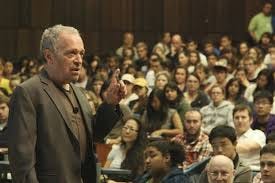
 I’m worried about my children. Not my biological ones — they’re fine — but my students, whom I think of as my children because I have taught them and counseled them and nurtured them for years.

They are at a time of their lives when they’re trying to figure out the meaning of social justice and their roles in seeking to advance it.

Yet some of them who are Jewish tell me they’re afraid.

Some who are Arab or Palestinian or Muslim tell me they’re afraid, too.

The two groups are afraid of each other. There have been perceived threats, slights, intimidation.

My Jewish students tell me of receiving antisemitic notes, of seeing swastikas, of feeling unsafe.

My Arab, Palestinian, and Muslim students tell me that speaking out against Israel’s aggression has resulted in “doxing,” and in some cases withdrawals of offers of employment. They are subject to anti-Palestinian and Islamophobic taunts. They also feel unsafe.

Here’s what I’m telling them in response.

First, if Jews and Palestinians, Arabs, and Muslims on an American college campus cannot feel safe around each other, they will never feel safe around each other, anywhere.

Second, the only way forward is to reject stereotypes, and begin to talk to one another.

Talking to one another involves listening — listening to the fears and anguish, to the anger and resentments on the other side. Trying to understand those feelings and not dismiss them.

Active listening is itself therapeutic to a community torn by dreadful actions thousands of miles away. It is an important act in the pursuit of social justice.

Third, what does not move us closer to social justice is to attribute collective guilt to all Palestinians (or Arabs or Muslims) or to all Jews, for atrocities committed by Hamas or by Israel’s government. Such mass attribution is racist and immoral.

And what moves us away from social justice is to demean, criticize, or threaten others based on their ethnicity or religion.

Fourth, the war raises issues that are morally complicated, because they have complex histories extending back generations, if not centuries, in which both sides feel aggrieved and afraid.

This complexity can make the war difficult or uncomfortable to discuss. The pursuit of social justice is easier when there are clear oppressors and oppressed. Few feelings are more satisfying than righteous indignation.

What Hamas did on October 7 was horrific. Israel’s attack on Gaza is barbaric. The occupation of the West Bank by Israeli settlers has inflicted hardship and cruelty on Palestinians. There is never any moral justification for the killing and maiming of innocent people.

Im not suggesting bland “both-sides”-ism here. I believe that Israel has been tragically wrong, that its invasion of Gaza is a terrible mistake, and that it is morally unacceptable to consider certain peoples lives more valuable than other peoples lives. 

But the central issue for us should not be who is wrong. All of us are complicit to some degree. The central issue now is how we move forward.

I ask them not to be consumed by their own rage and fear.

I try to dissuade them from putting their energies and efforts into “statements” that reflect only part of the truth, or believe that demonstrations and petitions somehow legitimize their own points of view. I don’t want them to think that there is any easy way to a lasting peace.

Finally, I tell them that there is no ready formula for social justice. Social justice is a process. It requires the discovery — or the creation — of a shared sense of common good.

This may be nearly impossible for Israel and Hamas, so long as Hamas is dedicated to killing all Jews and erasing Israel, and Israelis now live with that fear.

But finding a shared sense of the common good is an achievable goal on the college campuses of America. It must be.

The core of a good liberal arts education is ethics. The central question is the meaning of a good society. This has been the case since the 18th century, when most of America’s prestigious institutions of higher education were founded.

There is no single answer to the meaning of a good society, of course. It is the pursuit of it that draws on one’s judgment and conscience. This is why higher education has advanced the role of reason in human affairs and stood for the Enlightenment values of tolerance and democracy.

My dear students — you, whom I think of as my children — please know that I deeply admire and love you. But I beseech you not to replicate here on this campus the threats and violence now devastating the Middle East.

Use this time in your young lives to chart a different path — of listening, understanding, and respecting each other. 

You may not solve the entrenched problems of the Middle East this way, but you will provide a small beacon of hope for social justice in the world.

Robert Reich, 2023,