Saturday, October 27, 2018

The China toll deepens: Growth in the bilateral trade deficit between 2001 and 2017 cost 3.4 million U.S. jobs, with losses in every state and congressional district

The China toll deepens: Growth in the bilateral trade deficit between 2001 and 2017 cost 3.4 million U.S. jobs, with losses in every state and congressional district: The growing U.S. trade deficit with China has eliminated 3.4 million U.S. jobs between 2001 and 2017. U.S. jobs lost are spread throughout the country but are concentrated in manufacturing. Not surprisingly, the hardest-hit congressional districts include districts where manufacturing jobs are concentrated.

Wednesday, October 24, 2018

White House Sees Threat to Economy : Socialists

What Could Kill Booming U.S. Economy? ‘Socialists,’ White House Warns
A report from the Council of Economic Advisers compares Bernie Sanders to Chairman Mao, and warns that pickup trucks cost more in Sweden.

https://www.nytimes.com/2018/10/23/us/politics/socialist-democrats-trump-elections.html

When was the last time anyone talked about the Council of Economic Advisers? We are certainly far from the days when Walter W. Heller, chairman of the CEA under Presidents Kennedy and Johnson, appeared on the cover of Time magazine twice in two years. On Tuesday, the CEA made its first newsworthy move of the Trump presidency, releasing a seventy-two-page “report” warning that “socialism is making a comeback in American political discourse.” The reaction has been universal mockery, which the report and its authors richly deserve. Most of the pages are given over to a potted discussion of the failures of state socialist agriculture and the decline of Venezuelan oil production under Chavismo. There is a confusing discussion of the Scandinavian countries, which are presented variously as being nonsocialist, suffering lower standards of living because of socialism, and benefiting from the inborn tendency of Nordic stock to high incomes. These lessons in comparative history are tenuously connected to U.S. politics through constructions like, “The socialist narrative names the oppressors of the vulnerable, such as the bourgeoisie (Marx), kulaks (Lenin), landlords (Mao), and giant corporations (Sanders and Warren).”
The report has drawn comparisons to “a middle school book report assigned by the Heritage Foundation” and “a Red Bull–addled college freshman’s attempt to parse their introductory economics course through a first-response paper.” The resemblances are certainly there, right down to an appeal to “the Oxford English Dictionary, which defines socialism as…” and the caveat that certain socialists are “different in these important ways.” But reading the document and following the citations, you find a range of references that goes beyond casual Google searches and chain-email folk memory, to include serious socialist thinkers like John Roemer and Alec Nove. There are also references to the work of two CEA staffers, Tyler Goodspeed and Casey Mulligan, perhaps a clue to the authorship of the collectively attributed document.

Saturday, October 20, 2018

Financing the Anti Proposition 10 Campaign


Sam Levin
October 16, 2018
The Guardian
The President of the NAACP’s California chapter has a history of leveraging the NAACP brand to line her own pockets. This year she is slated to reap at least $800,000 to oppose a statewide rent control measure on the November statewide ballot.

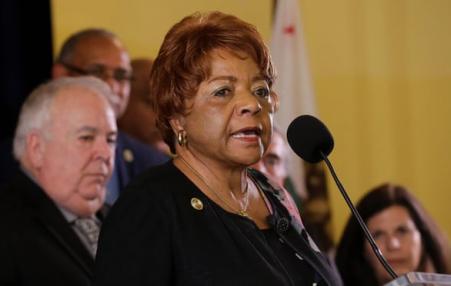
Like the pharmaceutical and tobacco industries before it, the real estate industry is paying California NAACP President Alice Huffman lots of money to get the NAACP stamp of approval. , Jeff Chiu/AP

[Moderators Note: In recent years in California, serious ethical issues have placed the local and statewide leaders of the National Association for the Advancement of Colored People (NAACP) in the national spotlight. In 2014, the National Office of the NAACP forced the resignation of Leon Jenkins, then President of the Los Angeles Chapter, when it was revealed the branch, in exchange for a significant donation, was prepared to give a humanitarian award to Donald Sterling, real estate mogul and owner of the Los Angeles Clippers professional basketball franchise. 
Sterling, who had been successfully sued on several occasions for housing discrimination and sexual harassment, had made racist comments so egregious the NBA levied fines of more than $2 million and forced him to sell his franchise. 
At that time, Lorraine Miller, Interim President and CEO of the NAACP responded to NAACP members who demanded action, writing, “We will determine the shortcomings that enabled Donald Sterling to receive or be considered for any awards. We will prevent this from happening again.” She added, “We must not allow that need (for resources) to compromise our founding principles.” 
But by 2014, the President of the statewide NAACP chapter, Alice Huffman, had already turned selling the NAACP brand to the highest bidder into an art. In 2005, the pharmaceutical industry paid Huffman $375,000 in consulting fees. That year the California NAACP sided with the drug companies against two statewide ballot measures designed to lower prices for prescription drugs. 
In 2006, the state NAACP opposed a statewide tobacco tax increase and Huffman was paid $210,000 in campaign fees by the cigarette manufacturer Philip Morris. 
And in 2016, the drug companies were back. The “No on 61” committee, funded by the pharmaceutical industry in opposition to that statewide drug pricing measure, paid Huffman $108,500 for consulting work.
“Among the political class in Sacramento, it’s very well known that Alice essentially applies the NAACP good housekeeping seal to special interest causes in return for money,” said Garry South, the Democratic consultant leading the campaign to cap drug prices, told the Sacramento Bee’s Taryn Luna at the time. “I don’t know how she gets away with it.”
Huffman gets away with it in part because the national leadership of the NAACP has not honored its pledge “to prevent this from happening again.” 

Monday, October 15, 2018

Trumpka on the Trade Deal


Richard Trumpka-n it seems every talking head in Washington has been in a frenzy recently, rushing to either glorify or condemn the new North American Free Trade Agreement, known as the United States Mexico Canada Agreement. But the truth is that it is still too early to pass any final judgment.
It helps to understand that for a quarter of a century, NAFTA has wreaked havoc on the lives of working people across North America. More than 850,000 jobs in the United States have been shipped overseas. Mexican workers have toiled under poverty wages and repressive conditions, while large corporations have used that labor abuse as a twisted justification to slash pay and reduce benefits in the United States and Canada.
Working people are not standing for it anymore. We have demanded a trade regime that prioritizes those who work the hardest. We have marched and mobilized to build the fairer economy and more just society that we deserve. That is how we fought and defeated the Trans Pacific Partnership. That is how we brought NAFTA back to the negotiating table.
But before anyone can pat themselves on the back, working people need clear answers. We have already suffered long enough under the broken promises of NAFTA. Too many lives have been destroyed, too many jobs have been lost, too many families have been hurt, and too many communities have been devastated by corporate written and unfairly enforced trade deals. We are not interested in shaky promises or standards that rise and fall depending on who sits in the Oval Office.
To be sure, the draft agreement includes some improvements on labor protections, foreign investment, and American content standards. Yet, it is also apparent that the new NAFTA further cedes ground to corporate interests on a range of issues, from food labeling requirements and environmental protections to data privacy and affordable medicine.
There are also significant unknowns. For example, we do not know whether or how Mexico will raise labor standards. If these reforms are advanced and strictly enforced, Mexican workers will be able to join unions and negotiate for better pay, relieving some of the downward pressure on American wages. If the new NAFTA fails to secure those improvements, the entire agreement is a nonstarter for us.
Moreover, we do not know whether or how the parties will monitor and enforce the rest of the labor rules in the agreement. We also do not know how the automobile rules of origin, which are key to protecting industry jobs, will be enforced. These things matter to thousands of people. New rules are meaningless without swift and certain enforcement.
Working people are watching closely. As this trade deal is finalized, we will continue to make our voices heard. We are under no illusion that this new agreement will be perfect. Any grand promise to restore every job lost under NAFTA is as cynical as the rhetoric surrounding the original deal.
However, if negotiators can clearly demonstrate that this new agreement will change the terms of trade, by codifying the fundamental economic rights of Mexican workers and lifting up all North American workers, then it will represent an important step forward. If the new NAFTA ultimately advances the needs and rights of working families, we will fight to make it law. If, instead, it continues to sacrifice our livelihoods to enrich a few chief executives, we will fight tooth and nail to defeat it.
For now, one thing is clear. Working people have flipped the debate on trade. The fact that the national conversation is focused on fixing a bad agreement rather than passing a new one is a victory in itself. It offers real promise that future trade policies will finally put working families first.
Richard Trumka is the president of the AFL-CIO. He previously was its secretary treasurer and is a past president of the United Mine Workers.


LOAD COMMENTS (78)