Showing posts with label trade. Show all posts

Thursday, October 22, 2020

701 Economists Call for the Defeat of Donald Trump

NOTE: Institutions are listed for identification purposes and should not be viewed as signatories to the letter.


We, the undersigned economists, strongly urge voters not to re-elect Donald Trump on the following grounds:


  • His chaotic and ineffective approach to negotiation has damaged relations with trade partners, interrupted supply chains, degraded international norms, and harmed American farmers -- all without achieving his stated goal of reducing the trade deficit. Even his landmark trade deal, the USMCA, is not projected to have a meaningful impact on either GDP or the trade deficit.

  • His managerial incompetence has damaged the credibility and effectiveness of the public sector. Agencies cycle through acting heads, disgruntled former staffers frequently appear in the media with dire warnings, and family members are put in charge of critical pandemic response initiatives.


  • He claimed to have the unique ability to generate growth (in real GDP) of between 4% and 6%, but never surpassed 2.9% in his first three years in office. Furthermore, analysts at Goldman Sachs and Moody’s Analytics have projected that Joe Biden’s economic plans, if implemented, would actually generate faster growth in both employment and real GDP.


  • He failed to achieve his campaign’s core economic promises: manufacturing remained a small share of employment, and both the fiscal and trade deficits increased. As economists explained in 2016, most of his promises either didn’t make sense or weren’t achievable using his proposed policies. This remains true in 2020.

  • His administration’s public health response to COVID-19 was described by medical scientists as having turned "...a crisis into a tragedy" and as having underperformed relative to other democracies by "orders of magnitude."

  • He has consistently undermined the independence and credibility of our major health agencies, including the Food and Drug Administration, the Centers for Disease Control, and the National Institutes of Health, eroding public trust in their approvals and recommendations at exactly the time when we most desperately need it.

  • He has dramatically overemphasized the extent to which economic growth and public health are in conflict during a pandemic. In fact, many countries that have been more effective in their viral containment efforts have also performed better economically.


  • His personal behavior during the COVID-19 outbreak endangered public health, the economic recovery, and the safe re-opening of schools. He undermined mask use and social distancing, held indoor rallies, encouraged the use of unproven and potentially dangerous medical substances, downplayed the severity of the pandemic, and hosted a superspreader event that incapacitated the White House and forced military leadership into quarantine.

  • He regularly spreads dangerous misinformation, even during times of crisis, and has been the single largest source of misinformation during the pandemic.

  • He has made the country less attractive to skilled and hard-working immigrants by assaulting religious freedom and by insinuating that the children of non-white immigrants are not truly American.


  • He has made the country a less appealing place to do business by creating an atmosphere of perpetual chaos and uncertainty, and by using the levers of government to punish individuals and businesses that were insufficiently reverential.


  • He has fostered a culture of unabashed corruption by pressuring foreign countries to undermine his political opponents, using the resolute desk to promote a political supporter’s bean products, attempting to divert intergovernmental meetings to his commercial properties, using public resources to conduct campaign events, and allowing White House staff to openly flout the Hatch Act.

  • He has refused to release his tax returns -- unlike his political opponents in both 2016 and 2020 -- making it difficult to determine the extent to which his financial interests conflict with the country’s. Recent reporting, which has secured his returns for two decades, suggests that his businesses have consistently claimed large losses and that he appears to have many unresolved conflicts of interest.


  • He spreads conspiracy theories that undermine long-term trust in democractic institutions for seemingly no reason other than to influence media coverage in a single news cycle.

  • He has a poorly-informed, zero-sum view of economics that engenders needless viciousness and cruelty.


In just one term in office, Donald Trump has rendered the United States unrecognizable, and has faced no consequences for doing so. He has carried out a sustained assault on democratic institutions, put his family members in charge of critical government functions during a pandemic, called for his political opponents to be thrown in prison, normalized corruption, and weakened the economic recovery with selfish and reckless behavior. For these reasons, we strongly recommend that the electorate do what no one else can: reclaim your democracy by voting to remove Donald Trump from office.


Henry J Aaron, The Brookings Institution
Alberto Abadie, MIT
Teshome Abebe, Eastern Illinois University 
Ryan Abman, San Diego State University
Rahi Abouk, William Paterson University
Joelle Abramowitz, University of Michigan
David Abrams, University of Pennsylvania
Jason Abrevaya, University of Texas, Austin
Daron Acemoglu, MIT
Sara Adler-Mandelbaum, Western Governor's University
Amanda Agan, Rutgers University 
Dennis J. Aigner, University of California, Irvine
Ugur Aker, Hiram College
George Akerlof, Georgetown University
Stefania Albanesi, University of Pittsburgh
Randy Albelda, University of Massachusetts Boston 
Jim Albrecht, Georgetown University
Harold Alderman, IFPRI
Treb Allen, Dartmouth College
Andres Almazan, The University of Texas at Austin
Douglas Almond, Columbia University
Rosanne Altshuler, Rutgers University
Nurul Samiul Aman, University of Massachusetts Boston
Pedro Amaral, California State University, Fullerton
James E. Anderson, Boston College
Kathryn H. Anderson, Vanderbilt University
Robert M Anderson, University of California, Berkeley
Axel Anderson, Georgetown University 

Victor William Ribeiro Andre

Plus 700 more.  

Saturday, September 14, 2019

Roots of the U.S.-China Trade Dispute

Roots of the U.S.-China Trade Conflict
https://portside.org/2019-09-05/roots-us-china-trade-conflict
Author: David Kotz
Date of source: September 1, 2019
Democratic Left (Democratic Socialists of America)
The most anti-worker president in recent memory slaps big tariffs on products made in China — in the name of protecting the jobs of American workers. Corporate lobbyists criticize the tariffs — but say we must get tough on China’s trade policies. Some Democratic senators warn Trump not to back down in trade negotiations with China.
What can socialists make of all this? To answer this question, let’s examine the background of the trade conflict and the reasons why it broke out recently.
China Rises
Beginning in 1978, the ruling Communist Party in China made a radical turn, called the “reform and opening.” Central planning was gradually replaced by a market economy. The previously closed economy was opened to trade with the capitalist countries. Privately owned companies came to predominate. However, a core of large state-owned enterprises remains, and the government actively regulates the economy. China’s economic system today bears some resemblance to the heavily state-regulated capitalist economies of Western Europe in the post-Second World War decades, although paired with a different political and social system ruled by the Communist Party.
When China started down this road, the U.S. government was enthusiastic and supportive. U.S. big business saw big profit opportunities in a growing China market. The reform and opening led to remarkably rapid economic growth, at about 10% per year for decades. U.S. business lobbied for China’s admission to the World Trade Organization in 2001. Many U.S. companies set up shop in China, which has abundant low-wage (yet relatively healthy and well-educated) labor coming from a huge rural sector. China also has a business-friendly government, docile official trade unions, and a government that makes huge infrastructure investments in transportation and power that underpin the profitability of operating in the China market. 
As “Made in China” labels proliferated in U.S. stores, many U.S. workers lost their jobs. Cheap imports from China, along with those from other low-wage countries, have played a role in driving down the real wages of U.S. workers since 1980. That did not concern the U.S. corporations that were boosting profits by moving production to China, nor did it bother the many sectors of U.S. business that purchased cheap inputs from China. 
About Face

Read the entire piece here. 

Wednesday, June 19, 2019

Dealing with the over valued dollar

Elizabeth Warren released an “American jobs” plan recently. It includes several trade and manufacturing policies intended to benefit American workers and companies. Wall Street responded with righteous indignation, which suggests she may have hit a nerve.
One element of her plan most likely explains Wall Street’s angry reaction: a call to tackle America’s overvalued dollar.
The novel idea that the United States could achieve greater domestic prosperity by revaluing the dollar sounds obscure and a little risky. Who would want to tinker with our currency?
The reality is that China and about 20 other nations are already doing so. By using public capital to purchase huge quantities of United States government securities over the past two decades, they have driven up the value of the dollar to make their own exports supercompetitive.

https://www.nytimes.com/2019/06/16/opinion/elizabeth-warren-dollar.html

Tuesday, June 4, 2019

Elizabeth Warren Gets Serious- and Accurate- About Trade

Elizabeth Warrenbuilt her brand for the  2020 presidential primary on wonkery. From childcare to housing to higher ed, Warren has leveraged decades of economic policy expertise and a network of liberal intellectuals ― many of them former students in Warren’s law school classes ― to propose ambitious, meticulously detailed reforms.
The trade platform Warren unveiled Tuesday in Detroit is a little different. It retains Warren’s wonk-flair with a proposal to reorganize the disparate trade regulators currently scattered throughout the Washington bureaucracy inside a single, consolidated agency. But the heart of her proposal is ideological rather than technical. Warren is making a crystal-clear statement of principles, and an equally plain break with the past 30 years of American trade policy ― up to and including the presidency of Donald Trump.
 “America chose to pursue a trade policy that prioritized the interests of capital over the interests of American workers,” Warren told a crowd in Detroit Tuesday. “We have encouraged companies to invest abroad, ship jobs overseas, and keep wages low. All in the interest of serving multinational companies and international capital with no particular loyalty to the United States.”
What matters in Warren’s vision is not the specifics of any particular trade tool or enforcement tactic. Warren isn’t pro-tariff or anti-tariff, for instance. It depends on the tariff. She’s in favor of international rules that are designed to achieve actual policy goals other than corporate profit. What we call “free trade,” she emphasizes, isn’t really a system where governments get out of the way. The rules of international commerce determine its outcomes ― and there is no such thing as a trade regime without rules. When governments agreed to grant 20-year monopolies on life-saving medicines under WTO treaties, for instance, they were not simply allowing nature to take its course — they were setting up a system.


Sunday, January 13, 2019

Free Trade” Is Today’s Imperialism by the 1 Percent

PUBLISHED
January 13, 2019
Opposition to “free” trade is clearly growing — both the progressive and the corporate elements of the Democratic Party are now critical of agreements like the North American Free Trade Agreement and the Trans-Pacific Partnership. Less clear are the alternatives to free trade that might emerge. As progressives continue to build power inside and outside of the Democratic Party, we must clarify our understanding of the international political economy, and imagine and begin to build real alternatives to free trade. Building these alternatives must become an essential component of a more progressive US foreign policy. 
The conventional wisdom says that if you oppose free trade, you must support protectionism or economic nationalism. This is misleading. There is no such thing as “free” trade. People create all of the systems that govern our political economy. These systems inevitably favor certain human activities over others, and we can design them to act any way that we want. The important question is: For whom are trade policies “free”? Put another way: Who do trade policies favor?
Debunking “Free” Trade
“Free” trade is free only for capital owners: the plutocratic fewwho own and control multinational corporations. When countries enter into free trade agreements, the governments of both countries effectively agree that their laws will not favor businesses from their country over businesses from any other countries. The main way that free trade does this is by attempting to reduce all tariffs to as close to 0 percent as possible, to eliminate import quotas that countries can use to limit the amount and types of goods imported from specified countries, and to discourage countries from more directly subsidizing their own businesses. 
Read the entire piece:  https://truthout.org/articles/free-trade-is-todays-imperialism-by-the-1-percent/

Thursday, December 13, 2018

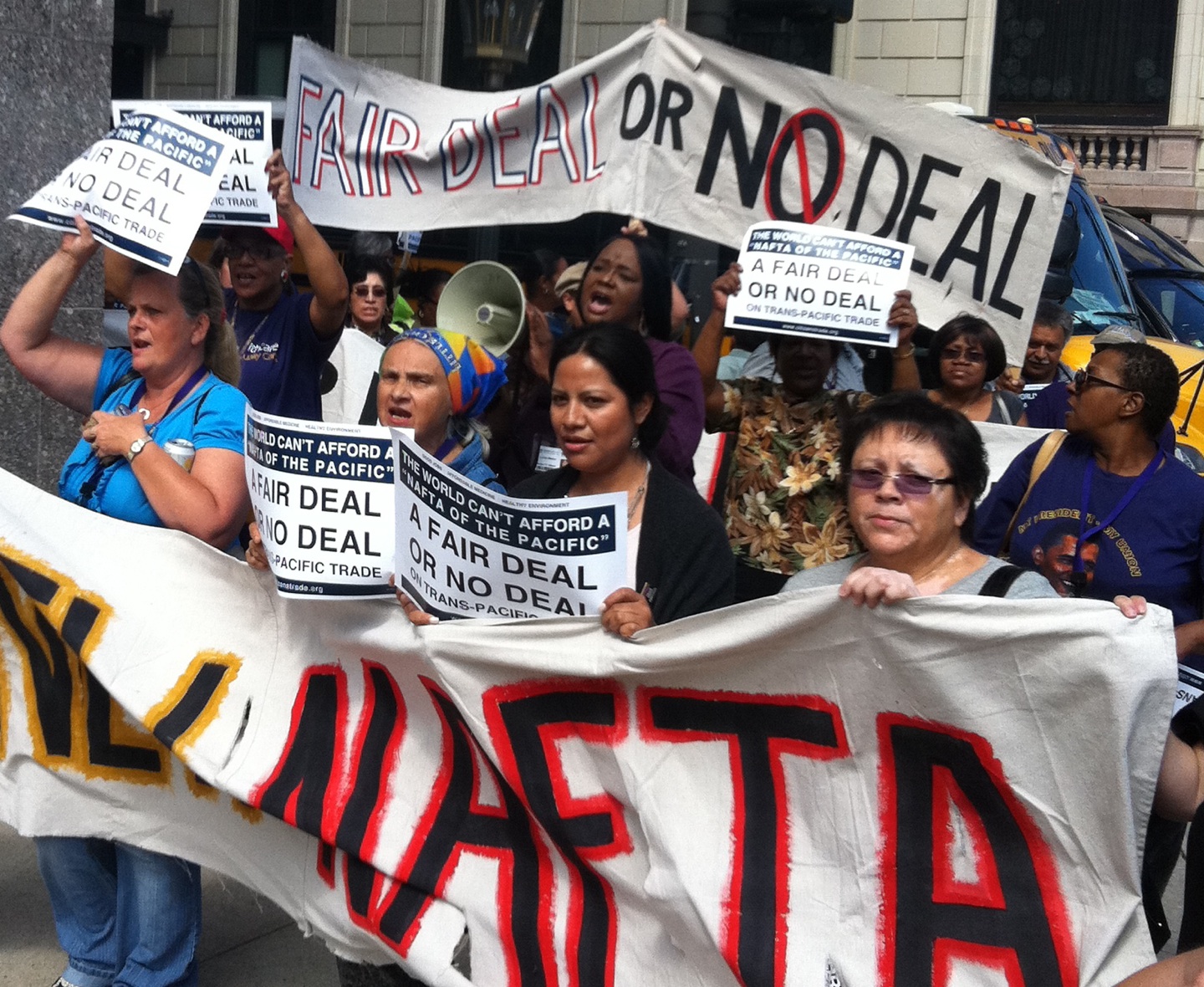
Oppose Nafta 2.0

better deal, please sign on here.  Thanks!  — Arthur


NAFTA 2.0 Doesn't Cut ItEarly next year, the U.S. International Trade Commission (USITC) will publish a formal report on expected impacts from the proposed North American Free Trade Agreement (NAFTA) revision.  This report will be used by Congress to make decisions about whether to support NAFTA 2.0 as written or to demand further changes.

TAKE ACTION: Please join us in urging that the official report on NAFTA 2.0 highlight its failure to include critical changes needed to protect jobs, raise wages and promote healthy communities.
Each week, NAFTA continues to destroy livelihoods across the continent.  Unfortunately, the revised NAFTA deal currently on offer would continue to facilitate the outsourcing of jobs, the suppression of wages and the dumping of toxins.  Among other problems, it also takes big steps backwards on access to medicine.

We need Congress to insist on substantive changes to the proposed text before there’s a real NAFTA replacement that working people can be happy about.  An accurate USITC report would help bolster that effort.

The USITC is now accepting official public comments on the NAFTA proposal.  Please sign onto our commentsurging the USITC to explicitly acknowledge that:
  • NAFTA 2.0’s lack of strong, easily-enforced labor and environmental standards has a real cost. Without such provisions, the revised NAFTA will continue to help big corporations move good-paying jobs to Mexico to take advantage of sweatshop wages, ongoing worker rights abuses and the ability to pollute with impunity.  
  • NAFTA 2.0’s expansion of pharmaceutical monopolies has a real cost. Worse than the original NAFTA, new language in the current proposal would lock-in bad policies that keep healthcare costs high in the United States, and make it harder for affordable, generic medicines to reach those who need them at home and abroad.  
  • NAFTA 2.0’s refusal to address climate change and end environmentally-destructive practices has a real cost.  Not only does the current text fail to even mention climate change, but it also contains special loopholes for some of the planet’s worst corporate polluters that would allow destructive practices to continue unchecked and could potentially undermine future attempts to tackle the climate crisis.

Friday, December 7, 2018

Trump Trade Policy- Without a Clue

Paul Krugman
Are we going to have a full-blown trade war with China, and maybe the rest of the world? Nobody knows — because it all depends on the whims of one man. And Tariff Man is ignorant, volatile and delusional.
Why do I say that it’s all about one man? After all, after the 2016 U.S. election and the Brexit vote in Britain, there was a lot of talk about a broad popular backlash against globalization. Over the past two years, however, it has become clear that this backlash was both smaller and shallower than advertised.
Where, after all, is the major constituency supporting Donald Trump’s tariffs and threats to exit international agreements? Big business hates the prospect of a trade war, and stocks plunge whenever that prospect becomes more likely. Labor hasn’t rallied behind Trumpist protectionism either.
Meanwhile, the percentage of Americans believing that foreign trade is good for the economy is near a record high. Even those who criticize trade seem to be motivated by loyalty to Trump, not by deep policy convictions: During the 2016 campaign self-identified Republicans swung wildly from the view that trade agreements are good to the view that they’re bad, then swung back again once Trump seemed to be negotiating agreements of his own. (We have always been in a trade war with Eastasia.)

Thursday, November 1, 2018

China and Trade.


Tomgram: Michael Klare, On the Road to World War III?

Monday, October 15, 2018

Trumpka on the Trade Deal


Richard Trumpka-n it seems every talking head in Washington has been in a frenzy recently, rushing to either glorify or condemn the new North American Free Trade Agreement, known as the United States Mexico Canada Agreement. But the truth is that it is still too early to pass any final judgment.
It helps to understand that for a quarter of a century, NAFTA has wreaked havoc on the lives of working people across North America. More than 850,000 jobs in the United States have been shipped overseas. Mexican workers have toiled under poverty wages and repressive conditions, while large corporations have used that labor abuse as a twisted justification to slash pay and reduce benefits in the United States and Canada.
Working people are not standing for it anymore. We have demanded a trade regime that prioritizes those who work the hardest. We have marched and mobilized to build the fairer economy and more just society that we deserve. That is how we fought and defeated the Trans Pacific Partnership. That is how we brought NAFTA back to the negotiating table.
But before anyone can pat themselves on the back, working people need clear answers. We have already suffered long enough under the broken promises of NAFTA. Too many lives have been destroyed, too many jobs have been lost, too many families have been hurt, and too many communities have been devastated by corporate written and unfairly enforced trade deals. We are not interested in shaky promises or standards that rise and fall depending on who sits in the Oval Office.
To be sure, the draft agreement includes some improvements on labor protections, foreign investment, and American content standards. Yet, it is also apparent that the new NAFTA further cedes ground to corporate interests on a range of issues, from food labeling requirements and environmental protections to data privacy and affordable medicine.
There are also significant unknowns. For example, we do not know whether or how Mexico will raise labor standards. If these reforms are advanced and strictly enforced, Mexican workers will be able to join unions and negotiate for better pay, relieving some of the downward pressure on American wages. If the new NAFTA fails to secure those improvements, the entire agreement is a nonstarter for us.
Moreover, we do not know whether or how the parties will monitor and enforce the rest of the labor rules in the agreement. We also do not know how the automobile rules of origin, which are key to protecting industry jobs, will be enforced. These things matter to thousands of people. New rules are meaningless without swift and certain enforcement.
Working people are watching closely. As this trade deal is finalized, we will continue to make our voices heard. We are under no illusion that this new agreement will be perfect. Any grand promise to restore every job lost under NAFTA is as cynical as the rhetoric surrounding the original deal.
However, if negotiators can clearly demonstrate that this new agreement will change the terms of trade, by codifying the fundamental economic rights of Mexican workers and lifting up all North American workers, then it will represent an important step forward. If the new NAFTA ultimately advances the needs and rights of working families, we will fight to make it law. If, instead, it continues to sacrifice our livelihoods to enrich a few chief executives, we will fight tooth and nail to defeat it.
For now, one thing is clear. Working people have flipped the debate on trade. The fact that the national conversation is focused on fixing a bad agreement rather than passing a new one is a victory in itself. It offers real promise that future trade policies will finally put working families first.
Richard Trumka is the president of the AFL-CIO. He previously was its secretary treasurer and is a past president of the United Mine Workers.


LOAD COMMENTS (78)

Wednesday, October 10, 2018

International Trade - Sanders


Meagan Day
October 10, 2018
Jacobin Magazine
In a new speech, “Building a Global Democratic Movement to Counter Authoritarianism,” Sanders spells out that we must develop a global movement against unaccountable state and corporate power, which are mutually reinforcing.

, Gage Skidmore / Flickr

Bernie Sanders has been called “bad on foreign policy” by just about everyone under the sun. Coming from those to his right, it typically means insufficiently deferential to the hawks of the foreign policy establishment. Sanders vocally opposed and voted against the Iraq War, is more critical of Israel than any other major American politician, has proposed drastic cuts in military spending, sought to terminate the US nuclear weapons program, opposes US support for the Saudi-led offensive in Yemen, and has expressed strong opposition to past CIA-backed coups in Latin America and Iran, among other unorthodox foreign policy positions.
Coming from the Left, criticisms have often been founded in legitimate concern that Sanders’s foreign policy hasn’t departed from the bipartisan consensus as much as his domestic economic policy has. For example, while all of the above is true, he doesn’t support the movement for Boycott, Divestment, and Sanctions (BDS) against Israel, and he has cast his vote for US military intervention several times during his decades-long tenure in the Senate. He has spoken on occasion about the need to preserve American military might, even while he inveighs against the waste and the abuses of the US military at other times.

Monday, October 1, 2018

New Trade Agreement is Not Better


#ReplaceNAFTAThe Trump administration just published proposed text for its renegotiated version of the North American Free Trade Agreement (NAFTA), and they've failed to make the critical changes needed to protect jobs, raise wages, defend human rights and reverse environmental damage.  

As much as the White House wants to spin the current deal as a win, a lot more work is needed before there’s a real NAFTA replacement that working families can be happy about. 

TAKE ACTION: 
Please urge your Members of Congress to insist on a comprehensive NAFTA replacement that puts working people and the planet ahead of corporate profits. 

Each week, NAFTA continues to destroy livelihoods across the continent.  Unfortunately, the deal currently on offer does not include the enforcement mechanisms needed for labor and environmental standards to prevent employers from moving jobs to areas where worker rights and environmental protection are routinely ignored.  

Without strong labor and environmental rules with swift and certain enforcement, Trump’s version of NAFTA will continue to facilitate the outsourcing of jobs, the suppression of wages and the dumping of toxins.  While steps forward have been made in other areas, a NAFTA replacement without this fundamental fix is a nonstarter.

In addition, Trump’s proposal is significantly worse than the original NAFTA on access to medicines.  The world needs trade policies that increase the affordability of life-saving medications — not ones that extend monopolies for pharmaceutical giants and raise healthcare costs.  

Saturday, September 29, 2018

Trade and Development

On global dialogue and the international economic forum
“Gordon Brown recently expressed his concern at the current weaknesses in global relationships to deal with any future economic crises. With major nations on the brink of a trade war, and with climate change accelerating, we can’t risk the kind of international breakdown that led to the Great Depression.
“Just as at the Bretton Woods conference in 1944, there is an urgent need to work out if the current international system can cope with these threats. It isn’t working for the Western world, where stagnant wages have helped feed the rise of the racist right.
“And it isn’t working for the developing world, whose wealth is plundered by multinational corporations or stashed in Western banks.
“We will be convening in the spring an international social forum to bring together leading economists, politicians and civil society representatives, launching a dialogue on the common risks we face and the actions we need to take.
“I am pleased to announce that Nobel Prize winning economist, Joseph Stiglitz, has agreed to lead this discussion for us.” •
 
 
Speech to Labour Conference 2018.  British Labour Party
John McDonnell MP  _ English

Wednesday, September 26, 2018

China Is Being Smart, Trump Isn't

China’s Being Smart, and Trump Isn’t
Thomas L. Friedman

Early in the movie “Crazy Rich Asians” a Chinese-Singaporean father admonishes his young kids to finish their dinner, saying, “Think of all the starving children in America.” I’m sure that everyone of my generation in the theater laughed at that joke. After all, we’d all been raised on the line: “Finish your dinner. Think of all the starving children in China.”
That little line contained within it many messages: The first, which any regular traveler to China’s biggest urban areas can tell you, is that rich China today — its luxury homes, cars, restaurants and hotels — is really rich, rich like most Americans can’t imagine.
The second is that this moment was destined to be a test of who will set the key rules of the global order in the 21st century: the world’s long-dominant economic and military superpower, America, or its rising rival, China. And this test is playing out with a blossoming full-scale trade war.
What does such a test of wills sound like? It sounds like a senior Chinese official telling me at a seminar at Tsinghua University in April that it’s just “too late” for America to tell China what to do anymore on issues like trade, because China is now too big and powerful. And it sounds like President Trump, in effect, telling China: “Says who? Show me what you got, baby!” Or as Trump actually tweeted last week: “We are under no pressure to make a deal with China, they are under pressure to make a deal with us. … If we meet, we meet.”
Read the entire essay. 

Tuesday, May 1, 2018

Trump and Trade War

So Trump has postponed unveiling his list of nations against whose steel he’ll impose tariffs. The grand Trumpian gesture would be to include everybody, but by firing that blunderbuss, he’d penalize both the trade-law miscreants and the trade-law compliers (not that distinctions such as these have deterred Trump up to now). The United Steelworkers have made clear that the point of the tariffs shouldn’t be to penalize producers like Canada, which don’t undercut U.S. steelmakers, but those nations that provide state subsidies to their producers so they can underprice us.
If Trump (for that matter, if the American economic establishment) wished to ferret out the real culprits behind our massive trade deficit, they’d look first and foremost to Wall Street. It was the rising power of American finance and its shareholder-über-alles ideology that propelled our manufacturing sector to move offshore in search of cheaper labor and higher profits. There are many reasons why Germany has retained its manufacturing sector while we have not, but chief among them is the fact that Germany has no equivalent of Wall Street or London’s “the City.” But for Deutsche Bank, Germany lacks a global investment titan, and its far stronger community-banking sector is committed, by virtue of its control by local stakeholders rather than distant shareholders, to bolstering domestic manufacturing. Germany has problems of its own, but a financial sector committed to undermining the nation’s economy isn’t one of them. It’s only one of ours. ~ HAROLD MEYERSON

Sunday, April 15, 2018

Trade Dispute With China


Testimony before the Senate Finance Committee Subcommittee on International Trade, Customs, and Global Competitiveness for a hearing on ‘Market Access Challenges in China’ 
Testimony • By Thea M. Lee • April 11, 2018


This litany of unfair trade practices and currency manipulation has had a serious and pervasive negative impact on American jobs and wages. As my colleague, Rob Scott, demonstrated in a 2017 report, Growth in U.S.–China Trade Deficit between 2001 and 2015 Cost 3.4 Million Jobs [ https://www.epi.org/publication/growth-in-u-s-china-trade-deficit-between-2001-and-2015-cost-3-4-million-jobs-heres-how-to-rebalance-trade-and-rebuild-american-manufacturing ], the deficit cost jobs in all 50 states and the District of Columbia. Between 2001 and 2011, the growing trade deficit cost directly impacted workers $37 billion a year, while also putting downward pressure on the wages of all non-college graduates by $180 billion a year.
Well informed analysis. 


Read the testimony. 

Friday, March 23, 2018

Trump, Trade, China, tariffs,

How the Globalists Brought Us Trump. The headlines today are filled with alarmist language about how Trump’s retaliatory tariffs against China risk setting off a trade war. He’s imposing up to $60 billion worth of tariffs against an array of goods to compensate for a range of Chinese predatory tactics, including theft of intellectual property, subsidy of production below cost, and coercive “partnerships” with U.S.-based companies seeking to do business in China.
Here’s the pity of it all. The financial and political elite had this coming, by denying for decades the reality of China’s mercantilism. I write about this in the current issue of the Prospect. But Trump is pursuing a long overdue correction in a foolhardy way.
The right way to go after China’s predatory state capitalism would have been to keep China out of the WTO until we agreed on some set of symmetrical rules of the road. Clinton and Bob Rubin blew that one.
The elites deceived themselves into thinking that if we let China into the club first, China would evolve into a liberal, free-trade democracy. That sure produced some chuckles in Beijing.
The right way now would be to get together with the EU and mount a common diplomatic offense against China’s mercantilism. Instead, Trump went after the EU as well with his steel and aluminum, and is now facing retaliatory tariffs from Europe against the U.S. 
Trump has blown open a door to a long overdue drastic revision of policy—but in the crudest possible way, one that could backfire. His trade advisers, unlike Trump, are serious people. Trade chief Robert Lighthizer, a veteran of trade negotiations, knows how to do this diplomacy right. But this is really complex stuff, and it’s unlikely that Trump will listen to Lighthizer, except on the headlines. (His own lawyer defending him in the Mueller investigation, John Dowd, just quit because Trump refused to take his advice.)

Saturday, March 10, 2018

Enforcing Trade Rules is not a Trade War

Enforcing trade rules is not a ‘trade war’

The recent tariffs on steel and aluminum have been characterized as trade war. This is weird, because countries often enforce trade rules with targeted tariffs and sanctions, and markets adjust. What’s the real issue?

[Stan Sorscher | March 9, 2018  | The Stand]

In the orthodoxy of free trade, tariffs are heresy. Any tariff suggests that the neoliberal free trade approach has failed and government intervention is required. Also, if we protect steel, then the “protectionist barbarians” all rush in and want import restrictions, too.

This begs the question, “Why have rules for globalization at all, if we won’t enforce them?”

The context for the recent steel and aluminum tariffs should start with a central message from the 2016 presidential campaign. Millions of workers and communities around the country feel left behind by our approach to globalization. We can do something about that ….. or not.

President Trump speaks in terms of win-lose or “everyone is out to get us.” But he is doing something. The advice from free-trade establishment experts seems to be:
●  We can’t do anything;