| Rev. William Barber Yes, the Dow is at a record high and unemployment rates are lower than they have been in decades – but 140 million people are also poor or low wealth |
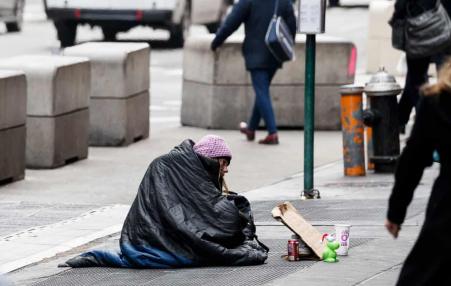
‘Sixty per cent of African Americans are poor or low income, as are 64% of Hispanics, but the largest single racial group among America’s poor and low income – 66 million Americans – are white.’ , Justin Lane/EPA
|
Rather than offer a report on the State of the Union, Donald Trump used his annual primetime slot in the House of Representatives to host a re-election rally. The House speaker, Nancy Pelosi, summed up the sentiment of the House majority when she stood behind Trump and ripped the text of his speech in half. “I tore up a manifesto of mistruths,” she later said. But of all the lies he told, the president is proudest of the economy he claims is booming. Poor and low-income Americans know that the economy is, in fact, his greatest vulnerability.
Yes, the Dow is at a record high and official unemployment rates are lower than they have been in decades. But measuring the health of the economy by these stats is like measuring the 19th-century’s plantation economy by the price of cotton. However much the slaveholders profited, enslaved people and the poor white farmers whose wages were stifled by free labor did not see the benefits of the boom.
In America today, 140 million people are poor or low wealth. While three individuals own as much wealth as all of them put together, the real cost of living has soared as wages have stagnated. Since the 1970s, the number of people who are paying more than a third of their monthly income in rent has doubled, and there is not a single county in the nation where a person working full-time at minimum wage can afford to rent a two-bedroom apartment. Sixty per cent of African Americans are poor or low-income, as are 64% of Hispanics, but the largest single racial group among America’s poor and low-income – 66 million Americans – are white.
Every day in America roughly 700 people die from poverty
While Trump stirs racial fears by attacking “sanctuary cities” and black political leaders, there are more white Americans who are unable to meet their basic needs than at any time in this nation’s history. Every day in America roughly 700 people die from poverty. When seven young people died from vaping, Trump called it a national emergency. But for the past four decades, Republicans have racialized poverty while Democrats have run from it, adopting euphemisms like “those who aspire to the middle class” to talk about poor people. By accepting the lie that everyone does better when the economy does better, both parties paved the way for the extremism of a plutocratic presidency.
We know that elites whose stock portfolios and personal taxes have benefited from the Trump tax cuts are going to stand by this president. But those people are an extreme minority – a literal plutocracy – in this nation. The question in 2020 is not whether Trump’s most ardent supporters will stand by him, but whether Democrats will embrace an agenda that can inspire poor and marginalized people to engage in a political system that has simply overlooked them for decades.
|
Sunday, February 16, 2020
Trump's Greatest Vulnerability is the Economy- Just Ask the Poor

Friday, February 14, 2020
How Misinformation Serves Trump
“Flood the zone with shit”: How misinformation overwhelmed our democracy
The impeachment trial didn’t change any minds. Here’s why.
Share this story
On Wednesday, the Senate voted to acquit President Trump of charges of abuse of power and obstruction of justice.
Despite all the incontrovertible facts at the center of this story, it was always inevitable that this process would change very few minds. No matter how clear a case the Democrats made, it was always highly likely that no single version of the truth was ever going to be accepted.
This fact underscores a serious problem for our democratic culture. No amount of evidence, on virtually any topic, is likely to move public opinion one way or the other. We can attribute some of this to rank partisanship — some people simply refuse to acknowledge inconvenient facts about their own side.
But there’s another, equally vexing problem. We live in a media ecosystem that overwhelms people with information. Some of that information is accurate, some of it is bogus, and much of it is intentionally misleading. The result is a polity that has increasingly given up on finding out the truth. As Sabrina Tavernise and Aidan Gardiner put it in a New York Times piece, “people are numb and disoriented, struggling to discern what is real in a sea of slant, fake, and fact.” This is partly why an earth-shattering historical event like a president’s impeachment did very little to move public opinion.
The core challenge we’re facing today is information saturation and a hackable media system. If you follow politics at all, you know how exhausting the environment is. The sheer volume of content, the dizzying number of narratives and counternarratives, and the pace of the news cycle are too much for anyone to process.
One response to this situation is to walk away and tune everything out. After all, it takes real effort to comb through the bullshit, and most people have busy lives and limited bandwidth. Another reaction is to retreat into tribal allegiances. There’s Team Liberal and Team Conservative, and pretty much everyone knows which side they’re on. So you stick to the places that feed you the information you most want to hear.
House Speaker Nancy Pelosi reading totals of a vote approving articles of impeachment. Robert Alexander/Getty Images
My Vox colleague Dave Roberts calls this an “epistemic crisis.” The foundation for shared truth, he argues, has collapsed. I don’t disagree with that, but I’d frame the problem a little differently.
We’re in an age of manufactured nihilism.
The issue for many people isn’t exactly a denial of truth as such. It’s more a growing weariness over the process of finding the truth at all. And that weariness leads more and more people to abandon the idea that the truth is knowable.
I call this “manufactured” because it’s the consequence of a deliberate strategy. It was distilled almost perfectly by Steve Bannon, the former head of Breitbart News and chief strategist for Donald Trump. “The Democrats don’t matter,” Bannon reportedly said in 2018. “The real opposition is the media. And the way to deal with them is to flood the zone with shit.”
This idea isn’t new, but Bannon articulated it about as well as anyone can. The press ideally should sift fact from fiction and give the public the information it needs to make enlightened political choices. If you short-circuit that process by saturating the ecosystem with misinformation and overwhelm the media’s ability to mediate, then you can disrupt the democratic process.
What we’re facing is a new form of propaganda that wasn’t really possible until the digital age. And it works not by creating a consensus around any particular narrative but by muddying the waters so that consensus isn’t achievable.
Bannon’s political objective is clear. As he explained in a 2017 Conservative Political Action Conference talk, he sees Trump as a stick of dynamite with which to blow up the status quo. So “flooding the zone” is a means to that end. But more generally, creating widespread cynicism about the truth and the institutions charged with unearthing it erodes the very foundation of liberal democracy. And the strategy is working.
What flooding the zone actually means
For most of recent history, the goal of propaganda was to reinforce a consistent narrative. But zone-flooding takes a different approach: It seeks to disorient audiences with an avalanche of competing stories.
Bloomberg Blames 2008 Economic Crisis on End of Redlining. Warren - Not so.
WASHINGTON (AP) — At the height of the 2008 economic collapse, then-New York Mayor Michael Bloomberg said the elimination of a discriminatory housing practice known as “redlining” was responsible for instigating the meltdown.
“It all started back when there was a lot of pressure on banks to make loans to everyone,” Bloomberg, now a Democratic presidential candidate, said at a forum that was hosted by Georgetown University in September 2008. “Redlining, if you remember, was the term where banks took whole neighborhoods and said, ‘People in these neighborhoods are poor, they’re not going to be able to pay off their mortgages, tell your salesmen don’t go into those areas.’”
He continued: “And then Congress got involved ― local elected officials, as well ― and said, ‘Oh that’s not fair, these people should be able to get credit.’ And once you started pushing in that direction, banks started making more and more loans where the credit of the person buying the house wasn’t as good as you would like.”
Bloomberg, a billionaire who built a media and financial services empire before turning to electoral politics, was correct that the financial crisis was triggered in part by banks extending loans to borrowers who were ill-suited to repay them. But by attributing the meltdown to the elimination of redlining, a practice used by banks to discriminate against minority borrowers, Bloomberg appears to be blaming policies intended to bring equality to the housing market.
The term redlining comes from the “red lines” those in the financial industry would draw on a map to denote areas deemed ineligible for credit, frequently based on race.
“It’s been well documented that the 2008 crash was caused by unethical, predatory lending that deliberately targeted communities of color,” said Debra Gore-Mann, president and CEO of the Greenlining Institute, a nonprofit that works for racial and economic justice. “People of color were sold trick loans with exploding interest rates designed to push them into foreclosure. Our communities of color and low income communities were the victims of the crash, not the cause.”
Campaign spokesman Stu Loeser said that Bloomberg “attacked predatory lending” as mayor and, if elected president, has a plan to “help a million more Black families buy a house, and counteract the effects of redlining and the subprime mortgage crisis.”
The campaign also pointed to efforts by Bloomberg’s private philanthropy to help other cities craft policies that will help reduce evictions. He promised in a January speech to do a version of the very thing he criticized in 2008: Ask lenders to update their credit-scoring models, “because millions of black households don’t have a credit score which is needed to get a mortgage.”
After this story was published, Loeser added: “He’s saying that something bad - the financial crisis - followed something good, which is the fight against redlining that he was part of as Mayor.”
Bloomberg’s 2008 remarks stand in contrast with the decadeslong positions some of his rivals have held.
Massachusetts Sen. Elizabeth Warren’s work as a professor and attorney has been devoted to the study of bankruptcy and the disastrous impact it has on the financial well-being of families. As a young Delaware senator, Joe Biden held hearings on unfair lending practices and sponsored legislation to ban discrimination in lending and crack down on industry figures who did.
The remarks are the latest instance of past comments by Bloomberg that have resurfaced in recent days that make him appear racially insensitive.
On Tuesday, an audio recording ricocheted around social media of the then-mayor defending his police department’s use of the controversial “stop-and-frisk” tactic during a 2015 appearance at the Aspen
Institute.
Under the program, New York City police officers made it a routine practice to stop and search multitudes of mostly black and Hispanic men to see if they were carrying weapons.
Although he has since apologized for his support for the policy, in the recording Bloomberg said that “95%” of murders and murder victims are young male minorities and that “you can just take the description, Xerox it and pass it out to all the cops.” To combat crime, he said, “put a lot of cops where the crime is, which means in minority neighborhoods.”
Bloomberg’s resurfaced comments about redlining come as he’s in the midst of a two-day tour of the South that in part is focused on building relationships with black voters who are the backbone of the Democratic Party. On Thursday, he plans to launch “Mike for Black America”
Speaking to reporters in Tennessee on Wednesday, he refused to directly apologize for the 2015 comments. In response to repeated questions, he said, “I don’t think those words reflect how I led the most diverse city in the nation.”
“I apologized for the practice and the pain that it caused,” he said Wednesday. “It was five years ago. And, you know, it’s just not the way that I think, and it doesn’t reflect what I do every day.”
Introducing Bloomberg at an event in Chattanooga, Tennessee, Dr. Elenora Woods, president of the city’s NAACP chapter, said he would be a tireless fighter for economic justice for black Americans.
“Look, I know what racism looks like. I know what it looks like, and that’s not Mike Bloomberg,” she said.
Warren Says Bloomberg Shouldn’t Be Nominee, Citing Redlining Remarks
Her comments about Michael Bloomberg, who has faced criticism over a statement he made 12 years ago about a discriminatory housing practice, came as she tries to reignite enthusiasm for her campaign.


ARLINGTON, Va. — Senator Elizabeth Warren of Massachusetts said Thursday that Michael R. Bloomberg should not be the Democratic presidential nominee because of newly surfaced comments he made 12 years ago in which he said the end of a discriminatory housing practice had helped contribute to the 2008 financial crisis.
Ms. Warren’s comments, made at an event here in Northern Virginia, were a strikingly direct broadside against a rival as she tries to reignite enthusiasm for her campaign after her fourth-place finish in New Hampshire this week.
“A video just came out yesterday in which Michael Bloomberg is saying, in effect, that the 2008 financial crash was caused because the banks weren’t permitted to discriminate against black and brown people,” Ms. Warren told a crowd of supporters packed into a high school gymnasium. “That crisis would not have been averted if the banks had been able to be bigger racists. And anyone who thinks that should not be the leader of our party.”
Associated Press writers Alexandra Jaffe in Washington and Kathleen Ronayne in Chattanooga, Tenn., contributed to this report.
___
Thursday, February 13, 2020
Krugman, Sanders Isn't a Socialist, but he plays one on T.V.
Tuesday, February 11, 2020
The Ins and Outs of Trump's Budget
The Ins and Outs of Trump's Budget
https://www.nytimes.com/2020/02/10/business/economy/trump-budget-explained-facts.html?
https://www.nytimes.com/2020/02/10/business/economy/trump-budget-explained-facts.html?
Friday, February 7, 2020
The Triumph of Fiscal Hypocrisy - Trump
Paul Krugman,
Donald Trump’s re-election campaign will be centered around claims that he has done great things for the economy. And let’s be honest: The U.S. economy is running pretty hot these days. Growth in G.D.P. and employment has been good, though not spectacular; the unemployment rate is near a historic low.
There are some shadows in the picture. Economic gains have been lopsided, with a large increase in corporate profits that mainly reflects giant tax breaks, while workers haven’t seen comparable gains (and gains for lower-wage workers have been driven in part by minimum-wage increases in blue states). The huge gains in health insurance coverage under President Barack Obama have stalled or gone into reverse, and there has been a sharp increase in the number of Americans who report delaying medical treatment because of costs.
Still, it is indeed a strong economy. But if we ask what lies behind that strength, the main answer is an explosion in the federal budget deficit, which exceeded $1 trillion last year. And the story of how that happened has deeply disturbing implications for the future of U.S. politics.
Let’s go back for a minute to early 2009, when the economy was imploding and desperately needed help in the form of deficit spending. The Obama administration did indeed propose a significant stimulus plan — but it was much too small relative to the size of the problem, largely because the administration wanted to win bipartisan support and wasn’t willing to use reconciliation to bypass the filibuster.
This isn’t hindsight. In January 2009 I was practically tearing my hair out over the inadequacy of the stimulus, and warned of a scenario in which “the plan limits the rise in unemployment, but things are still pretty bad, with the rate peaking at something like 9 percent and coming down only slowly. And then Mitch McConnell says, ‘See, government spending doesn’t work.’” That is, of course, exactly what happened.
Then, in 2010, Republicans took control of the House and were in a position to force Obama into years of spending cuts that exerted a significant drag on economic growth. This drag wasn’t enough to prevent a sustained economic recovery, but the recovery could and should have been much faster. There was no economic reason we shouldn’t have returned to full employment by, say, 2013; instead, largely thanks to fiscal austerity, the average unemployment rate that year was still above 7 percent.
Donald Trump’s re-election campaign will be centered around claims that he has done great things for the economy. And let’s be honest: The U.S. economy is running pretty hot these days. Growth in G.D.P. and employment has been good, though not spectacular; the unemployment rate is near a historic low.
There are some shadows in the picture. Economic gains have been lopsided, with a large increase in corporate profits that mainly reflects giant tax breaks, while workers haven’t seen comparable gains (and gains for lower-wage workers have been driven in part by minimum-wage increases in blue states). The huge gains in health insurance coverage under President Barack Obama have stalled or gone into reverse, and there has been a sharp increase in the number of Americans who report delaying medical treatment because of costs.
Still, it is indeed a strong economy. But if we ask what lies behind that strength, the main answer is an explosion in the federal budget deficit, which exceeded $1 trillion last year. And the story of how that happened has deeply disturbing implications for the future of U.S. politics.
Let’s go back for a minute to early 2009, when the economy was imploding and desperately needed help in the form of deficit spending. The Obama administration did indeed propose a significant stimulus plan — but it was much too small relative to the size of the problem, largely because the administration wanted to win bipartisan support and wasn’t willing to use reconciliation to bypass the filibuster.
This isn’t hindsight. In January 2009 I was practically tearing my hair out over the inadequacy of the stimulus, and warned of a scenario in which “the plan limits the rise in unemployment, but things are still pretty bad, with the rate peaking at something like 9 percent and coming down only slowly. And then Mitch McConnell says, ‘See, government spending doesn’t work.’” That is, of course, exactly what happened.
Then, in 2010, Republicans took control of the House and were in a position to force Obama into years of spending cuts that exerted a significant drag on economic growth. This drag wasn’t enough to prevent a sustained economic recovery, but the recovery could and should have been much faster. There was no economic reason we shouldn’t have returned to full employment by, say, 2013; instead, largely thanks to fiscal austerity, the average unemployment rate that year was still above 7 percent.
Subscribe to:
Posts (Atom)