Wednesday, May 8, 2024

Most Campus Protestors Aren't Extremists, But..


https://www.dsanorthstar.org/blog/most-campus-protesters-arent-extremists-but-the-extremists-have-seized-the-narrative-thanks-to-the-media


MOST CAMPUS PROTESTERS AREN’T EXTREMISTS, BUT THE EXTREMISTS HAVE SEIZED THE NARRATIVE, THANKS TO THE MEDIA


By Peter Dreier

On our blog. 


It is hard to find an objective analysis of the ongoing student protests about Israel and Palestine – which so far have taken place on over 50 campuses and led to over 2,000 arrests --  or the wider war that has provoked the demonstrations. Here are some thoughts:  


1. Most of the student protesters want an end to the horrific violence and violations of basic human rights (housing, health care, food) that they see on TV and on social media every day. 


2. Most protesters don’t support Hamas (a theocratic, anti-women and anti-LGBTQ terrorist organization) or want to see  the mass murder or exile of Israeli Jews. Still, a small fraction of protesters do support Hamas.  For example, when the  national office of Students for Justice in Palestine called Hamas’ October 7 attack on Israel "a historic win for the Palestinian resistance," and when 34 Harvard student organizations issued a joint statement saying they "hold the Israeli regime entirely responsible for all unfolding violence," that can reasonably be interpreted as support for Hamas.  These views are often what the media reports and what gets the headlines. Most news outlets, particularly TV, are suckers for extremism. 


3.  Most of the protesters want an end to the Jewish settlements in the West Bank and to Israel’s widespread discrimination against its Palestinian citizens. They want equality and peaceful co-existence between Jews and Palestinians. They want Netanyahu gone, but they don’t know enough about Israeli politics to know what kind of government might replace him and his government. They don’t have clear or well-reasoned thoughts on the end-game, such as what to do when the Gaza war is over. But neither do most well-informed experts. I favor a two-state solution and many of the protesters I’ve talked to share some vague idea that this would be a good idea, but they don’t understand much about Israel-Palestine history or the real options. They don't know about the Israeli peace movement or groups like Standing Together, founded by Israeli Jews and Palestinians to work toward mutual understand, justice, and peace. They don't understand the geo-politics of the Middle East and what it would take to forge a real peace settlement between Israel and the Palestinians that would require pressure from other Arab governments, the US, the EU, and the UN to allow self-governance for both Jews and Palestinians. 


4.  I don’t deny the existence of campus anti-Semitism nor do I deny that it has been increasing.  Anti-Semitism is not the same as anti-Zionism, but sometimes the two overlap.  When Jewish students hear slogans like “intifada forever,”  “Zionists don’t belong here,” or  “Settlers, Settlers Go Back Home,  Palestine Is Ours Alone,”  they aren’t unreasonable to view them as attacks on Jews.  When protesters tell Jewish students to “go back to Poland,” when they see swastikas on campus buildings, or view the poster of UC-Berkeley Law School Dean Erwin Chermininsky that calls him a “Zionist” and depicts him with flood on his knife and folks “while Gaza starves,” they recognize it as anti-Jewish bigotry.  Such incidents  only have to happen once and they can be hard to forget. 


More:  Updated 


https://www.dsanorthstar.org/blog/most-campus-protesters-arent-extremists-but-the-extremists-have-seized-the-narrative-thanks-to-the-media


Thursday, May 2, 2024

Choosing Democracy: Its Hard to Write This e mail

Choosing Democracy: Its Hard to Write This e mail:     This email is hard to write. Last weekend, my husband and I joined the anti-war encampment at Washington University in St. Louis to supp...

Monday, April 22, 2024

The Rebirth of U.S. Labor


The stunning rebirth of the American labor movement 

The pendulum is swinging toward countervailing power


Friends,

On Friday, Volkswagen employees in Chattanooga, Tennessee, voted overwhelmingly to join the United Auto Workers union. 

This is a truly big deal. The mainstream media — most of whom no longer have labor reporters — have barely mentioned it, but I believe it marks a major turning point for organized labor. 

The victory in Chattanooga is the first successful organizing drive of an automaker outside of Detroit’s Big Three and the first major union victory in the South. 

Volkswagen had told workers — in a very conservative Republican area — that the “UAW = Biden” and that the union would “turn Chattanooga into Detroit.” Six southern state governors attacked the union as a threat to “liberty and freedoms” and in a joint statement condemned the UAW’s push to organize in their states.

But the union and the workers triumphed anyway. 

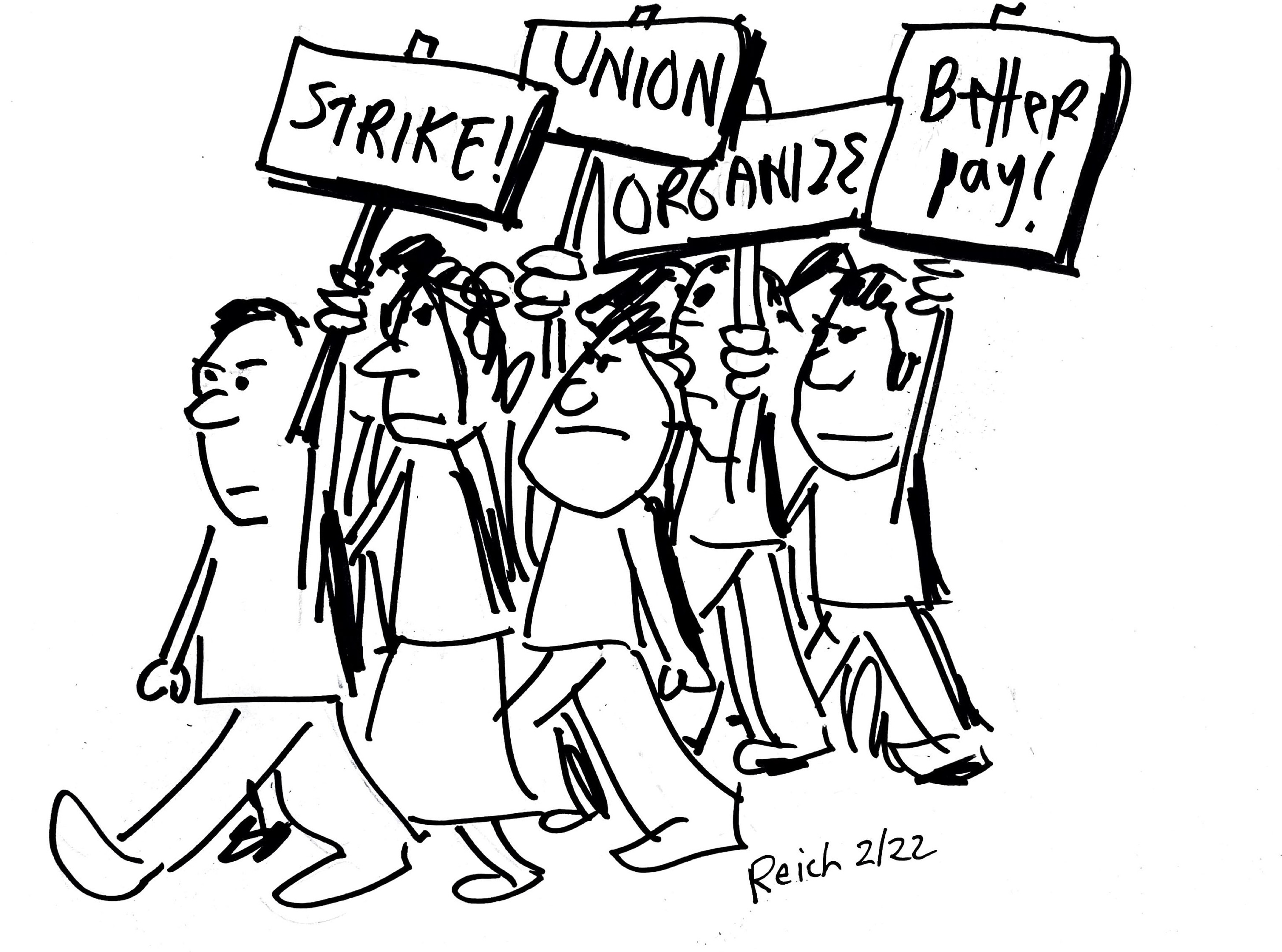
We are witnessing a historic rebirth of the labor union movement in America. Labor unions are not just an interest group. They are gaining the heft, solidarity, and passion to become what they once were — a movement. 

And it’s about time. 

For 30 years — from 1946 to the late 1970s — the American middle class expanded, largely because American labor unions won increases in wages and benefits that roughly tracked gains in overall productivity.

Non-union companies gave their workers similar raises because they knew they’d be targets of union organizing if they didn’t. 

As American workers produced more, they got paid more. It was America’s postwar social contract.

As unions gained leverage at the workplace, they also gained political power. Unions supported major federal laws — Medicare and Medicaid, the Civil Rights and Voting Rights Acts, the Family and Medical Leave Act. They became the major force countering the growing political power of large corporations.

But since the late 1970s, union power has been waning. As a result, the wages of production workers have been nearly stagnant, adjusted for inflation. And workers have lost pension benefits and job security. 

Think about it. More than four decades of near flat wages, even though the United States economy is now more than three times the size it was four decades ago. 

Where did the economic gains go? Mostly to the top. 

Whenever I bring this up, some people accuse me of being a class warrior. I’m not. I’m a class worrier. For years, I’ve worried about what would happen to America as the middle class continued to shrink and most of the economic gains went to the top. 

Well, I think we’re now seeing the results, as millions of Americans have grown so cynical and despairing about their chances to make it that they’re even willing to support an authoritarian sociopath for president. 

As the voices of workers became muted inside corporations, their voices also became muted in Washington. 

Why else would America enter into trade agreements that caused millions of working people to lose their jobs, without access to new ones paying them at least as much? Why else would entire regions of the nation be economically abandoned, without any concerted national effort to reverse the tide? 

More states fell for the snake oil of so-called “right-to-work” laws, which should be called “right-to-work-for-less” laws. 

Meanwhile, Wall Street was deregulated, allowing ever more of our economy to become dominated by the moneyed interests. 

To add insult to widespread injury, Wall Street was bailed out after it brought the world to the precipice of economic Armageddon. Millions of people lost their jobs, wages, and homes in the financial crisis, but not a single major Wall Street executive was charged with a crime. 

Corporate raiders got the right to mount hostile takeovers of companies and then demand bigger profits. And since payrolls comprise about two-thirds of corporate costs, the raiders forced corporations to limit wages and benefits.

To achieve this, corporations sought to bust unions — outsourcing jobs abroad and moving to “right-to-work-for-less” states. They also illegally fired workers who tried to organize — at worst getting their hands slapped by a National Labor Relations Board that might eventually order them to reinstate workers and give them back pay. 

Ronald Reagan legitimized all this when in 1981 he fired more than 11,000 striking air traffic controllers represented by the Professional Air Traffic Controllers Organization.

The result was a dramatic decline in the bargaining power of ordinary workers — both inside companies and in American politics. And with this decline came a shrinkage of the American middle class. It’s estimated that between 1979 and 2017, the typical U.S. worker lost out on $3,250 in pay every yeardue to the decline of unions. 

In the 1950s, over a third of all private-sector workers were unionized. Today, unionized workers comprise just 6 percent of private-sector workers (10 percent of all workers belong to a union, but many work in the public sector).

From 1946 through the early 1970s, unions staged hundreds of major strikes each year. Between 1981 and 2022, the number of major strikes dropped to a few dozen per year.

But here’s the good news: The pendulum is now starting to swing back.

It’s not just the UAW. Recent contracts negotiated by Hollywood writers, UPS workers, Kaiser Permanente health care workers, and even university employees, among others, provide significant pay increases and more job security (writers even got some protections against AI).

Last year’s union contracts gave workers an average first-year wage increase of 6.6 percent — the highest raise since at least 1988. With signing bonuses and other lump-sum payments added in, 2023’s average first-year wage increase was 7.3 percent, also a record high.

Overall, according to the Bureau of Labor Statistics, U.S. union membership grew by 191,000 workers last year — although the share of employees represented by a union fell slightly as strong job growth outpaced organizing efforts.

More good news: Most Americans are solidly behind unions. Approval of labor unions is near 70 percent, the highest point in five decades. At the same time, confidence in big business is at its lowest point in decades.

What accounts for this burst of labor activism and public support?

Partly, I think, it’s the harsh inequalities exposed by the pandemic. The pandemic dramatically revealed how much easier it is for rich Americans to survive than everyone else and how dependent all of us are on average workers just doing their jobs.

Couple this with the rise in populist politics in a system looking increasingly rigged against average people — starting with Bernie Sanders’s surprisingly strong showing in 2016, while Donald Trump posed as the “voice” of workers. 

Union victories have fueled a virtuous cycle — encouraging more workers to join unions and more unions to flex their muscles and demand wage hikes.

Then there’s the tight post-pandemic labor market, in which consumers are spending like gangbusters, the economy is surging, and employers worry about getting and keeping the workers they need.

Not the least is Joe Biden — the most pro-union president America has had in 60 years. And a National Labor Relations Board that’s the most pro-union board I’ve seen in decades.

“Congratulations to the workers at Volkswagen in Chattanooga, Tennessee, on their historic vote for union representation with the United Auto Workers,” Biden said Friday in a statement.

Don’t wait for Trump to say anything positive about what just happened in Chattanooga. 

Finally, both good news and a sign of how resistant corporations have become to unions: The share of non-union workers who would like to have a union at their workplace is far higher than the share who actually have a union representing them.

This is good news in terms of potential organizing drives. But it’s also evidence of the continuing effectiveness of corporate union-busting and the need for much stronger federal labor laws.

I believe the pendulum will continue to swing toward unions. Which means better wages and working conditions, a larger middle class, and laws and regulations that benefit the many rather than the few. And the possibility that America’s working class will return to the fold of the Democratic Party, where it belongs. 

At a time when there’s a lot to be disillusioned about, this is the clearest, most positive trend in America. 

Robert Reich. 

Americans Overestimate the Size of Minority Groups

 Americans Overestimate the Size of Minority Groups


Taylor OrthDirector of Survey Data Journalism

March 15, 2022, 3:23 PM GMT-7 

When it comes to estimating the size of demographic groups, Americans rarely get it right. In two recent YouGov polls, we asked respondents to guess the percentage (ranging from 0% to 100%) of American adults who are members of 43 different groups, including racial and religious groups, as well as other less frequently studied groups, such as pet owners and those who are left-handed. 

When people’s average perceptions of group sizes are compared to actual population estimates, an intriguing pattern emerges: Americans tend to vastly overestimate the size of minority groups. This holds for sexual minorities, including the proportion of gays and lesbians (estimate: 30%, true: 3%), bisexuals (estimate: 29%, true: 4%), and people who are transgender (estimate: 21%, true: 0.6%). 

It also applies to religious minorities, such as Muslim Americans (estimate: 27%, true: 1%) and Jewish Americans (estimate: 30%, true: 2%). And we find the same sorts of overestimates for racial and ethnic minorities, such as Native Americans (estimate: 27%, true: 1%), Asian Americans (estimate: 29%, true: 6%), and Black Americans (estimate: 41%, true: 12%).


Yougov poll.


https://today.yougov.com/politics/articles/41556-americans-misestimate-small-subgroups-population?redirect_from=/topics/politics/articles-reports/2022/03/15/americans-mises

Duane Campbell


Friday, April 19, 2024

Choosing Democracy: Republicans Attack Columbia University - and Win

Choosing Democracy: Republicans Attack Columbia University - and Win:   Republicans Attack Columbia University – and win   https://www.theguardian.com/commentisfree/2024/apr/18/columbia-university-congress-anti...

Tuesday, April 16, 2024

Sanders: A Complicated Political Situation

Sanders. A complicated political  situation. 

If you believe in democracy, if you believe in science, if you believe in justice and workers' rights, let me be very clear: The next several months will be the most important in modern American history.

Unfortunately, we are confronting a very difficult and complicated political situation. 

Earlier this week, the Wall Street Journal released a poll showing Trump leading in almost every swing state. He leads by 5 in Arizona, 3 in Michigan, 4 in Nevada, 3 in Pennsylvania, and is tied in Wisconsin.

If Trump wins even two of those states, it's game over. 

And I think sometimes we slouch off the idea that Trump can win. It's hard to imagine that someone who was such a menace to the working class of this country could be popular enough with them to win a second term -- especially after we all lived through his first. I also believe sometimes we don't think enough about just how bad it will be policy-wise if he is re-elected.

Take one issue for example: Climate change.

Trump does not believe in climate change.

So what does that mean? 

It means that not only all of the work we have done in trying to transform our energy systems away from fossil fuel will be undone, but every other country in the world is going to say “Hey if the second largest emitter in the world is giving up, than we're not going to do it either.”

And that really means dooming our kids and future generations to a very, very unhealthy, perhaps uninhabitable world. 

So you don't need to know anything more than that to understand how dangerous Trump is. 

But obviously the danger is much greater than just climate change.

Take another issue for example: American democracy.

Trump does not believe in, or care about, the future of American democracy. 

So what does that mean?

It means that if he wins, you can expect more extreme gerrymandering, more laws and regulations making it easier for billionaires to buy elections, more efforts to keep people of color and young people from the ballot box, more election workers being harassed and threatened, more refusing to accept the outcome of election results, more political violence and, as a result of his policies and lies, more and more people increasingly believing democracy itself does not work for them.

I happen to believe that what this really means is that if Trump wins, the almost 250-year experiment of American democracy is all but over. 

But obviously the danger is much greater than just that.

Trump has already tried to take away health care from tens of millions of people. He’ll try again in a second term.

Trump signed tax cuts where almost all the benefits went to the top 1 percent. He’ll try to make them permanent in a second term. 

Trump brags about appointing 3 justices to the Supreme Court who helped repeal Roe v. Wade. He and his supporters have escalated their attacks on women’s’ rights across the country. In a second term he’ll try for a national abortion ban.

Other issues like education, gun control, criminal justice reform, income and wealth inequality, the cost of prescription drugs, workers rights, LGBTQ rights and more will all move backward.

Bottom line: We have to appreciate how unbelievably severe this current moment is.

Many of us believe that while the Biden administration can lay claim to some significant accomplishments, they are simply not enough given the very serious crises facing the working families of our country. Further, millions of us strongly disagree with the President’s position on the war in Gaza. 

So what are we as progressives to do in this election? 

First, we must all acknowledge that sitting out this election or even voting for Trump is definitely not the answer. That leads to catastrophe.

So then what? 

In this unprecedented moment in American history we must make clear to the Democratic leadership and everyone else that we cannot return to the same old, same old establishment politics. 

We must make it clear that if Democrats are given another chance after this election we cannot continue to ignore the needs of tens of millions of working families. We cannot continue to accept a political system where billionaires buy elections and an economy which has more income and wealth inequality than at any time since the 1920s. We cannot accept a government where the very rich get much richer while a majority of Americans live in economic desperation. We must go further on climate change. And we must restore faith in American democracy.

We must make it clear that we will fight for a strong, progressive agenda that represents the needs of working people, and not just the billionaire class, lobbyists and wealthy campaign contributors.

How do we do that? 

It means supporting not just Joe Biden, but progressives who will fight for that agenda in Congress. It means donating, volunteering, posting on social media about your desire not just to beat Trump, but that your expectation for what a second term would look like for a Biden administration.

That is the work I will be doing over the course of the next several months, but it will take all of us to get it done. So I am once again asking for your financial support:


Bernie Sanders