Showing posts with label NAFTA. Show all posts

Sunday, January 13, 2019

Free Trade” Is Today’s Imperialism by the 1 Percent

PUBLISHED
January 13, 2019
Opposition to “free” trade is clearly growing — both the progressive and the corporate elements of the Democratic Party are now critical of agreements like the North American Free Trade Agreement and the Trans-Pacific Partnership. Less clear are the alternatives to free trade that might emerge. As progressives continue to build power inside and outside of the Democratic Party, we must clarify our understanding of the international political economy, and imagine and begin to build real alternatives to free trade. Building these alternatives must become an essential component of a more progressive US foreign policy
The conventional wisdom says that if you oppose free trade, you must support protectionism or economic nationalism. This is misleading. There is no such thing as “free” trade. People create all of the systems that govern our political economy. These systems inevitably favor certain human activities over others, and we can design them to act any way that we want. The important question is: For whom are trade policies “free”? Put another way: Who do trade policies favor?
Debunking “Free” Trade
“Free” trade is free only for capital owners: the plutocratic fewwho own and control multinational corporations. When countries enter into free trade agreements, the governments of both countries effectively agree that their laws will not favor businesses from their country over businesses from any other countries. The main way that free trade does this is by attempting to reduce all tariffs to as close to 0 percent as possible, to eliminate import quotas that countries can use to limit the amount and types of goods imported from specified countries, and to discourage countries from more directly subsidizing their own businesses. 
Read the entire piece:  https://truthout.org/articles/free-trade-is-todays-imperialism-by-the-1-percent/

Thursday, December 13, 2018

Oppose Nafta 2.0

better deal, please sign on here.  Thanks!  — Arthur


NAFTA 2.0 Doesn't Cut ItEarly next year, the U.S. International Trade Commission (USITC) will publish a formal report on expected impacts from the proposed North American Free Trade Agreement (NAFTA) revision.  This report will be used by Congress to make decisions about whether to support NAFTA 2.0 as written or to demand further changes.

TAKE ACTION: Please join us in urging that the official report on NAFTA 2.0 highlight its failure to include critical changes needed to protect jobs, raise wages and promote healthy communities.
Each week, NAFTA continues to destroy livelihoods across the continent.  Unfortunately, the revised NAFTA deal currently on offer would continue to facilitate the outsourcing of jobs, the suppression of wages and the dumping of toxins.  Among other problems, it also takes big steps backwards on access to medicine.

We need Congress to insist on substantive changes to the proposed text before there’s a real NAFTA replacement that working people can be happy about.  An accurate USITC report would help bolster that effort.

The USITC is now accepting official public comments on the NAFTA proposal.  Please sign onto our commentsurging the USITC to explicitly acknowledge that:
  • NAFTA 2.0’s lack of strong, easily-enforced labor and environmental standards has a real cost. Without such provisions, the revised NAFTA will continue to help big corporations move good-paying jobs to Mexico to take advantage of sweatshop wages, ongoing worker rights abuses and the ability to pollute with impunity.  
  • NAFTA 2.0’s expansion of pharmaceutical monopolies has a real cost. Worse than the original NAFTA, new language in the current proposal would lock-in bad policies that keep healthcare costs high in the United States, and make it harder for affordable, generic medicines to reach those who need them at home and abroad.  
  • NAFTA 2.0’s refusal to address climate change and end environmentally-destructive practices has a real cost.  Not only does the current text fail to even mention climate change, but it also contains special loopholes for some of the planet’s worst corporate polluters that would allow destructive practices to continue unchecked and could potentially undermine future attempts to tackle the climate crisis.

Monday, October 8, 2018

NAFTA, Neoliberalism, and Unions in Mexico

Independent unions have formed a new federation. They hope to win progressive labor law reform and finally end the reign of corrupt, pro-employer unions.
Jeffery Hermanson
October 4, 2018
Labor Notes
Independent unions have formed a new federation. They hope to win progressive labor law reform and finally end the reign of corrupt, pro-employer unions.

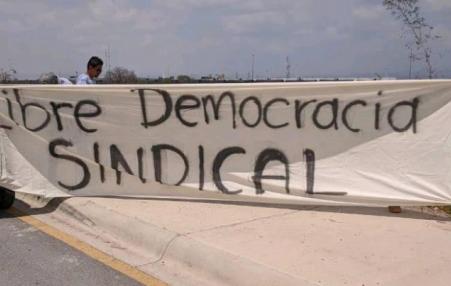
Workers hold a banner calling for union democracy outside a Goodyear tire factory in San Luis Potosí, Mexico. Goodyear dismissed 50 workers in July for trying to set up an independent union., Sindicato Independiente de Trabajadores de Goodyear México

The landslide victory of Andrés Manuel López Obrador (“AMLO”) in the Mexican presidential election in July has raised workers’ hopes for a revitalized and democratized labor movement.
Independent unions have formed a new federation. They hope to win progressive labor law reform and finally end the reign of corrupt, pro-employer unions.
The coalition led by AMLO’s National Regeneration Movement (MORENA) won not only the presidency but also the majority in both houses of the Mexican congress. Till now, the Institutional Revolutionary Party (PRI) had dominated Mexican politics for decades.
The pro-employer unions that make up Mexico’s main labor federation, the Congress of Labor (CT), especially the Confederation of Mexican Workers (CTM), have historically been part of the PRI’s popular base. Top union leaders were nominated as the party’s senators and congresspersons.
'PROTECTION UNIONS’
The CT unions are the largest in Mexico, representing around 10 percent of the formal workforce, though they have been in decline in recent years. These unions were enthusiastic cooperators in the low-wage neoliberal economic strategy adopted by the Mexican political and economic elite in the 1990s— including signing on to NAFTA. Their plan was to grow the Mexican economy by attracting U.S. and Canadian investors with cheap labor.
The CT unions have supported the government’s low-wage development strategy by signing sweetheart “protection contracts” with employers before any workers are hired. They use their relationships with employers and with the Mexican federal and state governments to prevent any real negotiations or strikes.
The absence of authentic worker representation in most sectors has kept Mexican workers’ wages low and even declining in real terms over the past decade. Meanwhile CT union leaders have grown incredibly wealthy through their corrupt alliances with employers and government.
Other practitioners of protection unionism are the “gangster unions” of the industrial belt surrounding Mexico City and the employer-controlled “white unions” of Monterrey, a center of industrial growth.
UNDERDOG UNIONS
In 1997, several unions broke with this trend and established a federation of independent and democratic unions, the National Union of Workers (UNT). Among them were the unions of telephone workers, social security workers, university workers, and Volkswagen workers.
The UNT has supported labor law reform, pushing for secret-ballot union representation elections, a public registry of union contracts, and workers’ right to vote on strikes and contract ratifications.
However, the UNT has remained a loose grouping unable to seriously challenge the domination of the corrupt CT unions.
Other unions broke with the CT but remained independent, notably the National Mineworkers and Metalworkers Union (Los Mineros). After a mining disaster in 2006 cost the lives of 65 miners, the union waged a bitter campaign against Mexico’s most powerful mining and rail conglomerate, Grupo México.
The company and the government then brought false charges of corruption against the union’s leader, Napoleon Gómez Urrutia, leading to his 12-year exile in Canada. There he was supported by the United Steelworkers, with whom Los Mineros have an affiliation agreement.
Now Gómez Urrutia has been elected senator on MORENA’s ticket and has returned to Mexico to take his seat—giving the independent labor movement a powerful voice in the Senate.
DISASTROUS POLICIES
The neoliberal economic model enshrined in NAFTA has been a disaster for the Mexican people. The rural economy collapsed, forcing millions to emigrate to the cities, the northern border, or the U.S.
Wages declined in both domestic industries and maquiladora (export) factories. Corruption and violence grew to unprecedented levels.
Little wonder then that the Mexican people defied the political establishment and media to vote for AMLO and MORENA, who have promised to end corruption and violence and to institute a transformation that puts poor and working people first.
As his Secretary of Labor, AMLO has appointed Luisa María Alcalde, a 31-year-old former federal legislator with close ties to the independent labor movement.
Alcalde has pledged to increase the minimum wage (currently $4.57 a day) and to work to pass labor legislation to outlaw protection contracts and implement much of the independent labor movement’s agenda.
In 2017, Mexico passed a reform of the labor provisions of the Mexican Constitution, under pressure from the Obama administration. The motive was to comply with International Labor Organization rulings against protection unionism in order to gain entry to the Trans-Pacific Partnership.
The reform calls for the elimination of the corrupt tripartite labor boards now dominated by the CT unions and employers, and for the establishment of independent labor boards as part of the judiciary.
However, the secondary legislation necessary to implement these reforms has yet to be passed.
AN INDEPENDENT FEDERATION
In July the three most important independent Mexican auto unions—at Volkswagen and Audi in Puebla, and Nissan in Morelos—announced they were joining with independent unions in auto parts, rubber, and aerospace to form a new industrial federation.
The Volkswagen, Audi, and Nissan unions are single-factory unions, each with several thousand members. The new federation aims to influence labor law reform and to bolster the growth of independent and democratic unions in the auto industry.
This is an important development. Auto, auto parts, tires, and aerospace together make up one of the biggest and most advanced industrial sectors of the Mexican economy. There are around 85,000workers in the country’s auto assembly plants and as many as 850,000 in parts and component suppliers.
The newly formed Independent Union of Goodyear Workers (SINTG) is a part of the new federation. Workers struck for a day at Goodyear’s six-month-old factory in San Luis Potosí in April to protest poor wages, benefits, and working conditions negotiated behind their backs in a protection contract signed in 2015, two years before the factory opened.
“We’ve never seen these so-called [union] representatives,” operator Francisco Javier Cuestas told global union federation IndustriALL. “They don’t know the first thing about us. Because we have nobody to speak for us, the company gets away with paying very low wages—less than a dollar and a half per hour—for what is very dangerous and difficult work.”
In July Goodyear fired 50 workers, allegedly in retaliation for forming an independent union.
Many of the unions in the new federation have gone through similar struggles. The federation is organizing solidarity support for the Goodyear workers for what is likely to be a long fight.
FIGHTING HARD
The role of the Volkswagen workers union (SITIAVW) in the new federation is important, given the union’s militant history and the fact that the Puebla plant is the largest manufacturing complex in Mexico.
Originally VW workers were forced to join a protection union established before the plant opened its doors. But they fought for decades against the corrupt CTM, and ultimately established their independence. The union requires secret-ballot votes for leadership, strike authorization, and contract ratification. It has waged militant strikes and negotiated the best wages and benefits in Mexico’s manufacturing sector.
Also important are Los Mineros, whose jurisdiction includes aerospace and auto parts. The union has aided efforts to form independent unions at auto parts manufacturers like Johnson Controls and PKC, and has won representation at a Bombardier subway car plant in Hidalgo.
One of the weaknesses of Mexico’s independent labor movement is that many of the unions are confined to single employers or single factories. In this new federation, the unions are joining together to influence national politics and to confront the auto industry, including its parts and component suppliers, with a united voice and the power of thousands of workers.
Jeff Hermanson is an organizer who has worked since 1977 with the ILGWU (later UNITE), Carpenters, Writers Guild, and AFL-CIO Solidarity Center. He is currently working with the International Union League, an organization of garment and textile unions in Asia, Latin America, and the Middle East.
For news on Mexico’s labor movement (in both English and Spanish), follow the Facebook page Mexico Labor Update.
A version of this article appeared in Labor Notes #475. Don't miss an issue, subscribe today.

Tuesday, October 2, 2018

Trump and the New Nafta


Trump and the new NAFTA

https://www.nytimes.com/2018/10/01/us/politics/nafta-deal-trump-canada-mexico.html?

Revised Nafta sets up a showdown with China. NYT: “A jubilant Mr. Trump celebrated the new Nafta agreement as the fulfillment of a bedrock campaign promise. He claimed it was a vindication of his aggressive use of tariffs and vowed to keep imposing them to extract deals from other trading partners, like the European Union and Japan. The updated Nafta, which will be called the United States-Mexico-Canada Agreement, or U.S.M.C.A., represents Mr. Trump’s biggest trade achievement to date, and it comes after more than a year of intense negotiations that frequently fell into personal rancor between Mr. Trump and the leaders of Canada and Mexico. Like some of Mr. Trump’s other accomplishments in business and government, the deal is partly a step forward and partly an exercise in rebranding. Canada will ease longstanding protections on its dairy market and provide access greater than what the United States would have gained through the Trans-Pacific Partnership, a trade treaty negotiated by President Barack Obama, from which Mr. Trump withdrew last year. The United States relented on its demand to eliminate an independent tariff dispute settlement system that Canada had said was a red line. Preserving it was a major concession for the United States, which had eliminated the mechanism, known as Chapter 19, as part of its deal with Mexico. The pact also makes a series of changes to areas like intellectual property and the digital economy, including protections for patents and domain names — all of which refresh Nafta, a 25-year-old pact that had become somewhat outmoded in the digital age. But many of these innovations were drawn from the Trans-Pacific Partnership, which included Canada and Mexico, and it prompted a senior Trump adviser to offer a rare endorsement of an Obama legacy achievement that Mr. Trump delighting in dismantling.”

Monday, October 1, 2018

New Trade Agreement is Not Better


#ReplaceNAFTAThe Trump administration just published proposed text for its renegotiated version of the North American Free Trade Agreement (NAFTA), and they've failed to make the critical changes needed to protect jobs, raise wages, defend human rights and reverse environmental damage.  

As much as the White House wants to spin the current deal as a win, a lot more work is needed before there’s a real NAFTA replacement that working families can be happy about. 

TAKE ACTION: 
Please urge your Members of Congress to insist on a comprehensive NAFTA replacement that puts working people and the planet ahead of corporate profits. 

Each week, NAFTA continues to destroy livelihoods across the continent.  Unfortunately, the deal currently on offer does not include the enforcement mechanisms needed for labor and environmental standards to prevent employers from moving jobs to areas where worker rights and environmental protection are routinely ignored.  

Without strong labor and environmental rules with swift and certain enforcement, Trump’s version of NAFTA will continue to facilitate the outsourcing of jobs, the suppression of wages and the dumping of toxins.  While steps forward have been made in other areas, a NAFTA replacement without this fundamental fix is a nonstarter.

In addition, Trump’s proposal is significantly worse than the original NAFTA on access to medicines.  The world needs trade policies that increase the affordability of life-saving medications — not ones that extend monopolies for pharmaceutical giants and raise healthcare costs.  

Monday, August 27, 2018

Fake News on NAFTA

NAFTA: More Fake News from Trump. The White House threw together a rushed announcement of a “preliminary” agreement with Mexico on auto industry tariffs and perhaps wages. This was conjured up on short notice to divert attention from Trump’s rising legal woes and the appalled reaction from legislators of both parties to his refusal to keep the White House flag at half-staff to honor Senator John McCain, who passed away on August 25.
What makes the NAFTA announcement fake? First, an agreement to raise slightly the North American content (from 62.5 percent to 75 percent) required to qualify autos for tariff-free import into the U.S. has always been the low-hanging fruit of the deal. It’s all the other provisions—on the environment, on the ability of corporations to sue in special tribunals to block regulations, on farm and energy provisions, and on myriad others, that have and continue to be the sticking points.
Second, there is no revised NAFTA deal on autos without Canada, and it’s not clear that Canada will agree to such a partial deal. Third, there is no such thing as a preliminary agreement—either NAFTA is renegotiated or it isn’t.
This is complex stuff, but not all that complex. Yet most of the press coverage has taken the White House announcement at face value. Have a look at The New York Times.
Not addressed were Trump’s steel and aluminum tariffs, or revisions in policies that compromise Mexico’s energy independence, a priority issue for Mexico’s new progressive president, Andrés Manuel López Obrador.
Besides diverting attention from other embarrassing Trump pratfalls, the NAFTA announcement was intended to peel off labor support. It didn’t work. Here is a statement just released from America’s leading industrial union officials:
We are aggressively engaged in pursuing an agreement that works for working people in all three countries, and we are not done yet. There is more work that needs to be done to deliver the needed, real solutions to NAFTA’s deeply ingrained flaws.
Any new deal must raise wages, ensure workers’ rights and freedoms, reduce outsourcing and put the interests of working families first in all three countries. And working people must be able to review the full and final text and have the confidence not only in the terms of the deal, but its implementation, monitoring and enforcement. We remain committed to working with the administration to get NAFTA right. Our members’ jobs depend on it. But, as always, the devil is in the details.
Richard Trumka, AFL-CIO President
Leo Gerard, United Steelworkers (USW) International President
Gary Jones, International Union, United Automobile, Aerospace and Agricultural Implement Workers of America (UAW) President
Robert Martinez Jr., International Association of Machinists and Aerospace Workers International President
Chris Shelton, Communications Workers of America President
Don’t expect a real NAFTA breakthrough any time soon, and don't fall for Fake Trump News. Now, back to the special counsel. That's real. ~ ROBERT KUTTNER
August 27, 2018
Citizens Trade Campaign
ReplaceNAFTA
If you've already signed, you can make an even bigger difference by forwarding this request to others!
Trade negotiators from the U.S. and Mexico announced they’ve come to a basic understanding on how to revise the North American Free Trade Agreement (NAFTA) — but labor allies who have seen some of the secret texts are warning that, “There is more work that needs to be done to deliver the needed, real solutions to NAFTA’s deeply ingrained flaws."

Thursday, November 2, 2017

What is NAFTA ?

NAFTA, passed by the U.S. Congress in  1994,  has produced  massive migrations of exploited workers, refugees, displaced farmers, and  agricultural workers, as a result of an  unjust global political and economic system ( neo liberalism) that works for the benefit of transnational corporations and at the expense of working people. Most of the jobs created in Mexico come without benefits and without a written contract.  Salaries in Mexico today are lower than they were when NAFTA was signed.
Much of the current wave of migration to the United States from
Mexico, Central America, and the Caribbean can be traced to NAFTA , CAFTA, and other unjust “free trade” agreements that enabled subsidized U.S. agribusiness to flood these societies with cheap produce, destroying the livelihoods of millions of small farmers and other rural workers.
            NAFTA created a loss of over 680,000  jobs in the U.S. and over a million jobs in Mexico. People who lost their jobs moved to the cities or to the U.S. producing immigration.  NAFTA was a trade agreement for the corporations.  U.S. owned transnational corporations, including  Ford, Chrysler, Apple, and more eliminated jobs in the U.S. and moved these jobs to other nations where labor was cheaper.

Wednesday, October 26, 2016

Tom Hayden on NAFTA

Instead of NAFTA’s corporate escape from New Deal-style regulation, the new agenda would be an extension of the most progressive elements of the New Deal to global society, a new social contract in place of market fundamentalism. Globalization from the bottom up. Instead of NAFTA-style agreements that solely protect foreign investors, this alternative model would offer enforceable protections to workers, women and the environment as well–on both sides of the border. Instead of sweatshops and child labor there would be unions and literacy programs. Instead of damming rivers and slashing rainforests, there would be conservation programs for future generations.

2001