Showing posts with label capitalism. Show all posts

Monday, March 11, 2024

Trump, Capitalism, and the 2024 Election _ Reich

 Trump, American Capitalism, and the 2024 Election.

Robert Reich,

The Common good.  A book by Reich, 

At the first rally of his 2024 election campaign on March 25 in Waco, Texas — exactly 30 years after a deadly siege between law enforcement and the Branch Davidians resulted in the deaths of more than 80 members of that religious cult and four federal agents — Trump opened with a choir of men imprisoned for their role in the January 6 insurrection singing “Justice for All.” 

Their singing was interspersed with the national anthem and with Trump’s reciting the Pledge of Allegiance, his hand on his heart. Behind, projected on big screens, was footage from the Capitol riot.

Trump then repeated his bogus claim that the 2020 presidential election was “rigged.” He praised the rioters of January 6. He raged against the prosecutors overseeing multiple investigations into his conduct as “absolute human scum.” He told the crowd that “the thugs and criminals who are corrupting our justice system will be defeated, discredited and totally disgraced.”

Then he declared:

“Our enemies are desperate to stop us and our opponents have done everything they can to crush our spirit and to break our will. But they failed. They’ve only made us stronger. And 2024 is the final battle, it’s going to be the big one. You put me back in the White House, their reign will be over and America will be a free nation once again.”

A cartoon of a person with orange hair

Description automatically generated

SINCE THEN, as indictments have piled up against him and his poll numbers among Republicans have risen, Trump’s “final battle” comes into ever sharper focus. 

It is a battle against the rule of law. It is a battle for the soul of America. It is a battle between democracy and neofascism. 

On an Iowa radio show, Trump warned it would be “very dangerous” if Special Counsel Jack Smith and Judge Tanya Chutkan put him in jail, since his supporters have “much more passion than they had in 2020.”

The Republican Party is uniting behind Trump’s side of this battle line. 

If not defending the January 6 rioters outright, Republican lawmakers are attacking Smith, the Justice Department, the Manhattan district attorney, and other current and prospective prosecutors seeking to hold Trump accountable.

Trump’s upcoming trial on charges of seeking to overturn the results of the 2020 election will make it harder for Republican candidates across the nation to run on their fake nemeses: “woke” teachers and corporations, trans youth, LGBTQ+ people, immigrants, and “socialism.” It will force them instead to defend Trump’s side in the final battle.

Those who care about democracy and the rule of law should welcome the battle, and not just because it will help Biden and the Democrats.

It will also help clarify what’s at stake for the nation in 2024 and beyond.

It will show how eager Trump and the Republican Party are to abandon democracy and the rule of law in order to gain power. It will show that the vast majority of Americans reject their position.

A drawing of cartoon characters

Description automatically generated

FOR THE LAST 10 WEEKS, we’ve been examining American capitalism and asking why the common good has been so difficult to achieve in recent decades. 

We’ve seen that American capitalism is one of the harshest forms of capitalism on the planet. Its safety nets are in shreds. Its promise of equal opportunity has given way to deep cynicism and distrust toward all the major institutions of American society. 

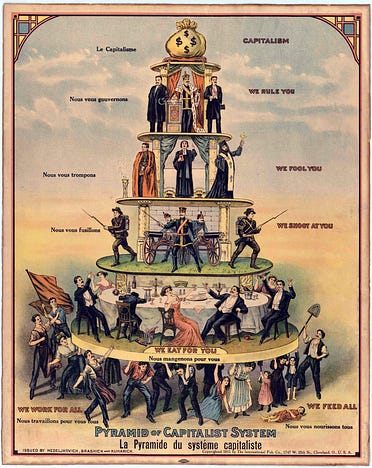
We’ve also examined the reason for this. The moneyed interests — large corporations, Wall Street financiers, and ultra-wealthy individuals — have taken over much of our politics and media. They want Americans to be divided, to fight each other, so we don’t look upward and see where all the wealth and power have gone. 

At the same time, the countervailing powers that once balanced the moneyed interests have all but disappeared. 

Most obviously left behind have been Americans without college degrees who tend to live in rural areas, who are white and more religious and older than the typical American. As the heartland has been hollowed out — denuded of industry and good jobs — they have been the first casualties. As such, they’ve been particularly susceptible to Trump’s lies and Fox News’s propaganda, and the angry and often bigoted politics they’ve spawned. 

But these Trumpers are far from the only casualties. Most Americans now live paycheck to paycheck. They have no job security. No pension. Little or no child care or elder care. They worry about affording to send their kids to college. They’re reluctant to see a doctor because, even with health insurance, they pay through the nose. 

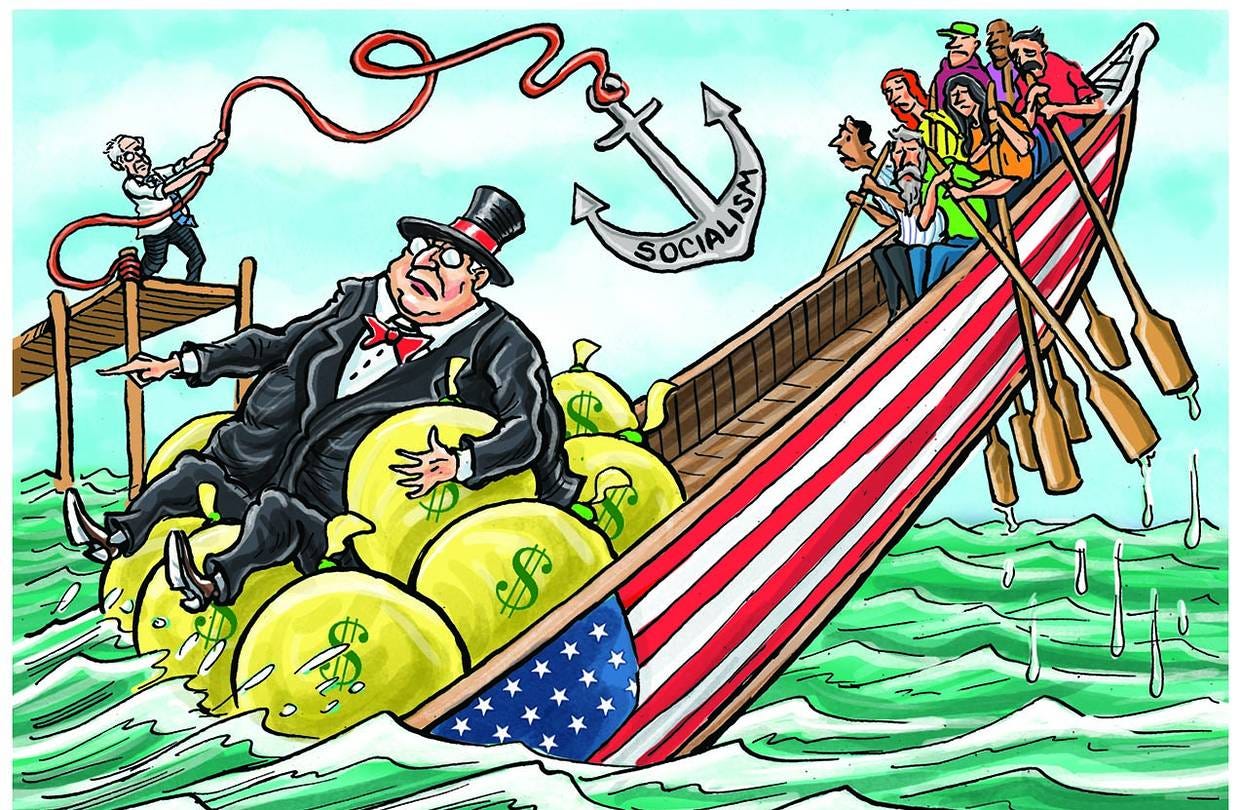
A cartoon of a person holding money bags

Description automatically generated

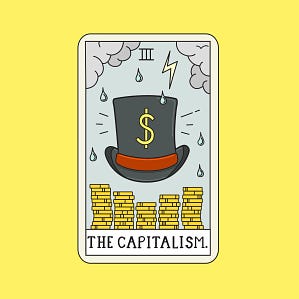
AMERICAN CAPITALISM once considered the employees and host communities of businesses “stakeholders” — equal in importance to shareholders. As the economy grew, so did wages and benefits, as did the prosperity of the communities where corporations were founded and grew. 

But in the 1980s, corporate raiders transformed the purpose of the corporation into being exclusively and obsessively about maximizing shareholder returns. 

At the same time, and partly as a result, corporations lobbied for trade treaties that allowed them to outsource jobs abroad. They busted unions. They monopolized their markets. They moved to where they could find the lowest wages and biggest tax subsidies. 

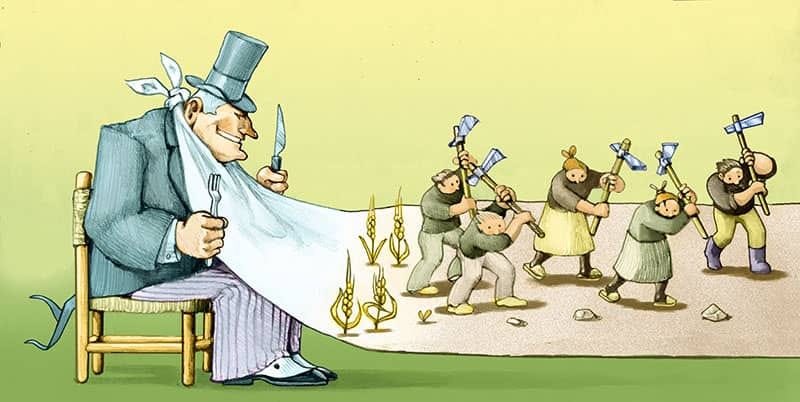
Accordingly, shareholder capitalism siphoned off the economic gains to a relatively small group at the top. 

The Democratic Party — and Democratic presidents Carter, Clinton, Obama, and Biden — have been far better than their Republican counterparts in seeking to resist these forces, but they have not succeeded. 

They have not established a new countervailing power. They have not called out the moneyed interests, on which too many have relied for campaign financing. They have allowed too many Americans to be left behind. 

Donald Trump has exploited this void with anger, vengeance, bigotry, and lies. 

So now we come to the final battle. 

A green dragon with red spikes and sharp teeth

Description automatically generated

AS A KID I WAS ALWAYS a head shorter than other boys, which meant I was bullied — mocked, threatened, sometimes assaulted. 

Childhood bullying has been going on forever. But over the last four decades, America has developed a culture of bullying that’s fiercer than anything I experienced as a kid. 

Wealthier Americans bully poorer Americans. CEOs bully their workers. People with privilege and pedigree bully those without. White people bully people of color. Authoritarian leaders (Putin, Xi, Modi, Netanyahu) bully ethnic and religious minorities. Men bully women. People born in America bully immigrants. 

Sometimes the bullying involves physical violence, but more often it entails intimidation, displays of dominance, demands for submission, or arbitrary decisions over the lives of those who feel they have no choice but to accept them. 

At its core, bullying is about power — typically the power of those who are rich, white, privileged, or male, or all of the above, to threaten and intimidate those who are not.

At some point, those who are bullied will fight back. 

I remember the exact day I did, when I had had enough. I was 10 years old. One morning when I was waiting for the school bus, a local bully started shaking me down. He wanted my lunch box and the change in my pocket. He began threatening me physically, as he had done several times before. I felt the rage well up inside me. I put down my lunch box and let him have it.

Trump is America’s bully-in-chief. He exemplifies those who use their wealth to gain power and celebrity, harass or abuse women and get away with it, lie and violate the law with impunity, and rage against anyone who calls them on their bullying. 

Trump became president by exploiting the anger of millions of white working-class Americans who for decades have been economically bullied. Even as profits have ballooned and executive pay has gone into the stratosphere, workers have been hammered. Their pay has gone nowhere, their benefits have shrunk, their jobs are less secure, their health has worsened. 

Trump has used this anger to build his political base, channeling their frustrations and anxieties into racism and nativism. He has encouraged Americans who have been bullied to feel more powerful by bullying people with even less power — poor Black people, Latinos, immigrants, Muslims, families seeking asylum.

This bullying game has been played repeatedly in history by self-described strongmen who pretend to be tribunes of the oppressed by scapegoating the truly powerless. 

Trump is no tribune of the people. He and his enablers, mostly but not exclusively in the Republican Party, work for the oligarchs — cutting their taxes, eliminating regulations, allowing some of them to profit off public lands and coastal waters, and slashing public services.

Eventually those who are bullied will gain the courage to fight back and reclaim economic and political power. 

A person in an orange shirt

Description automatically generated

AMERICANS HOLD DIFFERENT VIEWS about many things, but most of us oppose authoritarianism. We reject fascism.

We value the Constitution and the Bill of Rights. We are committed to democracy, even with its many flaws. We support the rule of law.

We want to live in a nation where no one is above the law. We want to be able to sleep at night without worrying that a president might unleash armed lackeys to drag us out of our homes because he considers us to be his enemy.

The pustule of Trump has been growing since 2016, but the authoritarian impulses underlying this infection have been allowed to fester for decades.

It is time to lance this boil. 

It is time to decisively rescue democracy and the rule of law. It is time to defeat Trump and his enablers, who are determined to defy the core values of America. 

It is also time to craft a capitalism that works for the many rather than the few — to achieve a common good whose benefits are widely shared. American capitalism does not have to be as rotten as it is. It can be reformed. 

This second goal of reforming American capitalism cannot be separated from the first. The common good can thrive only when the rule of law is powerful and democracy is strong. 

Trumpism can be overcome totally and finally only when American capitalism works for the many, not the few. 

Understanding what is happening and why is a prerequisite for positive change. But the change must come from the people — from you and me and millions of other Americans. In order for real change to occur, the locus of power in the system will have to change as well. 

I’m hopeful. Despite the anger, fear, and bigotry released by Trump, I believe we will come out of this stronger, more united, more sure of our ideals. 

The arc of American history shows that when privilege and power conspire to pull us backward, we rally and move forward. Sometimes it takes an economic shock like the bursting of a giant speculative bubble. Sometimes we reach a tipping point where the frustrations of average Americans turn into action. 

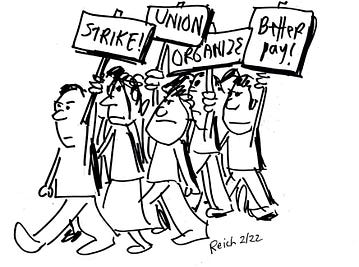
Look at the progressive reforms between 1900 and 1916; the New Deal of the 1930s; the civil rights struggle of the 1950s and 1960s; the widening opportunities for women, minorities, people with disabilities, and LGBTQ+ people; the environmental reforms of the 1970s and more recently under Joe Biden; and the recent resurgence of labor activism.

Look at the startling diversity of younger Americans. Most Americans now under 18 years old are Hispanic, Asian or Pacific Islander, African American, or of more than one race. In a very few years, most Americans under 30 will be. In fewer than three decades, most of America will be. 

That diversity will be a huge strength. Hopefully, it will mean a more tolerant, less racist, less xenophobic society. 

Our young people are determined to make America better. I’ve taught for more than 40 years, and I’ve never taught a generation of students as dedicated to public service, as committed to improving the nation and the world, as is the current generation. Another sign of our future strength.  

Meanwhile, most college students today are women, which means even more women will be in leadership positions in coming years — in science, politics, education, nonprofits, and corporate suites. That will also be a great boon to America.

As I tell my students, we are the leaders we’ve been waiting for. The future is up to us. 

This concludes my 10-week series on capitalism and the common good. But it’s really just the beginning of our work together toward a better and more just society. 

Thank you for joining me. I urge you to add your comments, take part in our discussion, and share with others.

Also, if you are able, please consider a paid or gift subscription. Subscribers to this newsletter keep it going.



Monday, December 4, 2023

Thursday, November 9, 2023

Reich: What Is Wrong With American Capitalism?


Friends,

Do you recall a time when the income of a single schoolteacher or baker or salesman or mechanic was enough to buy a home, have two cars, and raise a family? I do. 

In the 1950s, my father, Ed Reich, had a shop on the main street, from which he sold women’s clothing to the wives of factory workers. He earned enough for the rest of us to live comfortably. We weren’t rich but never felt poor, and our standard of living rose steadily through the 1950s and 1960s. 

That used to be the norm. For three decades after World War II, America created the largest middle class the world had ever seen. During those years the earnings of the typical American worker doubled, just as the size of the American economy doubled. Over the last thirty years, by contrast, the size of the economy doubled again but the earnings of the typical American went nowhere.  

Then, the CEOs of large corporations earned an average of about twenty times the pay of their typical worker. Now they get substantially over two hundred times. In those years, the richest 1 percent of Americans took home nine to ten percent of total income; today the top 1 percent gets more than twenty percent. 

Then, the economy generated hope. Hard work paid off, education was the means toward upward mobility, those who contributed most reaped the largest rewards, economic growth created more and better jobs, the living standards of most people improved through their working lives, our children would enjoy better lives than we had, and the rules of the game were basically fair.

But today all these assumptions ring hollow. Confidence in the economic system has sharply declined. The apparent arbitrariness and unfairness of the economy have undermined the public’s faith in its basic tenets. Cynicism abounds. To many, the economic and political system seems rigged. 

THE THREAT TO CAPITALISM is no longer communism or fascism but a steady undermining of the trust modern societies need for growth and stability. When most people stop believing they and their children have a fair chance to make it, the tacit social contract societies rely on for voluntary cooperation begins to unravel. In its place comes subversion, small and large – petty theft, cheating, fraud, kickbacks, corruption. Economic resources gradually shift from production to protection. 

The nation becomes susceptible to demagogues such as Donald Trump. 

We have the power to change all this, recreating an economy that works for the many rather than the few. But to determine what must be changed, and to accomplish it, we must first understand what has happened and why.

For a quarter century, I’ve offered in books and lectures an explanation for why average working people in advanced nations like the United States have failed to gain ground and are under increasing economic stress: Put simply, globalization and technological change have made most of us less competitive. The tasks we used to do can now be done more cheaply by lower-paid workers abroad or by computer-driven machines.

My solution has been an activist government that raises taxes on the wealthy, invests the proceeds in excellent schools and other means people need to get ahead, and redistributes to the needy.  These recommendations have been vigorously opposed by those who believe the economy will function better for everyone if government is smaller and if taxes and redistributions are curtailed.

WHILE THE STANDARD EXPLANATION for what has happened is still relevant, it overlooks a critically important phenomenon: the increasing concentration of political power in a corporate and financial elite that has been able to influence the rules by which the economy runs.  

And the governmental solutions I have propounded, while I think still useful, are in some ways beside the point because they take insufficient account of the government’s more basic role in setting the rules of the economic game. 

Worse yet, the ensuing debate over the merits of the “free market” versus an activist government has diverted attention from several critical issues: how the market has come to be organized differently from the way it was a half-century ago, why its current organization is failing to deliver the widely shared prosperity it delivered then, and what the basic rules of the market should be.

The diversion of attention away from these issues is not entirely accidental. Many of the most vocal proponents of the “free market” -- including executives of large corporations and their ubiquitous lawyers and lobbyists, denizens of Wall Street and their political lackeys, and numerous multi-millionaires and billionaires -- have for many years been actively reorganizing the market for their own benefit, and would prefer these issues not be examined.  

MARKETS DEPEND for their very existence on rules governing property (what can be owned), monopoly (what degree of market power is permissible), contracts (what can be exchanged and under what terms), bankruptcy (what happens when purchasers can’t pay up), and how all of this is enforced.

Such rules do not exist in nature. They must be decided upon, one way or another, by human beings. These rules have been altered over the past few decades as large corporations, Wall Street, and wealthy individuals have gained increasing influence over the political institutions responsible for them.

Simultaneously, centers of countervailing power that between the nineteen-thirties and nineteen-eighties enabled America’s middle and lower-middle classes to exert their own influence -- labor unions, small businesses, small investors, and political parties anchored at the local and state levels -- have withered. 

The consequence has been a market organized by those with great wealth for the purpose of further enhancing their wealth. This has resulted in ever-larger upward distributions inside the market, from the middle class and poor to a minority at the top. Because these distributions occur inside the market, they have largely escaped notice.

The meritocratic claim that people are paid what they are worth in the market is a tautology that begs the questions of how the market is organized and whether that organization is morally and economically defensible. In truth, income and wealth increasingly depend on who has the power to set the rules of the game.

CEOs of large corporations and Wall Street’s top traders and portfolio managers effectively set their own pay, advancing market rules that enlarge corporate profits while also using inside information to boost their fortunes. 

Meanwhile, the pay of average workers has gone nowhere because they have lost countervailing economic power and political influence. The simultaneous rise of both the working poor and non-working rich offer further evidence that earnings no longer correlate with effort. 

All of this has brought us Donald Trump and America’s lurch toward fascism. 

The solution is not less government. The problem is not the size of government but whom the government is for. The remedy is for the vast majority to regain influence over how the market is organized. This will require a new countervailing power, allying the economic interests of the majority who have not shared the economy’s gains. The current left-right battle pitting the “free market” against government is needlessly and perversely preventing such an alliance from forming.

The biggest political divide in America in years to come will be between the complex of large corporations, Wall Street banks, and the very rich that has fixed the economic and political game to their liking, and the vast majority who, as a result, have found themselves to be in a fix. 

The answer is not to give up on democracy. 

To the contrary, the only way to reverse course is for the vast majority who now lack influence over the rules of the game to become organized and unified, in order to reestablish the countervailing power that was the key to widespread prosperity five decades ago.

While I focus on the United States, the center of global capitalism, the phenomena I describe are increasingly common to capitalism as practiced elsewhere around the world, and I believe the lessons drawn from what has occurred here are as relevant to other nations. 

Although global businesses are required to play by the rules of the countries they do business in, the largest global corporations and financial institutions are exerting growing influence over the make-up of those rules wherever devised. And the cumulative frustrations of average people who feel helpless and powerless in the face of economies (and market rules) that are not working for them are generating virulent nationalist movements, sometimes harboring racist and anti-immigrant sentiments, as well as political instability in even advanced nations around the globe.

IF WE DISPENSE with mythologies that have distracted us from the reality we find ourselves in, we can make the system work for most of us — rather than for only a relative handful. 

History provides some direction as well as some comfort, especially in America, which has periodically readapted the rules of the political economy to create a more inclusive society while restraining the political power of wealthy minorities at the top. 

In the 1830s, the Jacksonians targeted the special privileges of elites so the market system would better serve ordinary citizens. In the late nineteenth and early twentieth centuries, progressives enacted antitrust laws to break up the giant trusts, created independent commissions to regulate monopolies, and banned corporate political contributions. In the 1930s, New Dealers limited the political power of large corporations and Wall Street while enlarging the countervailing power of labor unions, small businesses, and small investors.

The challenge is not just economic but political. The two realms — economics and politics — cannot be separated. Indeed, the field on which I draw used to be called “political economy” -- the study of how a society’s laws and political institutions relate to a set of moral ideals, of which a fair distribution of income and wealth was a central topic. 

The emergence of economics as a discipline distinct from political economy began in 1890 with the publication of Alfred Marshall’s Principles of Economics. The new discipline sought to identify abstract variables applicable to all systems of production and exchange, and paid little or no attention to the distribution of those resources or to a specific society’s legal and political institutions.

The study both of economics and of many other aspects of society thereafter began shifting from historically-specific political, moral, and institutional relationships to more universal and scientific “laws.” John Maynard Keynes’ General Theory of Employment, Interest, and Money (1936) dominated American economic policy from the end of World War II until the late 1970s.

After World War II, under the powerful influence of Keynesian economics, the focus shifted away from questions of politics and morals and toward government taxes and transfers as means of both stabilizing the business cycle and helping the poor. For many decades this formula worked. 

Rapid economic growth generated widespread prosperity, which in turn created a buoyant middle class. Countervailing power fulfilled its mission. We did not have to attend to the organization of the political economy or be concerned about excessive economic and political power at its highest rungs. Now, we do.

In a sense, then, these essays harkens back to an earlier tradition of inquiry, and a longer-lived concern. My optimism is founded precisely in that history. Time and again we have saved capitalism from its own excesses. I am confident we will do so again.

***

I urge you to add your comments, take part in our discussion, and share with others.

Thank you for joining me on this expedition. 

Subscribers to this newsletter are keeping it going. If you are able, please consider a paid or gift subscription. And we always appreciate your sharing our content with others and leaving your thoughts in the comments.

Sunday, March 20, 2022

Economics and Inequality - Piketty


The world’s foremost economist talks about wealth, inequality, and ideology. A video introduction. 


https://www.youtube.com/watch?v=g5Zb9Iu2wI0&t=1s


Nobody comes out of the womb a socialist, and Thomas Piketty, like the rest of us, was not born a socialist.  Socialists are made through life experiences, and the experiences that create socialists are unique to each of us even if there may be some common themes. 

In 2014, Piketty published an 800-page book, Capital in the 21st CenturyDespite its length and the fact that it was written by an economist, the book became a global best seller. It contained many ideas and proposals that socialists support, but Piketty did not define himself as a socialist.

Now he does. And his socialism is not dissimilar to that of many DSA members: it is opposed to hierarchies of domination based on gender, race, ethnicity, etc. It is a socialism that compels us to “change the economic system” by reducing inequalities and providing equal access to “education, employment and property, including a minimum inheritance for all, regardless of their origins” (p. 25). 

I think what made Piketty (and myself) a socialist is a long-time concern with inequality, especially wealth inequality and how to counter the overwhelming global power and planetary destructiveness of this concentration of wealth.  Let me be clear: Piketty does argue that wealth is less concentrated than perhaps it was in the “gilded age” of the late nineteenth century. But I believe – and I think he would agree – that the global concentration of wealth in the hands of no more than 2,500 people, a group – dare we say a global ruling class – that collectively holds more wealth than the global underclass of 4.6 billion, poses an existential challenge to humanity, and one that socialists must take on if we can have any hopes of “changing] the economic system.”  


https://www.dsausa.org/democratic-left/review-thomas-pikettys-time-for-socialism-dispatches-from-a-world-on-fire/

Bill Barclay.

Piketty in a video describes what he sees as the major ideological discussions of our time. 

In this interview he discusses what he thinks of the writing of Karl Marx.

https://www.dsausa.org/democratic-left/piketty/


Sunday, October 10, 2021

Background on Capitalism.

From Ken Cross's class 10 Major Crises in the U.S.

Top 10” U.S. Domestic Issues and Potential Solutions Seminar


  • Five myths about capitalism - Maybe greed isn’t so good.

https://www.washingtonpost.com/outlook/five-myths/five-myths-about-capitalism/2018/09/27/3f0b72f6-c06f-11e8-90c9-23f963eea204_story.html?utm_term=.7156e0e211f8


Myth No. 1 - Greed,  natural human instinct, makes markets work.


Myth No. 2 – Corporations must be run to maximize value for shareholders.


Myth No. 3 – Workers’ pay is an objective measure of economic contribution.


Myth No. 4 – Equality of opportunity is all people need to climb the economic ladder.


Myth No. 5 – Making the economy fairer will make it smaller and less prosperous.


By Steven Pearlstein - Steven Pearlstein, a Washington Post economics columnist and the Robinson professor of public affairs at George Mason University, is the author of “Can American Capitalism Survive?” September 28, 2018


SOLUTIONS for Wall Street and Capitalism Abuses:


  • What Should Be Done? Charles Ferguson - author of the Inside Job: The Financiers Who Pulled Off the Heist of the Century

Bring the financial sector under control:

  • Reform, and tightly regulate, compensation structures at the individual, corporate, and industry levels.
  • Break up the largest banks.
  • Greatly strengthen the power and political independence of regulation and white-collar criminal law enforcement.
  • Tax financial transactions.
  • Tax financial sector income fairly.
  • Close loopholes for activities such as “innovations” designed for tax avoidance or for betting against one’s own securities.

Natural result of proper re-regulation of the financial sector:

  • Reduce its size, concentration & political power.

Many benefits:

  • Increasing the supply of talented people for more productive activities.
  • Reducing the pressures for political corruption.


Control the impact of money on politics:

  • Lobbying and political contributions should be heavily taxed .
  • Government and regulator salaries should be raised sharply, in return for strict prohibitions on revolving-door behavior.
  • Some form of public campaign financing for political campaigns should be mandatory.


Reform the tax system:

  • Both the individual and corporate, so as to raise revenues, increase fairness, and mitigate against the forms of hereditary and financial oligarchies.
  • Extremely high estate taxes are one important element of this, as is the fair taxation of very high financial sector incomes.


Greatly strengthen antitrust policy and the regulation of corporate governance

  • Antitrust policy and analysis have fallen victim to corruption in two ways:
  1. The corruption of U.S. government policy through campaign finance, lobbying, and revolving-door hiring.
  2. The corruption of the economics discipline that supplies the economic analysis, and the personnel, behind antitrust decisions.

Ø  In the areas of industrial organization, regulation, corporate governance, and antitrust theory, the economics discipline doesn’t just need reform; it needs a five-organ transplant and a yearlong stay at a reeducation camp.

  • More generally, America needs to figure out how to keep large, mature industries from going the way of General Motors, U.S. Steel, AT&T, Microsoft, or for that matter Citigroup and Merrill Lynch, either by deep reforms in corporate governance, by breaking up large and stagnant companies, or by creating other mechanisms for new entry in mature industries.


Improve educational opportunity and quality is fundamental.

  • A country cannot compete economically, elect wise leaders, or call itself a fair society if it has a 25 percent school drop rate, or if only the wealthy can attend good schools. Here, there is a fairness issue that not even a bank CEO can openly deny. If there is one thing that nearly everyone can agree on, it is that all children deserve a fair chance. If a child is born in a poor area, or to drug-addicted parents, it isn’t the baby’s fault. And yet the way we handle school funding, child nutrition, foster care, and child poverty remain shameful, especially in the U.S., and if anything, threaten to become more so. Beyond this, a well-educated population yields a far happier, more prosperous society. As it stands, we are wasting a startlingly high fraction of our people, in ways that are painful and very expensive.


Create a truly universally accessible, high-speed broadband Internet infrastructure, both wireline and wireless.

  • Broadband deployment should be viewed in much the same terms that a government deploys a national road system. If anything, broadband deployment is more important than transport, as a way to decrease foreign strategy dependence, insure security, and reduce global warning.


  • The “Fatal Flaw:”: What was Alan Greenspan's flaw?

In congressional hearings in 2008 before a House committee chaired by Henry Waxman, Greenspan testified that he“made a mistake in presuming that the self- interest of organizations, specifically banks and others, were [sic] such that they were best capable of protecting their own shareholders and their equity in the ...Jun 16, 2011


  • Film:

·        Inside Job, Charles Ferguson, 109 min. ISBN 43396 36916 10/8/2010 Academy Awards Best Documentary 2010

·        Inside Job (2010 Full Documentary Movie) YouTube > https://www.youtube.com/watch?v=T2IaJwkqgPk 

  • Books:

·        Inside Job: The Financiers Who Pulled off the Heist of the Century by Charles H. Ferguson (Oneworld Publications) 2012 ISBN: ISBN-10: 185168915X ISBN-13: 978-1851689156 384 Pages ISBN-13: 978 

Wednesday, February 24, 2021

Neoliberal Capitalism- A ( very) short history

 Definition.  Neoliberal Capitalism 


In addition to an economic policy, neoliberalism is also a political project.


Important components of neoliberalism are the consideration of the market as a pre eminent process of decision making. Markets are privileged and regulations or rules on trade and commerce are opposed.  Advocates of neoliberalism promote cutting public expenditures such as schooling and health care and social services. The promote deregulation of markets such as eliminating the Glass- Steagalls limits on banking and deregulation of any practice that produces profits for some. 


In many places they promote privatization of state owned enterprises through private investment, including energy companies, utilities, and similar companies.  


1.    The Rule of the Market which liberates “free” enterprise from any bonds (regulations) imposed by the government no matter how much social damage this causes. 

2.    Cutting Public Expenditures for social services such as education and health care.

3.    Deregulation of any policies, practices or laws that could diminish profits, including environmental protection and worker safety. 

4.    Privatization of state owned enterprises, goods, and services through sales to private investors

5.    Eliminating the Concept of “The Public Good” or “Community” and replacing it with “individual responsibility.” (Martinez & Garcia, 2000) 

6.    Assaults on labor unions. 


Based upon Gorlewski & Gorlewski, 2012


*The adoption of neo liberal policies by main stream Democrats helps to explain the anger of a portion of the White working class and their abandonment of the Democratic Party. 


Recent history of  neoliberal capitalism. 


How neoliberal capitalism worked.


·       Prior to the 1970’s 


A. Following the Great Depression, American workers enjoyed a social contract with a strong central government guided by Keynesian economic policy and an expanding industrial base with a global reach. By the 1950s, manufacturing was almost 30% of GDP. Industrial communities were stable and vibrant.


·       B. The private sector—with government support—oversaw the development of our industrial base, making the decisions on what sectors to develop and retain, the products to produce, the use of technologies, and the terms of engaging the labor market.


·       C. The labor movement and the government provided a more equitable distribution of wealth as well as good working conditions. The underlying assumption of that era was that the drive for profit and the private accumulation of wealth would be a tide that would lift enough boats to sustain political and economic stability as well as ensure global dominance.

1947- 1979


Neoliberal capitalism 2. 

  1980 – Present 


·       A. With the emergence of new information technologies, opportunities to generate high rates of profit in the short term dramatically expanded. Capital maximized profits by globalizing production. 

·        

·       B. Powerful sections of the financial community along with owners and managers of the manufacturing sector unilaterally violated the social contract. They abandoned their home communities and their stewardship of the productive sector that had been the bedrock of our society. This resulted in the closing of thousands of companies and the loss of millions of good manufacturing jobs.


C. The neoliberal strategy included blaming labor and demanding concessions in wages, benefits, and working conditions. Government complicity in the destruction of our industrial base was framed by President Reagan as “government [needs] to get out of the way of the private sector.”


D. Extreme growing inequality as shown in graphs and the videos.