Dissent's Fall 2019 issue, with a special section,
Left Paths in Rural America, is out October 7.
Subscribe to get your copy.
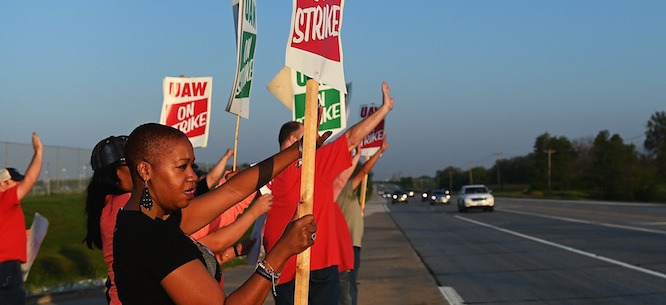
For almost one week, 49,000 General Motors (GM) workers have been on strike. The strike could have a big impact on U.S. politics and work life, but if so, it will have to break with the patterns of conflict and accommodation so long entrenched in a once iconic industry.
A General Motors strike used to send shock waves throughout the economy. In the fall of 1970 when 400,000 members of the United Auto Workers (UAW) shuttered nearly 100 GM factories for more than two months, the U.S. economy shrank by more than 2 percent, forcing President Nixon and his advisors to contemplate wage and price controls, eventually imposed in August of 1971. In those days, the U.S. auto industry was unquestionably one of world capitalism’s “commanding heights,” and General Motors the biggest and most emulated large corporation in the industrialized world.
Today the UAW has once again shut down General Motors, still the largest North American producer of automobiles. But if the workers on the picket line are to have a large impact on the U.S. economy, it will come in the realm of politics, policy, and culture, and not through economic leverage. GM is still a profitable auto corporation, but much diminished, and its thirty-three manufacturing plants (and twenty-two parts distribution warehouses) are concentrated in Michigan, Ohio, and Indiana.
General Motors had sales of $147 billion last year, but the company has been shrinking for decades. It produces 17 percent of all vehicles in the United States, down from nearly 28 percent a couple of decades ago. For more than half a century it was the largest company in the nation and owned the number one spot on the Fortune 500 list of big corporations; today it stands at number thirteen behind Walmart, Exxon-Mobil, Apple, Amazon, and even Ford, its century old rival. GM went bankrupt in 2008 and had to be bailed out by the government. On a world scale, Volkswagen and Toyota sell more cars.
Unfortunately, the UAW is also much diminished from the days when President Walter Reuther could declare the million-member auto union the “vanguard in America.” (Knowing radicals, including an admiring C. Wright Mills, appreciated the Leninist flavor inherent in that phrase.) Factory closings, auto imports, and a general failure to organize new workers have reduced UAW membership in the auto industry to less than 200,000; the union’s official membership stands somewhat higher only because it has been able to organize a variety of other workers, including teaching assistants in California and some Midwestern state employees. The main problem—a truly existential one—has been the inability of the UAW to make inroads among the hundreds of thousands of Americans who work in the “transplant” parts and assembly plants that Toyota, Nissan, Honda, Kia, VW, Mercedes-Benz, and other foreign-based firms have built in Kentucky, Tennessee, Alabama, Mississippi, and elsewhere in the mid-South. Fully half of all U.S. auto production is today non-union, a crippling debility for a labor organization that seeks to raise the general wage level in its industry, and a potent competitive argument that GM and Ford can hurl at UAW negotiators when they seek redress for a decade of plant closings and wage stagnation.
And then there is the corruption scandal that is destroying the credibility of the UAW leadership. At least six UAW officials have been charged with or convicted of graft, and last month the FBI searched the houses of President Gary Jones and former President Dennis Williams. Jones has been conspicuously absent from strike leadership; more consequential, reports the always well-informed Labor Notes, has been the failure of the UAW to really prepare the membership for a strike. There were few meetings or bulletins designed to keep members in the bargaining loop; not a button was distributed in the plants and there was little outreach to the public.