Showing posts with label Keynes. Show all posts

Friday, July 30, 2021

Keynes, the economy, and the Democrats


July 30, 2021

By Paul Krugman, NYT. Opinion, 

So Joe Biden appears to have his bipartisan infrastructure deal. Of course, progressives will be bitterly disappointed if that’s the end of the story. But it probably won’t be. In the end, Democrats will probably pass a second bill through reconciliation, adding several trillion dollars in “soft” investment — especially spending on children, which almost surely will have bigger economic payoffs than repairing roads and bridges, important as that is.

But today’s newsletter won’t be about legislative maneuvering. Instead, I want to talk about a funny thing that has happened to economic policy debate, detailed in a recent article by Jim Tankersley. Suddenly, Republicans have become Keynesians, while Democrats are talking about the supply side.

Traditionally, Democrats sought to justify big spending plans, like the Obama stimulus, by arguing that they were needed to boost demand in a weak economy. This was even true to a limited degree about the arguments made for the American Rescue Plan, the $1.9 trillion package Biden got enacted soon after taking office — although as its name suggests, the plan was pitched largely as disaster relief rather than as Keynesian stimulus.

Republicans, by contrast, derided Keynesian arguments. In the aftermath of the 2008 financial crisis, they called for cutting spending, not increasing it, buying fully into the doctrine of “expansionary austerity” — the claim that spending cuts would actually increase demand by inspiring confidence (or as I put it, they believed in the confidence fairy).

When justifying their own plans for tax cuts, Republicans generally didn’t argue that those cuts would increase demand. Instead, they invoked supposed supply-side effects: Reduced taxes, they claimed, would increase incentives to work and invest, expanding the economy’s potential. Democrats generally ridiculed these claims.

Continue reading the main story

For what it’s worth, the evidence suggests that Democrats were right and Republicans wrong on both counts. The case for expansionary austerity was overwhelmingly refuted by experience, especially in the euro area, while the Keynesian multiplier-type analysis was vindicated. Supply-side economics has yet to offer a single convincing success story; the underwhelming results of the 2017 Trump tax cut are just the latest entry in an unbroken record of failure.

But a funny thing has happened. Republicans are now warning that Biden’s spending plans will cause the economy to overheat, feeding inflation — which is basically a Keynesian position, although it’s being used to argue against government expenditure. I guess the confidence fairy has left the building. Or maybe G.O.P. economics is situational — Keynesian or not depending on which position can be used to argue against Democratic spending plans.

Democrats, on the other hand, are arguing that their spending plans, while partly about social justice, will also have positive supply-side effects, raising the economy’s long-run potential.

What can we say about these claims on each side?

Concerns that Biden’s long-term spending plans will pump up demand in an economy that we hope will already be more or less at full employment aren’t entirely silly. It is, however, important to bear three things in mind.

Continue reading the main story

First, while the numbers being talked about are big, they’re 10-year spending plans, so annual spending will be in the hundreds of billions, not trillions — and the U.S. economy is very big. Here’s the Congressional Budget Office’s projection of potential G.D.P. over the next decade:


It’s a big, big, big, big economy.FRED

That cumulates to $295 trillion over the next 10 years, so even $4 trillion of spending is only 1.3 percent of G.D.P.

Continue reading the main story

ADVERTISEMENT

Second, the spending will be paid for with taxes to a considerable extent, so that net stimulus will be smaller than the headline numbers. It’s true that the pay-fors are likely to involve a lot of smoke and mirrors, and if that isn’t the most budget wonk thing I’ve ever written, I don’t know what is. Still, the “fiscal impulse” probably won’t be very big. And though we obviously don’t have details on most of what is likely to happen, we can look at the projected year-by-year deficit effects of the Biden budget proposal from earlier this year:


Not that stimulative.Office of Management and Budget

Even at its peak, this is a much smaller stimulus than the American Rescue Plan, which was around 8 percent of G.D.P.

Finally, there’s good reason to argue that the U.S. economy needs sustained fiscal stimulus, even at full employment. The argument for secular stagnation — persistent weakness of demand, so that interest rates are very low even in good times — remains strong. This prospect raises concerns about future economic management: The Fed probably won’t have enough room to cut rates to fight off future recessions. So some persistent deficit spending to give the Fed more room to act would actually be prudent.

In fact, I’ve said on a number of occasions that I’m concerned that Biden is being too fiscally responsible, that we could do with more deficit spending going forward than he seems to want.

Overall, then, the Republican case that Biden’s proposals are dangerously inflationary — while not as bad as some of what comes out of that party — is pretty weak.

What about supply-side economics, Democrat-style? Unlike Republicans, who have consistently promised economic miracles that never arrive, Democrats are being very cautious about their supply-side claims. Nonetheless, progressive economists believe that there will be large long-term payoffs to spending more on infrastructure, research and especially aid to children.

And they expect fairly quick results if the reconciliation bill includes “family-friendly” policies like paid parental leave and child care, which they believe would increase female participation in the paid work force. I suspect that most Americans have no idea how much we’ve fallen behind on that front relative to other advanced countries with policies that make it easier for mothers to maintain their careers:


Women not at (paid) work.OECD

So there’s a pretty good case that Democratic supply-side economics will actually work.

Anyway, the bottom line is that there has been a weird role reversal in how the parties talk about economic policy. Republicans have gone all Keynesian, while Democrats are talking about the supply side. However, only one of the parties seems to be making sense.

ant to share The New York Times with your friends and family? Invite them to enjoy unlimited digital access to our journalism with this special offer.


Saturday, February 13, 2021

Seminar Day 2 Biden is the Big Spender American Wants

Biden is the Big Spender America Wants.

The state of U.S. politics is horrifying.


Paul Krugman, Feb.12, 2021. New York Times.

A sustained campaign of lies on right-wing media — echoed by nearly half of the Republican senators — has convinced almost two-thirds of Republicans that the presidential election was somehow stolen. These lies set the stage for the Jan. 6 attack on the Capitol; but a great majority of Republican senators appear set to acquit Donald Trump for his undeniable role in promoting that attack.

Yet President Biden’s plans to rescue the economy command overwhelming, bipartisan support.

My sense is that the remarkably strong public consensus in favor of Bidenomics has largely flown under the radar. To be sure, I’m not saying that the surprising unity among voters (but not politicians) on economic policy compensates for the terrifying fact that one of our two major parties no longer accepts the legitimacy of elections it loses. But it’s still important for America’s future.

You might have thought that Democratic plans for a big rescue package, probably close to the $1.9 trillion the Biden administration has proposed, would lead to a Tea Party-style backlash. But a recent CBS News poll found that 79 percent of those surveyed either believe that the package is the right size or think that it’s too small. There are, of course, partisan differences, but even among Republicans, 61 percent support a plan as big as or bigger than the one in the works.

This broad public support for Biden’s signature economic policy is stunning given the depth of our political divisions. It’s also very different from what we saw in the early months of the Obama administration, during the Great Recession.

Biden has somewhat lower overall approval and much higher disapproval ratings than Barack Obama did at this point in his presidency. But Obama’s personal popularity didn’t translate into strong support for his stimulus plan, which only a narrow majoritysupported. Why is this time different? I’d suggest three reasons.

First, the Obama plan was sold as stimulus: deficit spending to boost overall demand. This was the right thing to do, but the Keynesian economic theory that supports deficit spending during recessions has always been hard for many people to grasp. When John Boehner, the House Republican leader, complained that “American families are tightening their belt, but they don’t see government tightening its belt,” he was peddling junk economics, but it resonated with many voters.

And at some level I think voters get that, and they support aid to those hurt by the pandemic.

Second, the Obama stimulus was conflated in many people’s minds with other policies, such as Wall Street bailouts, that were deeply unpopular. In particular, the Tea Party movement was not, despite many claims from commentators, mainly a protest against budget deficits. It began with outrage over the idea that “losers” might receive debt relief.

There isn’t anything comparable this time. Most Americans seem to realize that people who lost their jobs because of Covid-19 aren’t suffering for their own fecklessness.

Finally, Republican politicians have lost all credibility on fiscal matters. In 2009 many people believed them when they pretended to care about budget deficits. Since then, both the failure of the often-predicted fiscal crisis to materialize and the way the G.O.P. rammed through a huge, unfunded tax cut under Trump have made it hard to take such posturing seriously.

In fact, the only coherent objections to the Biden plan seem to be coming from some center-left economists who worry that it will lead to economic overheating. Many, perhaps most other economists, myself included, disagree, and the plan is likely to pass more or less as proposed. But it’s striking that G.O.P. politicians are barely even trying to challenge Democratic plans on the merits.

This intellectual vacuum won’t stop Republicans in Congress from voting against the Biden plan, quite possibly unanimously. But in so doing they’ll be at odds not just with the general public but also with many of their own voters. And that may matter.

In a better world, the Republican Party’s continuing fealty to a former president who tried to overturn an election with lies and violence would produce massive voter backlash; in America 2021, not so much.

But bread-and-butter issues still move voters. Low unemployment helped Republicans do better in the 2020 elections than most analysts expected; the promise of relief checks helped Democrats win the Georgia runoffs, and with them control of the Senate. Which is, by the way, one reason it would be foolish to scale back relief spending because some economists think it’s excessive.

This means that the refusal of Republicans in Congress to back highly popular economic policies may do the party more damage than their complicity in a violent attempt to reverse election results. It isn’t fair or right; but the G.O.P.’s ideological rigidity in a time of economic crisis may matter more, politically, than its rejection of democracy and rule of law.

https://www.nytimes.com/2021/02/11/opinion/biden-economic-plan.html

Have questions? 

Keynesianism Explained. 
on this blog.  by Paul Krugman,  2015. 

Attacks on Keynesians in general, and on me in particular, rely heavily on an army of straw men — on knocking down claims about what people like me have predicted or asserted that have nothing to do with what we’ve actually said. But maybe we (or at least I) have been remiss, failing to offer a simple explanation of what it’s all about. I don’t mean the models; I mean the policy implications.

So here’s an attempt at a quick summary, followed by a sampling of typical bogus claims.

I would summarize the Keynesian view in terms of four points:

1. Economies sometimes produce much less than they could, and employ many fewer workers than they should, because there just isn’t enough spending. Such episodes can happen for a variety of reasons; the question is how to respond.

2. There are normally forces that tend to push the economy back toward full employment. But they work slowly; a hands-off policy toward depressed economies means accepting a long, unnecessary period of pain.

3. It is often possible to drastically shorten this period of pain and greatly reduce the human and financial losses by “printing money”, using the central bank’s power of currency creation to push interest rates down.

4. Sometimes, however, monetary policy loses its effectiveness, especially when rates are close to zero. In that case temporary deficit spending can provide a useful boost. And conversely, fiscal austerity in a depressed economy imposes large economic losses.

Is this a complicated, convoluted doctrine? It doesn’t sound that way to me, and the implications for the world we’ve been living in since 2008 seem very clear: aggressive monetary expansion, plus fiscal stimulus as long as the zero lower bound constrains monetary policy.

But strange things happen in the minds of critics. Again and again we see the following bogus claims about what Keynesians believe:

B1: Any economic recovery, no matter how slow and how delayed, proves Keynesian economics wrong. See [2] above for why that’s illiterate.

B2: Keynesians believe that printing money solves all problems. See [3]: printing money can solve one specific problem, an economy operating far below capacity. Nobody said that it can conjure up higher productivity, or cure the common cold.

B3: Keynesians always favor deficit spending, under all conditions. See [4]: The case for fiscal stimulus is quite restrictive, requiring both a depressed economy and severe limits to monetary policy. That just happens to be the world we’ve been living in lately.

I have no illusions that saying this obvious stuff will stop the usual suspects from engaging in the usual bogosity. But maybe this will help others respond when they do.


Thursday, February 7, 2019

Green New Deal

Green New Deal Calls For National Climate Solutions

Keynesian economics. 
Green New Deal resolution calls for ‘national mobilization’ on climate, economy. Politico:“Rep. Alexandria Ocasio-Cortez (D-N.Y.) and Sen. Ed Markey (D-Mass.) will release a blueprint for a Green New Deal on Thursday urging a “10-year national mobilization” for a speedy shift away from fossil fuels and calling for national health care coverage and job guarantees in a sweeping bid to remake the U.S. economy. The burgeoning left-wing faction within the Democratic Party has sought to persuade the 2020 White House contenders to sign onto the Green New Deal’s tenets in a bid to push climate change and the broad economic platform up the ladder of party priorities. And so far, several presidential hopefuls, such as Sens. Elizabeth Warren (D-Mass.), Cory Booker (D-N.J.), Kirsten Gillibrand (D-N.Y.) and Kamala Harris (D-Calif.), have endorsed at least the concept of a Green New Deal. The six-page, non-binding resolution from Ocasio-Cortez and Markey is an attempt to add substance to the proposals that have fired up a wave of new activists who are planning to barnstorm lawmakers’ offices in the Capitol in the coming days — and to set an agenda for the Democrats in the 2020 election. “[A] new national, social, industrial, and economic mobilization on a scale not seen since World War II and the New Deal era is a historic opportunity … to create millions of good, high-wage jobs in the United States; to provide unprecedented levels of prosperity and economic security for all people of the United States; and to counteract systemic injustices,” the resolution, which was shared with POLITICO, states.”

Sunday, November 18, 2018

Keynesian Economics- What Happened to Greece ?

What is happening in the U.S.?

Time for Another Reinvention 

Socialist parties emerged as dynamic, powerful forces at the turn of the twentieth century. After decades of decline, can they revive themselves in the twenty-first?
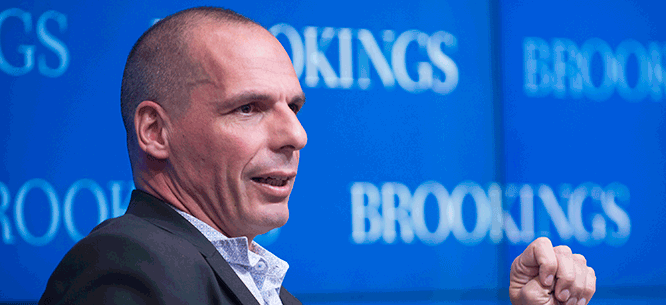
Former Greek Finance Minister Yanis Varoufakis speaks at the Brookings Institution. (Steve Purcell / Flickr) 
Leftism Reinvented: Western Parties from Socialism to Neoliberalism
by Stephanie L. Mudge
Harvard University Press, 2018, 524 pp.
 
To understand the obstacles facing the left today, we can start with Yanis Varoufakis’s ill-starred turn as Greece’s Finance Minister. Varoufakis came to office with one overriding ambition: to free Greece from the austerity regime imposed by the European Community and the International Monetary Fund. His argument was straightforward. Greece needed substantial relief from a debt burden that could not possibly be repaid, and austerity made a return to economic growth impossible.
Varoufakis used traditional Keynesian arguments to offer his European interlocutors a win-win solution that would make possible renewed growth in Greece and eventual repayment of Greece’s pared-down foreign debt. Europe’s leaders would have none of it. Even social democratic ministers turned away, praising him for his cleverness, then joining with their more conservative counterparts to force neoliberal solutions on Greece. How did Keynesianism become utopian? How did social democrats learn to speak the language of neoliberalism? How, in short, did we get here?
These are the questions that Stephanie Mudge (a colleague of mine at U.C. Davis) seeks to answer in her challenging new book, Leftism Reinvented: Western Parties from Socialism to Neoliberalism. Mudge transverses more than a century of European socialism to offer a persuasive and powerful explanation for the rise of what she terms “neoliberalized leftism” in both Europe and the United States. Along the way, she lays down a series of markers for other academics. First, she is working to revive serious analyses of political parties, treating them not simply as puppets in the hands of activists and donors but as sites where experts and intellectuals build coalitions that shape policy outcomes. It is imperative to look at who has been recruited by these parties to write the party platforms and formulate their economic programs. Second, she is trying to build a bridge between the social sciences and history by making individual biographies central to her narrative. She is here reacting against the bias towards structural analysis in sociology and political science, where all too often a focus on institutions renders individual people invisible.
The result is the kind of big book that has become increasingly rare in these times of tightly focused academic monographs. Drawing from history, sociology, political science, and political economy, Mudge has produced an account that transforms our understanding of how European and American left parties changed over the twentieth century and raises important questions about how the left must reinvent itself in the twenty-first.

Saturday, September 1, 2018

Ten Years After the Financial Crisis"


Larry Elliott
August 30, 2018
The Guardian
Capitalism’s near-death experience with the banking crisis was a golden opportunity for progressives. But they blew it

, Mitch Blunt

Placards are being prepared. Photo-opportunities are being organised. A list of demands is being drawn up by a coalition of pressure groups, unions and NGOs. Yes, preparations are well under way for protests to mark next month’s 10th anniversary of the collapse of Lehman Brothers – the pivotal moment in the global financial crisis.
Make no mistake, the fact that events will take place in all the world’s financial centres is no cause for celebration. On the contrary, it is a sign of failure. The banks were never broken up. Plans for a financial transactions tax are gathering dust. Politicians toyed with the idea of a green new dealand then promptly forgot about it. There never was a huge swing of the pendulum away from the prevailing orthodoxy, just a brief nudge that was quickly reversed. The brutal fact is that the left had its chance, and it blew it.
Ten years on, international finance is as powerful as it ever was. There has been only cosmetic reform of the banking industry. Corporate power is ever more concentrated. The benefits of the weakest global recovery from recession in living memory have been captured by a tiny minority. Wages and living standards for the majority in developed countries have grown only modestly, if at all.
September 2008 was a near-death experience for global capitalism. At one point there were fears for the entire western banking system; when the recession was at its worst, industrial production was collapsing more quickly than it had in the early stages of the Great Depression. It was that bad. The moment was ripe for politicians brave enough to state the obvious: that the crisis was the result of removing all the shackles on global financial capitalism put in place for good reason in the 1930s. But social democratic parties failed miserably to come up with a progressive response to the crisis that would have involved redressing the imbalance between capital and labour. They were timid when they should have been brave, and have paid a heavy price as a result. Mainstream parties patched up the system and paid scant heed to the anger felt by those who felt ignored. The bitterness bubbled away and eventually found other ways of manifesting itself.In the winter of 2008-09, there was a naive assumption on the left that the shock of Lehmans was so profound that change would inevitably occur. If the oil shocks of the 1970s had been the catalyst for the seizure of control by a rightwing political agenda, then the sub-prime mortgage crisis would do the same for the left. But it wasn’t quite that simple, because those who had done well in the decades that followed the Thatcher-Reagan revolution used all their power, influence, financial clout and cunning to resist change. A few tactical retreats were made in order to safeguard the status quo.

Friday, October 23, 2015

Keynes Comes to Canada

Paul Krugman
Canada has a reputation for dullness. Back in the 1980s The New Republic famously declared “Worthwhile Canadian Initiative” the world’s most boring headline. Yet when it comes to economic policy the reputation is undeserved: Canada has surprisingly often been the place where the future happens first.

  • And it’s happening again. On Monday, Canadian voters swept the ruling Conservatives out of power, delivering a stunning victory to the center-left Liberals. And while there are many interesting things about the Liberal platform, what strikes me most is its clear rejection of the deficit-obsessed austerity orthodoxy that has dominated political discourse across the Western world. The Liberals ran on a frankly, openly Keynesian vision, and won big.
Before I get into the implications, let’s talk about Canada’s long history of quiet economic unorthodoxy, especially on currency policy.
In the 1950s, everyone considered it essential to peg their currency to the U.S. dollar, at whatever cost — everyone except Canada, which let its own dollar fluctuate, and discovered that a floating exchange rate actually worked pretty well. Later, when European nations were scrambling to join the euro — amid predictions that any country refusing to adopt the common currency would pay a severe price — Canada showed that it’s feasible to keep your own money despite close economic ties to a giant neighbor.

Sunday, April 19, 2015

Economics and the Europe Crisis o


Paul Krugmam
BRUSSELS — America has yet to achieve a full recovery from the effects of the 2008 financial crisis. Still, it seems fair to say that we’ve made up much, though by no means all, of the lost ground.
But you can’t say the same about the eurozone, where real G.D.P. per capita is still lower than it was in 2007, and 10 percent or more below where it was supposed to be by now. This is worse than Europe’s track record during the 1930s.
Why has Europe done so badly? In the past few weeks, I’ve seen a number of speeches and articles suggesting that the problem lies in the inadequacy of our economic models — that we need to rethink macroeconomic theory, which has failed to offer useful policy guidance in the crisis. But is this really the story?


Paul Krugman
No, it isn’t. It’s true that few economists predicted the crisis. The clean little secret of economics since then, however, is that basic textbook models, reflecting an approach to recessions and recoveries that would have seemed familiar to students half a century ago, have performed very well. The trouble is that policy makers in Europe decided to reject those basic models in favor of alternative approaches that were innovative, exciting and completely wrong.