Showing posts with label Green New Deal. Show all posts

Monday, November 1, 2021

What is the Green New Deal ?

 Green New Deal


https://www.labor4sustainability.org/strike/the-green-new-deal-from-below/


The Green New Deal is a visionary program to protect the earth’s climate while creating good jobs, reducing injustice, and eliminating poverty. Its core principle is to use the necessity for climate protection as a basis for realizing full employment and social justice.

The Green New Deal first emerged as a proposal for national legislation, and the struggle to embody it in national legislation is ongoing. But there has also emerged a little-noticed wave of initiatives from community groups, unions, city and state governments, tribes, and other non-federal institutions designed to contribute to the climate protection and social justice goals of the Green New Deal. We will call these the Green New Deal from Below (GNDfB).

The purpose of this commentary is to provide an overview of Green New Deal from Below initiatives in many different arenas and locations. It provides an introduction to a series of commentaries that will delve more deeply into each aspect of the GNDfB. The purpose of the series is to reveal the rich diversity of GNDfB programs already underway and in development. The projects of Green New Dealers recounted here should provide inspiration for thousands more that can create the foundation for national mobilization–and reconstruction.

The original 2018 Green New Deal resolution submitted by Rep. Alexandria Ocasio-Cortez called for a national 10-year mobilization to achieve 100% of national power generation from renewable sources; a national “smart grid”; energy efficiency upgrades for every residential and industrial building; decarbonizing manufacturing, agriculture, transportation, and other infrastructure; and helping other countries achieve carbon neutral economies and a global Green New Deal. It proposed a job guarantee to assure a living wage job to every person who wants one; mitigation of income and wealth inequality; basic income programs; and universal health care. It advocated innovative financial structures including cooperative and public ownership and public banks. Since that time a wide-ranging discussion has extended and fleshed out the vision of the Green New Deal to include an even wider range of proposals to address climate, jobs, and justice.

See details.

Tuesday, November 19, 2019

The Green New Deal: Lessons from Chico California


NAOMI _KLEIN

Forged in Fire: California’s Lessons for a Green New Deal
Naomi Klein
November 7 2019, 6:00 a.m.


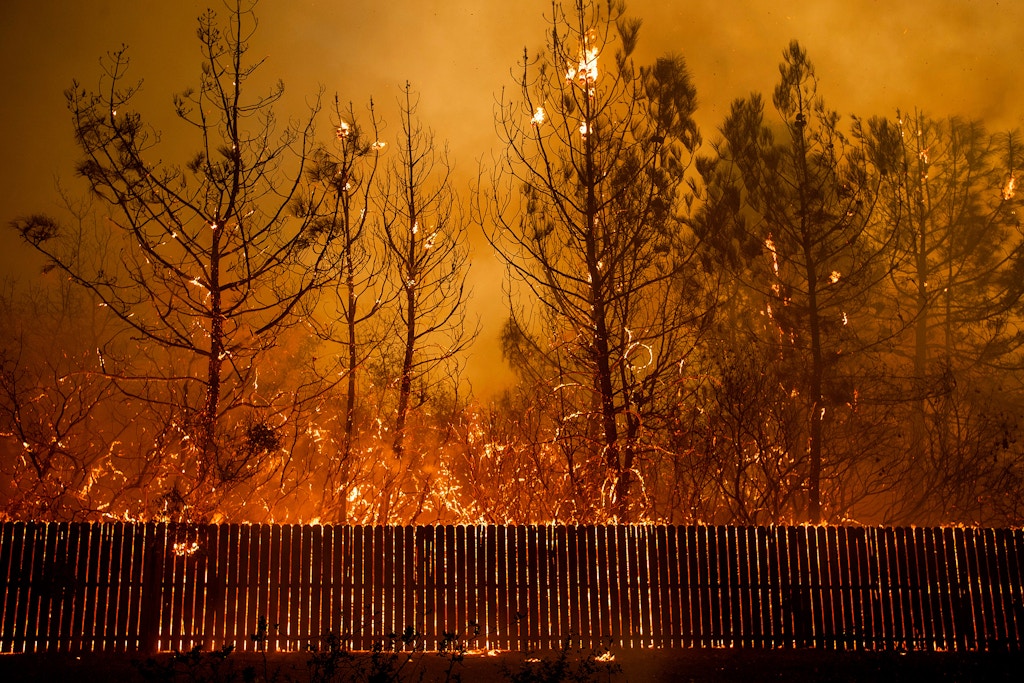
Flames climb trees as the Camp Fire tears through Paradise, Calif., on Nov. 8, 2018.

Photo: Noah Berger/AP


WE WERE JUST TAKING PICTURES. Of the ash, stray bricks, and weeds. Of twisted metal and charred patio furniture. Of the pine trees still standing on the edge of the lots, their towering trunks now charcoal black. Of the lonely white brick fireplace in the middle of it all, the only surviving structure, metal pokers hanging expectantly by the grate.

“Get the hell off my property!”

The words came bellowing from a burly man who had just pulled up to the pile of ash that once was his home in Paradise, California. As he shouted a litany of complaints, it became clear that his rage wasn’t only reserved for us trespassers — and there have been plenty who have gone to Paradise to gaze at the eerie emptiness where a thriving community once stood, before it was decimated by California’s deadliest fire one year ago.

The target was myriad forces that had conspired to twist the knife, again and again, on his already wrenching property loss — from the insurance company that wouldn’t pay up, to the county that wouldn’t let him clean up, to the state that wanted his (now contaminated) well to be sealed up. His rage was also directed at the absence of decent temporary housing for fire victims like him, not to mention the electric utility that had started the blaze and was still evading responsibility.

When the complaints petered out, I approached the man to introduce myself and apologize for our intrusion. But as I got closer, I felt his volatility: I have been in many disaster-struck communities and know how quickly the gale-force of emotion these events churn up can direct itself at the closest available target. We wished him luck and left.

The encounter was a reminder of the kind of stress that is in the air in the parts of California recently scorched by fire, as well as in the communities that have welcomed thousands of newly homeless neighbors to towns now bursting at the seams. The intersecting hardships experienced by so many in the region also explain why, days before the one-year anniversary of the deadly Camp Fire that burned down Paradise and killed 86 people, local politicians in neighboring Chico unveiled a plan calling for the small city to adopt its own Green New Deal.

Like its national inspiration, the Chico Green New Deal framework marries rapid decarbonization targets with calls for more affordable housing; a safe and sustainable food system; investments in “clean, 21st century” public transit; green jobs creation, including projects earmarked for the poorest residents; and much more.

Chico shows that there is no way to cope with climate breakdown without a simultaneous shift to a very different kind of economy.


“Your city council has heard the call of its community that has resounded locally and across the nation,” saidChico Vice Mayor Alex Brown when the plan was announced. “We are choosing to walk the walk of this movement and to take the leadership being demanded of us.” In an interview, Brown told me that the Camp Fire’s impact on both Paradise and Chico was a glimpse of the future unless action is taken to both radically lower emissions and build “communities that are more resilient to these shifts.” Brown is well aware that a small city like hers isn’t going to make much of a dent in global emissions. But, she said, “We can demonstrate what a Green New Deal looks like at the local level.”

The Chico plan is one of many similar local initiatives that have sprung up in the year since the Sunrise Movement occupied the office of then-prospective House Speaker Nancy Pelosi, with young demonstrators demanding that the Democratic Party embrace a sweeping Green New Deal to meet the twin crises of climate disruption and deepening inequality. Since then, as the Green New Deal proposal has picked up momentum in the Democratic primaries, several states and big cities have unveiled their own frameworks, including Maine and Seattle, where city council recently passed a resolution that included the city’s most ambitious climate justice targets to date. It also pledged to create an oversight board to hold the city to its commitments, a body that will be made up of representatives from communities directly impacted by racial, economic, and environmental injustice, as well as climate experts and representatives from trade unions and green groups.

And yet the contribution now coming from humble Chico — a scrappy northern California college town with a population of approximately 100,000 — may be the most politically significant. Because the Chico Green New Deal is based directly on this region’s hard-won experience of living through the 2018 inferno; it was forged, quite literally, in fire.

Ever since the Green New Deal landed on the political map, liberals have attacked it for its supposedly impractical scope and ambition. Fighting poverty, racism, and homelessness are worthy goals, we have been told — but what do they have to do with lowering greenhouse gas emissions? Surely a carbon-centric approach — like a simple tax or cap-and-trade and some narrow regulations on polluters — would be more likely to succeed. And besides, connecting greenhouse-gas reductions with building a fairer society just confirms Republican beliefs that climate change is a vast left-wing plot: Better to focus exclusively on pollution and worry about the rest down the road. Conservative Chico city council members have gone on the offensive against the Green New Deal with precisely this kind of attack.


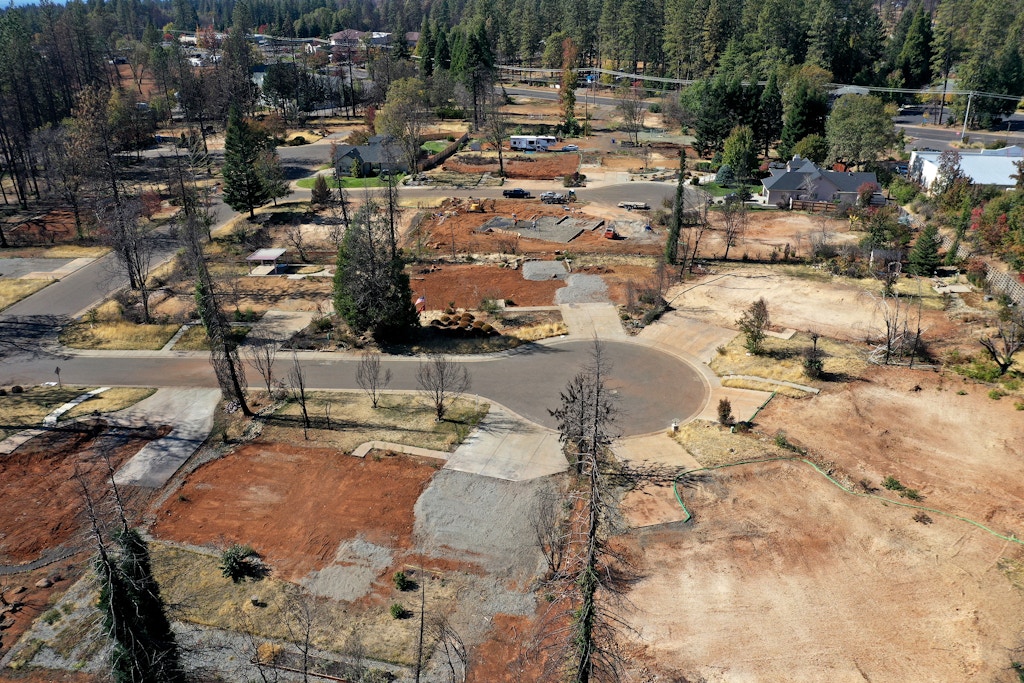
An aerial view of a destroyed neighborhood in Paradise, Calif., on Oct. 21, 2019, one year after the Camp Fire.

Photo: Justin Sullivan/Getty Images


Yet Chico’s lived experience over the past year is a devastating rebuke to this line of criticism. As the community that housed the vast majority of people displaced by the Camp Fire, Chico shows that there is no way to cope with climate breakdown without a simultaneous shift to a very different kind of economy, one that is willing to make major nonmarket investments in housing, transit, health (including mental health), water, electricity, and more.

Friday, April 12, 2019

Green New Deal or Medicare for All ?

Right now there are two big progressive ideas out there: the Green New Deal on climate change and “Medicare for all” on health reform. Both would move U.S. policy significantly to the left. Each is sponsored by a self-proclaimed socialist: the Green New Deal by Alexandria Ocasio-Cortez and Medicare for all by Bernie Sanders. (Of course, neither of them is a socialist in the traditional sense.) Both ideas horrify not just conservatives but also many self-proclaimed centrists.
Yet while they may seem similar if you think of everything as left versus right, they’re very different on another dimension, which you might call purity versus pragmatism. And that difference is why I believe progressives should enthusiastically embrace the G.N.D. while being much more cautious about M4A.

Paul Krugman

Tuesday, March 26, 2019

Its Green And It's a New Deal

It's Green And It's A New Deal

Virginia Meyer 
I’m from Lone Tree, Iowa – a town of about 1,300 in the eastern part of our state. Our Senator, Joni Ernst, has attacked the Green New Deal multiple times. She says it’s “radical,” “It will destroy jobs,” “It will hinder our strong ag industry,” and “It’s a far-left fantasy.” Ernst, sadly is far from alone in her hostility to environmental common sense. We hear similarly overheated remarks from her GOP colleagues, Majority Leader Mitch McConnell, and even a handful of Democrats. Yikes! That’s why I’m traveling to Washington on March 26 to set the record straight and demand that Senator Ernst, and all Senators, stand up and do the right thing for our planet and for their constituents: vote for the Green New Deal. It’s high time we worked together to address our most pressing problems. America has always benefitted from our spirit of innovation, technical expertise, our energy, optimism, and hard work. The Green New Deal will tap these qualities to tackle climate change. I do not consider these American values a “far-left fantasy.” The Green New Deal lifts us from denial or resignation to action and determination. It is an affirmation of love and concern for our children and all living things on Earth. Fight for our future with individual actions, collective participation in any of the many groups and organizations working for climate justice, and help elect tough and wise leadership to guide us.

Green New Deal Gets First Vote

Green New Deal, backed by Ocasio-Cortez, to get its first vote on Capitol Hill Tuesday. USA Today: “The Green New Deal, liberal Democrats’ sweeping proposal to address climate change, could get its first vote on Capitol Hill Tuesday. The Senate is scheduled to take up a procedural motion on the ambitious plan, which also calls for a broad social remake of the American economy, that could lead to a final vote as early as next week. The irony?

Monday, March 4, 2019

Moderate ( Neoliberal) Democrats Oppose the Green New Deal


Kate Aronoff
February 28, 2019
The Intercept
There may be no issue that lends itself better to a “which side are you on”-style politics than the climate crisis

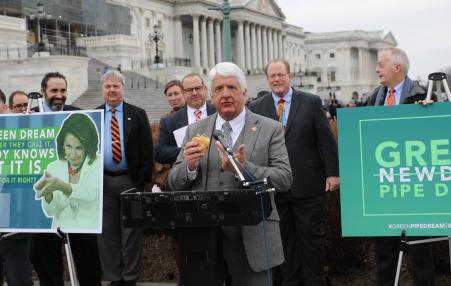
In an image posted to the Congressional Western Caucus's Facebook page, Rep. Rob Bishop, R-Utah, holds a hamburger while making a statement during the Western Caucus's press conference on the Green New Deal bill at the U.S. Capitol on Feb. 27, 2018., Congressional Western Caucus

FOR YEARS, THE terms of the debate about climate change in the United States have been clear. One side — flush with fossil fuel cash — cast doubt on whether the problem existed at all, spreading disinformation and calling global warming an elaborate hoax to bring about socialism. For the most part, they were Republicans. On the other side were those who believed the science and usually rallied around some call for climate action, however vague. The conversation around the Green New Deal has brought those sides together, as politicians on both sides of the aisle scramble to cobble together a third way.
That Republicans being paid by the fossil fuel industry have come out against a plan for the United States to reach net-zero greenhouse gas emissions by 2030 is hardly surprising. That they’re being joined by prominent Democrats in casting doubt on the idea is a signal for how old tribalisms around climate change are starting to radically shift.
“The Anti-Green New Deal Coalition,” a new report from the Public Accountability Initiative, or PAI, attempts to map these evolving allegiances.
Unsurprisingly, a common bipartisan thread in Green New Deal opposition is fossil fuel donations. Raking in 81 percent of all oil and gas donations since 1990, today’s GOP “operates as a de facto wing of the fossil fuel industry,” the report’s authors write. The exclusively white, male, and Republican leadership of the Congressional Western Caucus is a prime example. In the last election cycle, it accepted $837,480 from political action committees linked to the energy and natural resources industry, a fraction of the $4.3 million that same group has taken in from fossil fuel PACs over the course of its career. On Wednesday, the caucus hosted a “policy forum” on the Green New Deal — a “Green Pipe Dream,” as they call it — flanked by a who’s who of the country’s most prominent climate deniers, including the Competitive Enterprise Institute’s Myron Ebell to ClimateDepot founder Marc Morano. Ceremoniously, Rep. Rob Bishop, R-Utah, ate a hamburger.

Sunday, March 3, 2019

Path to a Green New Deal

The Climate Movement’s Decades-Long Path to the Green New Deal 
How the climate movement learned to play politics. 
Matthew Miles Goodrich  February 15, 2019

That the public sector must be massively mobilized in the fight against climate change has long been a bugbear of the right. But the failure to conceive of just how large a role the federal government will have to play in combating climate change has been the left’s own climate denial. The chasm between our present addiction to fossil fuels and the decarbonized economy the world needs is so daunting that it has proven easier to chant “we have the solutions” than it has been to build the political power to win in government.


Thursday, February 7, 2019

Green New Deal

Green New Deal Calls For National Climate Solutions

Keynesian economics. 
Green New Deal resolution calls for ‘national mobilization’ on climate, economy. Politico:“Rep. Alexandria Ocasio-Cortez (D-N.Y.) and Sen. Ed Markey (D-Mass.) will release a blueprint for a Green New Deal on Thursday urging a “10-year national mobilization” for a speedy shift away from fossil fuels and calling for national health care coverage and job guarantees in a sweeping bid to remake the U.S. economy. The burgeoning left-wing faction within the Democratic Party has sought to persuade the 2020 White House contenders to sign onto the Green New Deal’s tenets in a bid to push climate change and the broad economic platform up the ladder of party priorities. And so far, several presidential hopefuls, such as Sens. Elizabeth Warren (D-Mass.), Cory Booker (D-N.J.), Kirsten Gillibrand (D-N.Y.) and Kamala Harris (D-Calif.), have endorsed at least the concept of a Green New Deal. The six-page, non-binding resolution from Ocasio-Cortez and Markey is an attempt to add substance to the proposals that have fired up a wave of new activists who are planning to barnstorm lawmakers’ offices in the Capitol in the coming days — and to set an agenda for the Democrats in the 2020 election. “[A] new national, social, industrial, and economic mobilization on a scale not seen since World War II and the New Deal era is a historic opportunity … to create millions of good, high-wage jobs in the United States; to provide unprecedented levels of prosperity and economic security for all people of the United States; and to counteract systemic injustices,” the resolution, which was shared with POLITICO, states.”

Thursday, December 20, 2018

Climate Change and the Democrats

Gearing Up for a Green New Deal - Alexandria Ocasio-Cortez and the plan to change everything


A thirty-foot sperm whale comes up for air. Before slipping back into the deep blue its eye gleans sight of something strange in the distance. To the whale, it looks like a flock of seagulls, each with three wings flapping. For some reason, they can’t take off.
She doesn’t pay them any mind. She’s busy with a calf to feed, her third in the past decade. When she was a calf herself, the three-winged seagulls weren’t there. But she is spotting more and more of them as she swims off the coast of Long Island these days.
She’s noticed other changes as well. The water is cleaner, and there are more and more of her kind coming upon one another. And why not? There’s plenty of squid and a lot fewer plastic bags to prey on these days. 
Unbeknownst to her, the two aren’t unrelated, the fertile ocean and the strange birds on shore — what the whale’s distant evolutionary relatives in the human race refer to as wind turbines. If her eye could stray further, take on a loftier gaze, she would see that her distant cousins are busy at work, raising solar panels atop their buildings and homes, retrofitting them too, so that they will be cooler in the summer and warmer in the winter. She’d witness streets virtually devoid of vehicles save for schools of buses, gobbling up passengers like cephalopods and subway cars gliding without a hitch, graceful as eels over bridges.
This is a world where human and animal and environment are approaching harmony. It is nowhere near the “Hallelujah” chorus of Handel’s Messiah, but it has come a long way from the thrash-metal discord days of fracking, tar sands extraction, open-pit coal mining, uranium excavation, deepwater drilling, deforestation and the general masochistic flaming frenzy that characterized 20th and early 21st-century ecology. In other words, it is a far cry from the world we currently inhabit. It’s one that, if built, will be built by dreamers. It will require those in power now — who, for all their talk about the glory of capitalist innovation, can’t see beyond tomorrow’s Dow Jones index to save the planet — to listen to America’s youth, its scientists, its rebels and to the rumblings of Gaia herself and make way for some true innovation.
If this green future comes to pass, those of us fortunate enough to inhabit it may look back on Nov. 13, 2018 as a turning point. That’s the day 200 young climate change activists occupied the soon-to-be Speaker of the House’s office on Capitol Hill, many carrying orange placards that asked, “What is your plan?” Fifty-one youth in total were arrested, charged with obstruction.

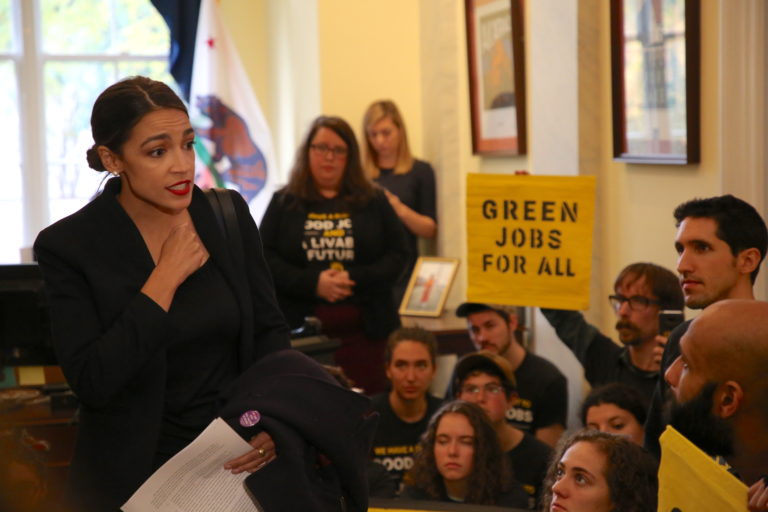
Incoming freshman Congresswoman Alexandria Ocasio-Cortez joins the cool kids with the Sunrise Movement in the principal’s office on her first day of class.
Credit: Sunrise Movement.
In addition to a fine, the charge carries with it a certain irony. While they were there to disrupt business as usual in Nancy Pelosi’s lair, the underlying purpose of their visit was to make a deal, a Green New Deal, and spur the kind of investment in combating and adapting to climate change that Pelosi and other leaders of the country’s two main political parties have obstructed over the past two decades. Coming as it did in the wake of a UN Intergovernmental Panel on Climate Change (IPCC) report that warns humankind has just 12 years to drastically reduce its output of heat-trapping greenhouse gases or global warming will be irreversible, and given extra media attention thanks to the presence of camera-trailed Congresswoman-elect, Alexandria Ocasio-Cortez (D-NY), the sit-in helped push the Green New Deal into the national conversation.

‘What Science And Justice Demand’

So, what is a Green New Deal and why are our nation’s elites so reluctant to move on it?