Showing posts with label Stiglitz. Show all posts

Thursday, September 23, 2021

17 Nobel Prize Winnners Endorse Biden's Stimulus Package

 Seventeen recipients of the Nobel Memorial Prize in Economic Sciences have signed an open letter in support of President Biden’s Build Back Better package currently being considered in Congress. Below is a statement from Nobel Laureate economist Joseph Stiglitz: 

The President’s economic agenda, the “Build Back Better” package being debated in Congress, would provide vital public investments in the nation’s physical and human infrastructure, as well as in our tattered safety net. These investments are long overdue—they were needed before the COVID-19 pandemic, and their necessity has been highlighted by the virus and the economic shock that came with it.

Some, however, have invoked fears of inflation as a reason to not undertake these investments. This view is short-sighted. These are importantly supply side measures, increasing the ability of more Americans to participate productively in the economy, helping to improve our low employment-working age population ratio. Significantly reducing the fraction of children growing up in poverty and giving these children access to pre-K and college education will reap large dividends in years to come. We need safe school buildings and bridges, and affordable child and elder care, whether inflation is 2% or 5%. With the investments being financed by tax increases, the inflationary impacts will be at most negligible—over the medium term outweighed by the supply side benefits; and their progressivity will help address one of the country’s critical problems, the growing economic divide. 

The Build Back Better package will provide much needed support to a still-recovering economy, but it will accomplish much more than that. By meeting long-standing social needs, boosting long-term economic performance, and taking serious steps toward addressing the climate crisis we can already see unfolding, it would transform the U.S. economy to be more efficient, equitable, sustainable, and prosperous for the long run, without presenting an inflationary threat.

I am pleased that 16 other winners of the Nobel Memorial Prize in economics join me in endorsing the contours of this transformative economic agenda. 

Read the open letter signed by 17 recipients of the Nobel Memorial Prize in Economic Sciences. 
Open letter from Nobel Laureates in Support of Economic Recovery Agenda

September 20, 2021
Economic Policy Institute

The American economy appears set for a robust recovery in part due to active government interventions over the past year and a half, including President Biden’s American Rescue Plan. But, reversing years of disinvestment in public goods and addressing the country’s long-term needs—including building toward sustainable and inclusive growth and facilitating our clean energy transition—will require more.

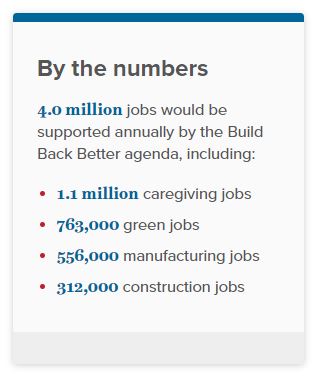
Success in the 21st century will require building upon the bi-partisan infrastructure deal that has passed the Senate, which prioritizes investments in our nation’s “hard” infrastructure. The President’s Build Back Better agenda employs a broader conception of infrastructure by making critical investments in human capital, the care economy, research and development, public education, and more, which will reduce families’ costs.

While we all have different views on the particulars of various economic policies, we believe that key components of this broader agenda are critical—including tax reforms that make our tax system more equitable and that enable our system to raise the additional funds required to facilitate necessary public investments and achieve our collective goals. Because this agenda invests in long-term economic capacity and will enhance the ability of more Americans to participate productively in the economy, it will ease longer-term inflationary pressures.

Signed by 17 recipients of the Nobel Memorial Prize in Economic Sciences:

  • George A. Akerlof, Professor, Georgetown University
  • Sir Angus Deaton, Professor, Princeton University
  • Peter Diamond, Professor, Massachusetts Institute of Technology
  • Robert Engle, Professor Emeritus and Co-Director of the Volatility and Risk Institute, New York University
  • Oliver Hart, Professor, Harvard University
  • Daniel Kahneman, Professor, Princeton University
  • Eric S. Maskin, Professor, Harvard University
  • Daniel McFadden, Professor, University of California, Berkley
  • Paul Milgrom, Professor, Stanford University
  • Roger Myerson, Professor, University of Chicago
  • Edmund S. Phelps, Professor and Director of the Center on Capitalism and Society, Columbia University
  • Paul Romer, Professor, New York University
  • William Sharpe, Professor Emeritus, Stanford University
  • Robert Shiller, Professor, Yale University
  • Christopher Sims, Professor, Princeton University
  • Robert Solow, Professor Emeritus, Massachusetts Institute of Technology
  • Joseph Stiglitz, Professor, Columbia University


Friday, January 17, 2020

The Truth About the Trump Economy

The Truth About the Trump Economy
Jan 17, 2020 JOSEPH E. STIGLITZ
It is becoming conventional wisdom that US President Donald Trump will be tough to beat in November, because, whatever reservations about him voters may have, he has been good for the American economy. Nothing could be further from the truth.

It is becoming conventional wisdom that US President Donald Trump will be tough to beat in November, because, whatever reservations about him voters may have, he has been good for the American economy. Nothing could be further from the truth.


Two years ago, a few rare corporate leaders were concerned about climate change, or upset at Trump’s misogyny and bigotry. Most, however, were celebrating the president’s tax cuts for billionaires and corporations and looking forward to his efforts to deregulate the economy. That would allow businesses to pollute the air more, get more Americans hooked on opioids, entice more children to eat their diabetes-inducing foods, and engage in the sort of financial shenanigans that brought on the 2008 crisis.
Today, many corporate bosses are still talking about the continued GDP growth and record stock prices. But neither GDP nor the Dow is a good measure of economic performance. Neither tells us what’s happening to ordinary citizens’ living standards or anything about sustainability. In fact, US economic performance over the past four years is Exhibit A in the indictment against relying on these indicators.
To get a good reading on a country’s economic health, start by looking at the health of its citizens. If they are happy and prosperous, they will be healthy and live longer. Among developed countries, America sits at the bottom in this regard. US life expectancy, already relatively low, fell in each of the first two years of Trump’s presidency, and in 2017, midlife mortality reached its highest rate since World War II. This is not a surprise, because no president has worked harder to make sure that more Americans lack health insurance. Millions have lost their coverage, and the uninsured rate has risen, in just two years, from 10.9% to 13.7%.
One reason for declining life expectancy in America is what Anne Case and Nobel laureate economist Angus Deaton call deaths of despair, caused by alcohol, drug overdoses, and suicide. In 2017 (the most recent year for which good data are available), such deaths stood at almost four times their 1999 level.
The only time I have seen anything like these declines in health – outside of war or epidemics – was when I was chief economist of the World Bank and found out that mortality and morbidity data confirmed what our economic indicators suggested about the dismal state of the post-Soviet Russian economy. 
Bundle2020_web
Trump may be a good president for the top 1% – and especially for the top 0.1% – but he has not been good for everyone else. If fully implemented, the 2017 tax cut will result in tax increases for most households in the second, third, and fourth income quintiles.
Given tax cuts that disproportionately benefit the ultrarich and corporations, it should come as no surprise that there was no significant change in the median US household’s disposable income between 2017 and 2018 (again, the most recent year with good data). The lion’s share of the increase in GDP is also going to those at the top. Real median weekly earnings are just 2.6% above their level when Trump took office. And these increases have not offset long periods of wage stagnation. For example, the median wage of a full-time male worker (and those with full-time jobs are the lucky ones) is still more than 3% below what it was 40 years ago. Nor has there been much progress on reducing racial disparities: in the third quarter of 2019, median weekly earnings for black men working full-time were less than three-quarters the level for white men.
Making matters worse, the growth that has occurred is not environmentally sustainable – and even less so thanks to the Trump administration’s gutting of regulations that have passed stringent cost-benefit analyses. The air will be less breathable, the water less drinkable, and the planet more subject to climate change. In fact, losses related to climate change have already reached new highs in the US, which has suffered more property damage than any other country – reaching some 1.5% of GDP in 2017.  
The tax cuts were supposed to spur a new wave of investment. Instead, they triggered an all-time record binge of share buybacks – some $800 billion in 2018 – by some of America’s most profitable companies, and led to record peacetime deficits (almost $1 trillion in fiscal 2019) in a country supposedly near full employment. And even with weak investment, the US had to borrow massively abroad: the most recent data show foreign borrowing at nearly $500 billion a year, with an increase of more than 10% in America’s net indebtedness position in one year alone.
Likewise, Trump’s trade wars, for all their sound and fury, have not reduced the US trade deficit, which was one-quarter higher in 2018 than it was in 2016. The 2018 goods deficit was the largest on record. Even the deficit in trade with China was up almost a quarter from 2016. The US did get a new North American trade agreement, without the investment agreement provisions that the Business Roundtable wanted, without the provisions raising drug prices that the pharmaceutical companies wanted, and with better labor and environmental provisions. Trump, a self-proclaimed master deal maker, lost on almost every front in his negotiations with congressional Democrats, resulting in a slightly improved trade arrangement.
And despite Trump’s vaunted promises to bring manufacturing jobs back to the US, the increase in manufacturing employment is still lower than it was under his predecessor, Barack Obama, once the post-2008 recovery set in, and is still markedly below its pre-crisis level. Even the unemployment rate, at a 50-year low, masks economic fragility. The employment rate for working-age males and females, while rising, has increased less than during the Obama recovery, and is still significantly below that of other developed countries. The pace of job creation is also markedly slower than it was under Obama.
Again, the low employment rate is not a surprise, not least because unhealthy people can’t work. Moreover, those on disability benefits, in prison – the US incarceration rate has increased more than sixfold since 1970, with some two million people currently behind bars – or so discouraged that they are not actively seeking jobs are not counted as “unemployed.” But, of course, they are not employed. Nor is it a surprise that a country that doesn’t provide affordable childcare or guarantee family leave would have lower female employment – adjusted for population, more than ten percentage points lower – than other developed countries.
Even judging by GDP, the Trump economy falls short. Last quarter’s growth was just 2.1%, far less than the 4%, 5%, or even 6% Trump promised to deliver, and even less than the 2.4% average of Obama’s second term. That is a remarkably poor performance considering the stimulus provided by the $1 trillion deficit and ultra-low interest rates. This is not an accident, or just a matter of bad luck: Trump’s brand is uncertainty, volatility, and prevarication, whereas trust, stability, and confidence are essential for growth. So is equality, according to the International Monetary Fund.
So, Trump deserves failing grades not just on essential tasks like upholding democracy and preserving our planet. He should not get a pass on the economy, either.
Joseph E. Stiglitz
Writing for PS since 2001 

Joseph E. Stiglitz, a Nobel laureate in economics, is University Professor at Columbia University and Chief Economist at the Roosevelt Institute. His most recent book is People, Power, and Profits: Progressive Capitalism for an Age of Discontent.
·       3
·       Facebook


Sunday, July 26, 2015

Greece, Sacrificed

Joseph Stiglitz,

ATHENS — AS the Greek crisis proceeds to its next stage, Germany, Greeceand the triumvirate of the International Monetary Fund, the European Central Bank and the European Commission (now better known as the troika) have all faced serious criticism. While there is plenty of blame to share, we shouldn’t lose sight of what is really going on. I’ve been watching this Greek tragedy closely for five years, engaged with those on all sides. Having spent the last week in Athens talking to ordinary citizens, young and old, as well as current and past officials, I’ve come to the view that this is about far more than just Greece and the euro.

Some of the basic laws demanded by the troika deal with taxes and expenditures and the balance between the two, and some deal with the rules and regulations affecting specific markets. What is striking about the new program (called “the third memorandum”) is that on both scores it makes no sense either for Greece or for its creditors.


As I read the details, I had a sense of déjà vu. As chief economist of the World Bank in the late 1990s, I saw firsthand in East Asia the devastating effects of the programs imposed on the countries that had turned to the I.M.F. for help. This resulted not just from austerity but also from so-called structural reforms, where too often the I.M.F. was duped into imposing demands that favored one special interest relative to others. There were hundreds of conditions, some little, some big, many irrelevant, some good, some outright wrong, and most missing the big changes that were really required.Photo

Saturday, May 31, 2014

Fair Taxes for All - Joseph Stiglitz

<iframe src="//player.vimeo.com/video/96870248" width="500" height="281" webkitallowfullscreen mozallowfullscreen allowfullscreen></iframe>

Sunday, April 6, 2014

Why Inequality Matters