Friday, January 4, 2019

Nancy Pelosi Joins With Austerity Crowd

Trump Tax Cut : Worse Than You Heard

Paul Krugman,  
The 2017 tax cut has received pretty bad press, and rightly so. Its proponents made big promises about soaring investment and wages, and also assured everyone that it would pay for itself; none of that has happened.
Yet coverage actually hasn’t been negative enough. The story you mostly read runs something like this: The tax cut has caused corporations to bring some money home, but they’ve used it for stock buybacks rather than to raise wages, and the boost to growth has been modest. That doesn’t sound great, but it’s still better than the reality: No money has, in fact, been brought home, and the tax cut has probably reduced national income. Indeed, at least 90 percent of Americans will end up poorer thanks to that cut.
Let me explain each point in turn.
First, when people say that U.S. corporations have “brought money home” they’re referring to dividends overseas subsidiaries have paid to their parent corporations. These did indeed surge briefly in 2018, as the tax law made it advantageous to transfer some assets from the books of those subsidiaries to the home companies; these transactions also showed up as a reduction in the measured stake of the parents in the subsidiaries, i.e., as negative direct investment (Figure 1).
Figure 1CreditBureau of Economic Analysis
Image
Figure 1CreditBureau of Economic Analysis
But these transactions are simply rearrangements of companies’ books for tax purposes; they don’t necessarily correspond to anything real. Suppose that Multinational Megacorp USA decides to have its subsidiary, Multinational Mega Ireland, transfer some assets to the home company. This will produce the kind of simultaneous and opposite movement in dividends and direct investment you see in Figure 1. But the company’s overall balance sheet – which always included the assets of MM Ireland – hasn’t changed at all. No real resources have been transferred; MM USA has neither gained nor lost the ability to invest here.
ADVERTISEMENT
If you want to know whether investable funds are really being transferred to the U.S., you need to look at the overall balance on financial account – or, what should be the same (and is more accurately measured), the inverse of the balance on current account. Figure 2 shows that balance as a share of GDP – and as you can see, basically nothing has happened.
Figure 2CreditBureau of Economic Analysis

So the tax cut induced some accounting maneuvers, but did nothing to promote capital flows to America.
The tax cut did, however, have one important international effect: We’re now paying more money to foreigners.
Bear in mind that the one clear, overwhelming result of the tax cut is a big break for corporations: Federal tax receipts on corporate income have plunged (Figure 3).
Figure 3CreditBureau of Economic Analysis
Image
https://static01.nyt.com/images/2019/01/01/opinion/190101krugman3/190101krugman3-articleLarge.png?quality=75&auto=webp&disable=upscale
Figure 3CreditBureau of Economic Analysis
The key point to realize is that in today’s globalized corporate system, a lot of any country’s corporate sector, our own very much included, is actually owned by foreigners, either directly because corporations here are foreign subsidiaries, or indirectly because foreigners own American stocks. Indeed, roughly a third of U.S. corporate profits basically flow to foreign nationals – which means that a third of the tax cut flowed abroad, rather than staying at home. This probably outweighs any positive effect on GDP growth. So the tax cut probably made America poorer, not richer.
ADVERTISEMENT
And it certainly made most Americans poorer. While 2/3 of the corporate tax cut may have gone to U.S. residents, 84 percent of stocks are held by the wealthiest 10 percent of the population. Everyone else will see hardly any benefit.
Meanwhile, since the tax cut isn’t paying for itself, it will eventually have to be paid for some other way – either by raising other taxes, or by cutting spending on programs people value. The cost of these hikes or cuts will be much less concentrated on the top 10 percent than the benefit of the original tax cut. So it’s a near-certainty that the vast majority of Americans will be worse off thanks to Trump’s only major legislative success.
As I said, even the mainly negative reporting doesn’t convey how bad a deal this whole thing is turning out to be.
Follow The New York Times Opinion section on Facebook, Twitter (@NYTopinion) and Instagram, and sign up for the Opinion Today newsletter. 
To see the graphics, go to the Opinion piece in the Times.

Paul Krugman has been an Opinion columnist since 2000 and is also a Distinguished Professor at the City University of New York Graduate Center. He won the 2008 Nobel Memorial Prize in Economic Sciences for his work on international trade and economic geography. @PaulKrugman


Thursday, December 20, 2018

Climate Change and the Democrats

Gearing Up for a Green New Deal - Alexandria Ocasio-Cortez and the plan to change everything


A thirty-foot sperm whale comes up for air. Before slipping back into the deep blue its eye gleans sight of something strange in the distance. To the whale, it looks like a flock of seagulls, each with three wings flapping. For some reason, they can’t take off.
She doesn’t pay them any mind. She’s busy with a calf to feed, her third in the past decade. When she was a calf herself, the three-winged seagulls weren’t there. But she is spotting more and more of them as she swims off the coast of Long Island these days.
She’s noticed other changes as well. The water is cleaner, and there are more and more of her kind coming upon one another. And why not? There’s plenty of squid and a lot fewer plastic bags to prey on these days. 
Unbeknownst to her, the two aren’t unrelated, the fertile ocean and the strange birds on shore — what the whale’s distant evolutionary relatives in the human race refer to as wind turbines. If her eye could stray further, take on a loftier gaze, she would see that her distant cousins are busy at work, raising solar panels atop their buildings and homes, retrofitting them too, so that they will be cooler in the summer and warmer in the winter. She’d witness streets virtually devoid of vehicles save for schools of buses, gobbling up passengers like cephalopods and subway cars gliding without a hitch, graceful as eels over bridges.
This is a world where human and animal and environment are approaching harmony. It is nowhere near the “Hallelujah” chorus of Handel’s Messiah, but it has come a long way from the thrash-metal discord days of fracking, tar sands extraction, open-pit coal mining, uranium excavation, deepwater drilling, deforestation and the general masochistic flaming frenzy that characterized 20th and early 21st-century ecology. In other words, it is a far cry from the world we currently inhabit. It’s one that, if built, will be built by dreamers. It will require those in power now — who, for all their talk about the glory of capitalist innovation, can’t see beyond tomorrow’s Dow Jones index to save the planet — to listen to America’s youth, its scientists, its rebels and to the rumblings of Gaia herself and make way for some true innovation.
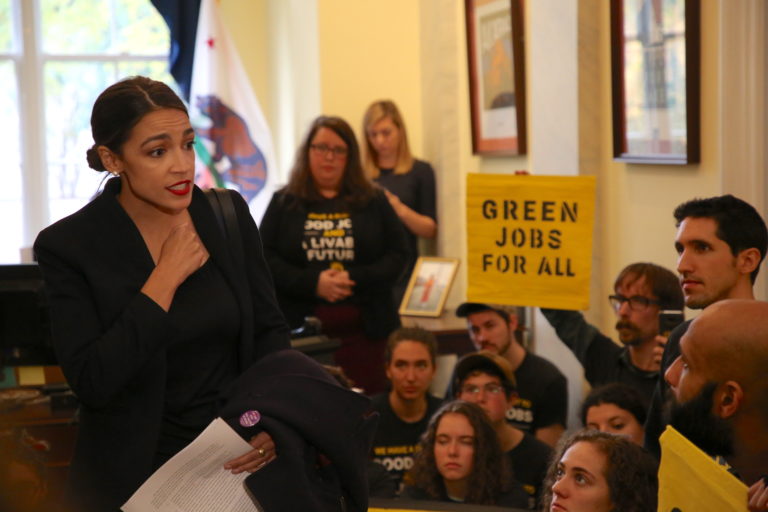
If this green future comes to pass, those of us fortunate enough to inhabit it may look back on Nov. 13, 2018 as a turning point. That’s the day 200 young climate change activists occupied the soon-to-be Speaker of the House’s office on Capitol Hill, many carrying orange placards that asked, “What is your plan?” Fifty-one youth in total were arrested, charged with obstruction.

Incoming freshman Congresswoman Alexandria Ocasio-Cortez joins the cool kids with the Sunrise Movement in the principal’s office on her first day of class.
Credit: Sunrise Movement.
In addition to a fine, the charge carries with it a certain irony. While they were there to disrupt business as usual in Nancy Pelosi’s lair, the underlying purpose of their visit was to make a deal, a Green New Deal, and spur the kind of investment in combating and adapting to climate change that Pelosi and other leaders of the country’s two main political parties have obstructed over the past two decades. Coming as it did in the wake of a UN Intergovernmental Panel on Climate Change (IPCC) report that warns humankind has just 12 years to drastically reduce its output of heat-trapping greenhouse gases or global warming will be irreversible, and given extra media attention thanks to the presence of camera-trailed Congresswoman-elect, Alexandria Ocasio-Cortez (D-NY), the sit-in helped push the Green New Deal into the national conversation.

‘What Science And Justice Demand’

So, what is a Green New Deal and why are our nation’s elites so reluctant to move on it?

Tuesday, December 18, 2018

Green New Deal

WEDNESDAY, DEC 12, 2018, 6:20 PM
12 Reasons Labor Should Demand a Green New Deal
/var/folders/3y/g6rbthzs38zdx0w5__xnj95r0000gn/T/com.microsoft.Word/WebArchiveCopyPasteTempFiles/GettyImages-1071538438_850_662.jpg
Labor shouldn't just back the Green New Deal, it should help lead the way. (Michael Brochstein/SOPA Images/LightRocket via Getty Images)   
Workers have gotten a raw deal. Employers and their Republican allies are trying to eliminate workers’ rights both in the workplace and at the ballot box. But even when Democrats controlled the presidency and both houses of Congress, they did little to protect, let alone expand, the rights of working people. Workers need a new deal.

Thursday, December 13, 2018

Oppose Nafta 2.0

better deal, please sign on here.  Thanks!  — Arthur


NAFTA 2.0 Doesn't Cut ItEarly next year, the U.S. International Trade Commission (USITC) will publish a formal report on expected impacts from the proposed North American Free Trade Agreement (NAFTA) revision.  This report will be used by Congress to make decisions about whether to support NAFTA 2.0 as written or to demand further changes.

TAKE ACTION: Please join us in urging that the official report on NAFTA 2.0 highlight its failure to include critical changes needed to protect jobs, raise wages and promote healthy communities.
Each week, NAFTA continues to destroy livelihoods across the continent.  Unfortunately, the revised NAFTA deal currently on offer would continue to facilitate the outsourcing of jobs, the suppression of wages and the dumping of toxins.  Among other problems, it also takes big steps backwards on access to medicine.

We need Congress to insist on substantive changes to the proposed text before there’s a real NAFTA replacement that working people can be happy about.  An accurate USITC report would help bolster that effort.

The USITC is now accepting official public comments on the NAFTA proposal.  Please sign onto our commentsurging the USITC to explicitly acknowledge that:
  • NAFTA 2.0’s lack of strong, easily-enforced labor and environmental standards has a real cost. Without such provisions, the revised NAFTA will continue to help big corporations move good-paying jobs to Mexico to take advantage of sweatshop wages, ongoing worker rights abuses and the ability to pollute with impunity.  
  • NAFTA 2.0’s expansion of pharmaceutical monopolies has a real cost. Worse than the original NAFTA, new language in the current proposal would lock-in bad policies that keep healthcare costs high in the United States, and make it harder for affordable, generic medicines to reach those who need them at home and abroad.  
  • NAFTA 2.0’s refusal to address climate change and end environmentally-destructive practices has a real cost.  Not only does the current text fail to even mention climate change, but it also contains special loopholes for some of the planet’s worst corporate polluters that would allow destructive practices to continue unchecked and could potentially undermine future attempts to tackle the climate crisis.

Friday, December 7, 2018

Trump Trade Policy- Without a Clue

Paul Krugman
Are we going to have a full-blown trade war with China, and maybe the rest of the world? Nobody knows — because it all depends on the whims of one man. And Tariff Man is ignorant, volatile and delusional.
Why do I say that it’s all about one man? After all, after the 2016 U.S. election and the Brexit vote in Britain, there was a lot of talk about a broad popular backlash against globalization. Over the past two years, however, it has become clear that this backlash was both smaller and shallower than advertised.
Where, after all, is the major constituency supporting Donald Trump’s tariffs and threats to exit international agreements? Big business hates the prospect of a trade war, and stocks plunge whenever that prospect becomes more likely. Labor hasn’t rallied behind Trumpist protectionism either.
Meanwhile, the percentage of Americans believing that foreign trade is good for the economy is near a record high. Even those who criticize trade seem to be motivated by loyalty to Trump, not by deep policy convictions: During the 2016 campaign self-identified Republicans swung wildly from the view that trade agreements are good to the view that they’re bad, then swung back again once Trump seemed to be negotiating agreements of his own. (We have always been in a trade war with Eastasia.)