Wednesday, February 5, 2020

How Solidarity Can Beat Trump

   Naomi Klein,
IT MADE FOR a tough juxtaposition. Late Monday night, CBS News reported that Bernie Sanders had just done exactly what many critics have long called on him to do: He asked his supporters to dial back the personal attacks on rivals in the Democratic primary and focus on substantial policy differences.
[ Note; Klein is the author of one of our two texts.  This is an update of her writing]
“We need a serious debate in this country on issues,” Sanders said. “We don’t need to demonize people who may disagree with us. … I appeal to my supporters: Please, engage in civil discourse.” He pointed out (rightly) that “we’re not the only campaign that does it. Other people act that way as well.” But he added, “I would appeal to everybody: Have a debate on the issues. We can disagree with each other without being disagreeable, without being hateful.”
Then, early the following morning, the Hollywood Reporter sent out a press release about its new cover story with the subject line: “Hillary Clinton on 2016, her new doc and Bernie: ‘Nobody likes him.’”
Inside were excerpts from a stunningly destructive interview in which Clinton obsessively picks every scab of the 2016 primary race and refuses to say that she would endorse Sanders if he wins the nomination — the very thing establishment Democrats falsely claim that Sanders did in 2016 (in fact, as the New Yorker reported, he campaigned tirelessly for her, sometimes doing three events a day).
Within seconds, that 2016 primary feeling flooded my bloodstream. Screw what I had planned for the morning — none of it felt as important as firing off a volley of rage tweets about Clinton, her staggering absence of self-awareness, and her outrageously revisionist history.
But I did something else instead. I blocked Twitter, chatted with my son about why he’s such a Bernie fan (“He will beat Donald Trump”), and started writing about being on the Sanders campaign trail in Iowa and New Hampshire over the last couple months. Because among Sanders’s steadily growing base of supporters, the mood is about as far from rage tweeting as you can get. In fact, despite the senator’s reputation as a finger-waving grump, the more time I spend with the campaign, whether in small meetups or huge rallies, the more I am struck by the undercurrent of tenderness that runs through all these events. Surprisingly enough, the force that is bridging what at first seem like huge divides — between multiracial urbanite Gen Z-ers and aging white farmers, between lifetime industrial trade unionists and hardcore climate organizers, between a Jewish candidate and a huge Muslim base — is a culture of quiet listening.
This crystalized for me last Sunday in Manchester, New Hampshire, when I met with about 15 volunteers who were heading out to knock on doors on a frigid morning. Huddling in a strip-mall campaign office next to a Subway and a Supertan, they were reviewing the messaging that is proving most resonant with voters. That Bernie will fight for us because he always has. That he has the courage to take on the billionaire class. That he has a path to victory because of the unprecedented grassroots movement that the campaign has built.
After the official part of the meeting, one of the volunteers took me aside. Making the case for the candidate and the policies is important, he said, “but what I have found is that the most important thing we can do is listen. People need to share their stories. That’s even more important than talking.”

Breaking News From Corporate Media: Billionaires Do Not Like Socialism


Just as the press are keen for you to know that Medicare for All is a very bad idea, they are equally anxious to make sure that the voices of beleaguered, unheard plutocrats are given as much of a boost as possible.


February 4, 2020 Alan MacLeod FAIRNESS AND ACCURACY IN REPORTING (FAIR)


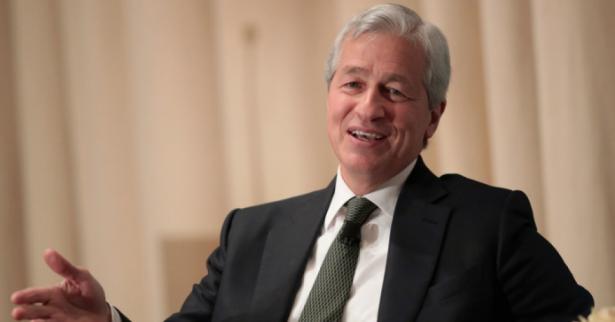
JPMorCEO Jamie Dimon Takes on Socialism, Says It Will Lead to an ‘Eroding Society.’, Scott Olson/Getty Images
Big news, everyone! Billionaires don’t like socialism.
In response to a rising progressive tide in the United States, a new genre of stories has emerged in corporate media: rich guys warning against taxing them, or really changing anything about the system at all. Just as the press are keen for you to know that Medicare for All is a very bad idea (FAIR.org, 4/29/19), they are equally anxious to make sure that the voices of beleaguered, unheard plutocrats are given as much of a boost as possible.
A case in point is CNBC’s recent article (1/22/20) headlined, “BP’s CEO Chides AOC and Bernie Sanders for Their ‘Completely Unrealistic’ Green New Deal Ideas.” Reporter Jessica Bursztynsky begins:
Outgoing BP chief Bob Dudley on Wednesday criticized sweeping climate proposals from Sen. Bernie Sanders, a top-tier 2020 Democratic presidential candidate, and Rep. Alexandria Ocasio-Cortez, a champion of the far left. “They have a completely unrealistic idea of the complexity of the global energy system,” Dudley told CNBC’s Squawk Boxfrom the World Economic Forum in Davos, Switzerland.
To sum up the story, a CNBC journalist went to Davos (where the cheapest hotel room last year was $1,000 per night) to get ideas about socialism and the environment from the CEO of BP, one of the 100 corporations responsible for over 70% of the world’s emissions. At no point did Bursztynsky warn the audience or even allude to the enormous conflict of interest the oil multi-millionaire might have in discussing solutions to the climate crisis. Instead, his views are presented as a straight and important news story.
In contrast, the first sentence primes the reader against AOC and Sanders by presenting them as “far left” – in other words, as some sort of out-there crazies, even though their ideas are supported by the majority of the American people (FAIR.org, 1/23/19). It allows Dudley to claim that there is a distinct “lack of realism” from his critics (emphasis added):
“There’s just a lot of people, very well-meaning people, who want to believe that there is a simple solution,” Dudley said at the Abu Dhabi International Petroleum Exhibition & Conference.
Jeez, I wonder what oil CEOs at an energy forum in a Mideastern monarchy think about renewable energy? Good thing CNBC is on the case.

Tuesday, February 4, 2020

Trump and the Economy

Myth Based Claims

In preparation for President Trump’s State of the Union speech, the Economic Policy Institute has assembled research from the last year that examines the real state of the union for working people on wages, manufacturing and trade, taxes, labor standards, housing, and immigration.
Wages and employment
2019 had solid job growth, but wage growth slowed. Average monthly job creation has held remarkably steady for the past nine years, but it did soften in the last year, from 223,000 in 2018 to 176,000 in 2019. Wage growth slowed for much of the year, providing further evidence that we are not yet at genuine full employment. After hitting a recent high point of 3.4% year-over-year wage growth, the growth rate has measurably decelerated and wage growth closed out the year at only 2.9% in December.
Wage growth for low-wage workers has been strongest in states with minimum wage increases
More on longer wage trends in our Nominal Wage Tracker.
Manufacturing and trade
Jobs lost to China. Recent EPI research found that 700,000 jobs were lost to China in the first two years of Trump’s presidency—many of them manufacturing jobs.
China trade deal will not restore 3.7 million U.S. jobs lost since China entered the WTO in 2001
U.S.-Mexico-Canada Agreement—Weak tea, at best
What’s good for Wall Street is often bad for American workers and manufacturing
Taxes


Tax Cuts and Jobs Act (TCJA) has been a policy failure. Notably, business investment contracted for the third straight quarter—the first time this has happened since the Great Recession in 2009. Given that boosting business investment was the primary stated goal of the Tax Cuts and Jobs Act (TCJA) passed in 2017, this seems like an unambiguous policy failure.:
On its second anniversary, the TCJA has cut taxes for corporations, but nothing has trickled down
Labor standards
The Trump administration has systematically weakened workers’ rights
More than eight million workers will be left behind by the Trump overtime rule

New Trump administration joint-employer rule has $1 billion price tag for workers
Workers will lose more than $700 million annually under proposed Trump DOL rule

Graduate student workers’ rights to unionize are threatened by Trump administration proposal
Housing
The Trump administration’s new housing rules will worsen segregation
Economic Policy Institute
Immigration
Trump and Kushner’s ‘merit-based’ immigration plan fails to propose the smart reforms needed to modernize and improve U.S. labor migration
Trump’s national emergency declaration over the border wall is dangerous and not justified by the facts
Congress and Trump discover bipartisanship on immigration—but only to increase H-2B visas for captive and underpaid migrant workers


As investment continues to decline, the Trump tax cuts remain nothing but a handout to the rich
President Trump is likely to tout the benefits of the 2017 Tax Cuts and Jobs Act (TCJA) during his annual State of the Union address. Given that boosting business investment—eventually boosting wages—was the primary stated goal of the TCJA, the subsequent decline in business investment shows the TCJA was an unambiguous policy failure for working people, benefiting only the rich and corporations. Read the blog »

Saturday, January 18, 2020

Top charts of 2019: Thirteen charts that clarify what our economic priorities need to be in 2020

Top charts of 2019: Thirteen charts that clarify what our economic priorities need to be in 2020: We’re in the longest economic expansion in U.S. history, but the top line numbers don’t tell the whole truth. Low unemployment is finally starting to produce some wage gains, but it is going to take much more to raise living standards for wide swaths of the workforce. Black unemployment and underemployment is still too high,…

Friday, January 17, 2020

The Truth About the Trump Economy

The Truth About the Trump Economy
Jan 17, 2020 JOSEPH E. STIGLITZ
It is becoming conventional wisdom that US President Donald Trump will be tough to beat in November, because, whatever reservations about him voters may have, he has been good for the American economy. Nothing could be further from the truth.

It is becoming conventional wisdom that US President Donald Trump will be tough to beat in November, because, whatever reservations about him voters may have, he has been good for the American economy. Nothing could be further from the truth.


Two years ago, a few rare corporate leaders were concerned about climate change, or upset at Trump’s misogyny and bigotry. Most, however, were celebrating the president’s tax cuts for billionaires and corporations and looking forward to his efforts to deregulate the economy. That would allow businesses to pollute the air more, get more Americans hooked on opioids, entice more children to eat their diabetes-inducing foods, and engage in the sort of financial shenanigans that brought on the 2008 crisis.
Today, many corporate bosses are still talking about the continued GDP growth and record stock prices. But neither GDP nor the Dow is a good measure of economic performance. Neither tells us what’s happening to ordinary citizens’ living standards or anything about sustainability. In fact, US economic performance over the past four years is Exhibit A in the indictment against relying on these indicators.
To get a good reading on a country’s economic health, start by looking at the health of its citizens. If they are happy and prosperous, they will be healthy and live longer. Among developed countries, America sits at the bottom in this regard. US life expectancy, already relatively low, fell in each of the first two years of Trump’s presidency, and in 2017, midlife mortality reached its highest rate since World War II. This is not a surprise, because no president has worked harder to make sure that more Americans lack health insurance. Millions have lost their coverage, and the uninsured rate has risen, in just two years, from 10.9% to 13.7%.
One reason for declining life expectancy in America is what Anne Case and Nobel laureate economist Angus Deaton call deaths of despair, caused by alcohol, drug overdoses, and suicide. In 2017 (the most recent year for which good data are available), such deaths stood at almost four times their 1999 level.
The only time I have seen anything like these declines in health – outside of war or epidemics – was when I was chief economist of the World Bank and found out that mortality and morbidity data confirmed what our economic indicators suggested about the dismal state of the post-Soviet Russian economy. 
Bundle2020_web
Trump may be a good president for the top 1% – and especially for the top 0.1% – but he has not been good for everyone else. If fully implemented, the 2017 tax cut will result in tax increases for most households in the second, third, and fourth income quintiles.
Given tax cuts that disproportionately benefit the ultrarich and corporations, it should come as no surprise that there was no significant change in the median US household’s disposable income between 2017 and 2018 (again, the most recent year with good data). The lion’s share of the increase in GDP is also going to those at the top. Real median weekly earnings are just 2.6% above their level when Trump took office. And these increases have not offset long periods of wage stagnation. For example, the median wage of a full-time male worker (and those with full-time jobs are the lucky ones) is still more than 3% below what it was 40 years ago. Nor has there been much progress on reducing racial disparities: in the third quarter of 2019, median weekly earnings for black men working full-time were less than three-quarters the level for white men.
Making matters worse, the growth that has occurred is not environmentally sustainable – and even less so thanks to the Trump administration’s gutting of regulations that have passed stringent cost-benefit analyses. The air will be less breathable, the water less drinkable, and the planet more subject to climate change. In fact, losses related to climate change have already reached new highs in the US, which has suffered more property damage than any other country – reaching some 1.5% of GDP in 2017.  
The tax cuts were supposed to spur a new wave of investment. Instead, they triggered an all-time record binge of share buybacks – some $800 billion in 2018 – by some of America’s most profitable companies, and led to record peacetime deficits (almost $1 trillion in fiscal 2019) in a country supposedly near full employment. And even with weak investment, the US had to borrow massively abroad: the most recent data show foreign borrowing at nearly $500 billion a year, with an increase of more than 10% in America’s net indebtedness position in one year alone.
Likewise, Trump’s trade wars, for all their sound and fury, have not reduced the US trade deficit, which was one-quarter higher in 2018 than it was in 2016. The 2018 goods deficit was the largest on record. Even the deficit in trade with China was up almost a quarter from 2016. The US did get a new North American trade agreement, without the investment agreement provisions that the Business Roundtable wanted, without the provisions raising drug prices that the pharmaceutical companies wanted, and with better labor and environmental provisions. Trump, a self-proclaimed master deal maker, lost on almost every front in his negotiations with congressional Democrats, resulting in a slightly improved trade arrangement.
And despite Trump’s vaunted promises to bring manufacturing jobs back to the US, the increase in manufacturing employment is still lower than it was under his predecessor, Barack Obama, once the post-2008 recovery set in, and is still markedly below its pre-crisis level. Even the unemployment rate, at a 50-year low, masks economic fragility. The employment rate for working-age males and females, while rising, has increased less than during the Obama recovery, and is still significantly below that of other developed countries. The pace of job creation is also markedly slower than it was under Obama.
Again, the low employment rate is not a surprise, not least because unhealthy people can’t work. Moreover, those on disability benefits, in prison – the US incarceration rate has increased more than sixfold since 1970, with some two million people currently behind bars – or so discouraged that they are not actively seeking jobs are not counted as “unemployed.” But, of course, they are not employed. Nor is it a surprise that a country that doesn’t provide affordable childcare or guarantee family leave would have lower female employment – adjusted for population, more than ten percentage points lower – than other developed countries.
Even judging by GDP, the Trump economy falls short. Last quarter’s growth was just 2.1%, far less than the 4%, 5%, or even 6% Trump promised to deliver, and even less than the 2.4% average of Obama’s second term. That is a remarkably poor performance considering the stimulus provided by the $1 trillion deficit and ultra-low interest rates. This is not an accident, or just a matter of bad luck: Trump’s brand is uncertainty, volatility, and prevarication, whereas trust, stability, and confidence are essential for growth. So is equality, according to the International Monetary Fund.
So, Trump deserves failing grades not just on essential tasks like upholding democracy and preserving our planet. He should not get a pass on the economy, either.
Joseph E. Stiglitz
Writing for PS since 2001 

Joseph E. Stiglitz, a Nobel laureate in economics, is University Professor at Columbia University and Chief Economist at the Roosevelt Institute. His most recent book is People, Power, and Profits: Progressive Capitalism for an Age of Discontent.
·       3
·       Facebook